Start with the opening you need to inspect and the probe diameter that fits it. Then compare focal range and lighting, because a camera that cannot focus at the distances you work at shows blur. The main tradeoff is between a thin flexible probe that reaches tight bends and a thicker rigid one that gives a steadier, sharper view. Buyers who only need occasional drain checks can choose a budget model; pros doing daily wall or pipe work should prioritize durability and image control.
Fit the probe to the gap first
The single decision that rules out most options is the camera head diameter. A drain cleanout, a spark plug hole, a wall cavity, or a motor housing each has a different opening. Measure the narrowest point the probe must pass through, not the widest part you want to see. A 5.5 mm head passes a small drain trap but a 9 mm head may not.
Do not confuse cable length with reach. A long cable that is too thick to enter the gap is useless. Check the listing for both the camera head diameter and the cable diameter. Some cables are narrower than the head, but the head is what gets stuck first.
For property maintenance, a semi rigid cable often works best. It holds a curve so you can push it around a P trap without it flopping. For a straight shot into a wall, a rigid probe gives a steadier image. If you work in several spaces, look for a probe that is thin enough for the smallest one you expect.
Focal range is what sharpness actually means
Resolution numbers on a borescope listing describe the sensor, not the picture you will see. A camera can have a high resolution sensor and still produce blurry video because the lens is focused for a fixed distance. If the target is closer or farther than that distance, nothing is crisp.
Check the listing for a focal range or minimum focus distance. A probe that focuses from 1 to 4 inches works for reading a label or inspecting a small crack up close. A probe focused from 4 to 12 inches is better for looking down a drain run or across a wall cavity. Some models have a fixed focus with no range listed; treat those as a gamble for close work.
If you need to inspect both a tiny wire and a wide duct, look for a probe with an adjustable focus or a longer focal range. Otherwise you will keep moving the camera back and forth trying to find the one sweet spot. That wastes time and can scratch the probe tip against the surface.
Lighting you can turn down matters more than more lumens
Every borescope has LEDs around the camera head, but brightness alone is not the feature. A bright light close to a shiny surface washes out the image. You need a way to reduce the light, not just add more. Check whether the listing mentions adjustable LED brightness or multiple light levels.
A dimmable light lets you balance the exposure when the camera is close to chrome, wet pipes, or white insulation. Without it, you get a white blob instead of a crack. Some models tie the light to the camera exposure automatically, which helps in changing conditions.
Side lighting from the LEDs can create shadows that hide detail. Look for a head design where the LEDs sit close to the lens, or where the light is diffused. If the listing does not say, compare photos of the camera head. A ring of bare LEDs around the lens often causes a hot spot in the center.
Cable stiffness is a personality, not a flaw
A flexible cable follows a drain bend but wiggles when you try to hold it still. A rigid cable stays put but cannot curve. The right choice depends on the path. For a straight pipe you can push a rigid probe. For a trap or a curved duct you need semi rigid or fully flexible.
Semi rigid cables are the middle ground most people should start with. They hold a bend long enough to steer around a corner, but they still flex when they hit a blockage. Fully flexible goosenecks are for very tight paths, but you may need a second hand to keep the tip on target.
Articulating tips add a joystick or dial that bends the last inch of the probe. This helps you look sideways inside a wall without moving the whole cable. The tradeoff is a larger head diameter and a higher price. If most of your work is straight line inspection, skip it.
| Probe style | Best path | Steadiness | Head size |
|---|---|---|---|
| Rigid probe | Straight pipes, walls | High | Often thicker |
| Semi rigid cable | Traps, gentle curves | Medium | Medium |
| Flexible gooseneck | Tight bends, drains | Low | Often thinner |
| Articulating tip | Cavities, side views | High when steered | Thickest |
Match the style to the most common path you inspect. A drain tech benefits from semi rigid or flexible. An electrician checking a stud bay benefits from a rigid or articulating probe.
Screen and connection shape how you actually work
A borescope either has its own screen or plugs into your phone. A built in screen starts faster and does not drain your phone battery, but the screen is usually small and the whole unit is bulkier. A phone connected model uses a larger, sharper display but depends on an app and a cable or Wi-Fi connection.
Check how the probe connects. USB-C works with most modern Android phones but not all iPhones without an adapter. Wi-Fi models connect to any phone but can lag or drop signal inside metal pipes. A dedicated handheld screen avoids these issues entirely.
For a plumber working in a wet basement, a self contained unit with a screen is often more reliable than a phone on a stand. For a homeowner doing a one time inspection, a phone model costs less and the screen you already own is better than any built in one.
Drain inspections reward a hook, a magnet, and patience
Drains are dark, curved, and often coated with residue. A probe alone shows you the clog but cannot move it. Look for a kit that includes a hook attachment for snagging hair or debris and a magnet for retrieving a dropped ring or screw. These small tools turn a look only camera into a retrieval tool.
Push the cable slowly and let the camera settle before you judge the image. A fast push stirs up sediment and the light reflects off the water. If the picture goes white, pull back an inch and reduce the LED brightness. The clog is usually right where the water backs up, not deep in the pipe.
A waterproof probe rated IP67 or higher survives a drop into standing water, but check the cable length against the drain run. A 10 foot cable reaches a bathroom sink trap but not a main line from the cleanout. For main lines you may need a longer cable, which usually means a thicker, stiffer probe.
Battery life and storage decide if it works next month
A built in battery that dies mid inspection is a common frustration. Check the listing for battery type and estimated run time. A removable lithium ion battery lets you swap in a spare, while a sealed battery means the tool is down when it is empty. For phone connected models, your phone battery is part of the equation.
Store the probe loosely coiled or hung, not kinked. A tight fold creates a permanent bend that makes the cable fight you on the next job. If the probe came with a case, use it. The camera head lens scratches easily, and a scratched lens softens every future image.
Long term costs are mostly batteries and replacement attachments. Hooks and magnets are cheap, but a cracked screen or a broken connector can end a budget unit. If you use it weekly, choose a model with a replaceable battery and a standard USB charging port.
Skip the borescope if a mirror or a drain auger does the job
A borescope is for seeing what you cannot reach with your eyes. If you only need to check a straight pipe with an open end, a flashlight and an inspection mirror cost less and never need charging. A borescope earns its price when the path bends or the target is more than an arm's length away.
For a clogged drain, a drain auger guide explains when a snake is the right tool. A borescope shows you the clog but does not clear it. If your goal is to fix the blockage, buy the auger first. If you need to diagnose a recurring problem or inspect a line before buying a house, the camera earns its place.
Home buyers and property managers use a borescope to check behind walls, under floors, and inside ducts where a moisture meter or a laser measure cannot see. If your questions are about moisture or dimensions, other tools answer them better. A borescope answers one question: what does it look like in there?
Marketing words that do not match the lens
High resolution claims on a small sensor do not mean sharp video. The lens and focal distance matter more. A 1080p sensor behind a fixed focus lens can be softer than a 720p sensor with a proper focal range. Compare sample images if the listing has them, but remember those are chosen to look good.
Waterproof ratings describe the probe, not the whole unit. IP67 means the camera head can be submerged briefly, but the screen or phone connection may not be. Check whether the listing says the entire unit is waterproof or only the probe. For drain work the probe rating is what matters.
Wireless often means Wi-Fi to your phone, not a cable free probe. The probe still has a cable. A true wireless probe that transmits video from inside a wall is a different, more expensive tool. If the listing says wireless, confirm whether it means the connection to the phone or the probe itself.
Inspection Borescope Questions Before You Buy
What is an inspection borescope used for?
It is a small camera on a flexible or rigid cable that you push into tight spaces: drains, wall cavities, engine cylinders, ducts, and behind appliances. It shows you live video of areas you cannot see directly. Plumbers use it to find clogs, home inspectors use it to check for hidden damage, and DIYers use it to retrieve dropped items or look inside walls before cutting.
How do I choose a borescope for drain inspections?
Pick a probe with a camera head diameter small enough for the drain opening, usually 8 mm or less for a sink trap. Choose a semi rigid or flexible cable that can follow the bends. Check the focal range for close up work and get adjustable LED brightness to avoid washout in wet pipes. A hook attachment helps retrieve hair clogs.
Is a borescope worth it for a home buyer?
For a single home inspection, a budget phone connected model can pay for itself if it reveals a hidden leak, mold, or pest damage behind a wall. You can also check drain lines and ductwork before committing. It does not replace a professional inspection, but it adds a visual check of spaces a standard inspection may not cover.
Which is better, a borescope with a screen or one that connects to a phone?
A built in screen is more reliable and faster to start, especially in wet or dirty conditions. A phone connected model uses a larger, sharper display and costs less, but it depends on an app and your phone battery. For occasional use a phone model is fine. For daily professional work a dedicated screen is usually worth the extra cost.
Can a borescope retrieve a dropped item?
Only if it has a hook or magnet attachment. The camera shows you where the item is, but the probe alone cannot grab it. Many kits include a small hook for rings or hair and a magnet for screws or keys. Check the listing for these attachments before you buy if retrieval is your goal.
Which Inspection Borescope Fits Your Work
A homeowner checking a sink trap or a wall cavity once a month should start with a semi rigid probe around 5.5 mm, a phone connection, and adjustable LED brightness. That combination reaches most household gaps and keeps the price in the budget tier. A plumber or property manager working daily in wet drains should instead choose a self contained unit with a waterproof probe, a removable battery, and a longer semi rigid cable, even at a mid range price, because reliability and quick startup matter more than a large screen.
Real inspection borescope listings, so you can check the points in this guide against actual products. These are affiliate links: as an Amazon Associate we earn from qualifying purchases, at no extra cost to you.
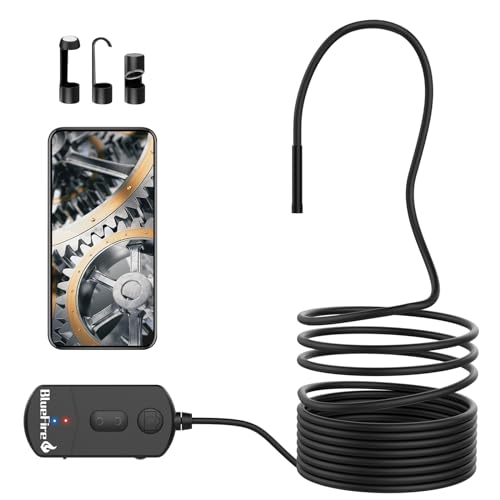 BLUEFIRE BlueFire 1080P Wireless Endoscope Camera, 5.5mm HD Borescope | 11.5FT…
View on Amazon ↗
 KINPTHY Endoscope Camera with Light,1920P HD Borescope Tools(16.4ft Dual-Lens) | IP67…
View on Amazon ↗
 DAXIONGMAO Daxiongmao Articulating Borescope, 1080P HD Inspection Camera with Light |…
View on Amazon ↗
Listing names and images come from Amazon and are rechecked against the live listings; last checked Nov 8, 2026. No prices shown; the current price is on the listing.
What this guide is. This guide covers the inspection borescope as a product type and the choices that apply across models, not any individual unit. It is written from general knowledge of how these tools work; no product documents, owner reviews, or tests were used, and you should verify any dimension on the listing before buying.