Two factors decide most wire wrapping results: how hard and smooth the jaws are, and whether the tip shape matches your wrap style. Soft jaws mark wire less, while smooth, rounded tips make tighter loops. A light spring return saves your hand on long sessions. The main tradeoff is between gentle grip and precise control.
Jaw Surface Sets Your Scratch Risk
Wire wrapping pliers come with three common jaw finishes: smooth steel, serrated steel, and nylon coated. Smooth steel is the safest starting point for copper, brass, and silver filled wire. It grips firmly without cutting into the surface, as long as the jaw faces are machined flat and polished.
Serrated jaws hold thick or half hard wire much better, but the teeth press small marks into soft metal. If you work mostly with dead soft copper or fine silver, those marks show up as texture on your finished piece. Nylon jaw pliers avoid that entirely, but the soft inserts wear down over time and need replacing.
Check the listing for the jaw material and whether replacement nylon inserts are sold separately. A seller that mentions polished steel faces is usually describing a plier designed for jewelry wire, not general hardware use.
Tip Shape Decides Your Loop Size
Wire wrapping uses three main tip shapes: round nose, chain nose, and flat nose. Round nose pliers taper to a point and make loops of different sizes depending on where you place the wire along the jaw. Chain nose pliers have a flat inner face and a rounded outer edge, good for gripping and bending without marking.
Flat nose pliers have two flat, wide jaws. They hold wire firmly for right angle bends and for gripping multiple wires at once. For most beginners, a round nose and a chain nose pair covers the essential wraps.
Look at the tip dimensions in the listing. A very fine round nose tip makes tiny loops but bends easily under pressure. A thicker tip lasts longer but cannot make small eye pins. Match the tip size to the wire gauge you plan to use most.
Spring Return Saves Your Hand
A built in spring opens the jaws after each squeeze. That sounds minor, but in a long wrapping session the difference is large. Without a spring, your hand does twice the work: close, then open, hundreds of times.
Spring tension varies between models. A very stiff spring fights your grip and tires your hand faster. A soft spring may not open the jaws fully. The listing rarely states tension, so look for photos that show the spring type and read the product description for words like 'light action' or 'gentle return'.
Some pliers use a leaf spring tucked between the handles. Others use a coil spring around the pivot. Leaf springs are easier to replace if they break. Coil springs are often quieter but harder to find as spare parts.
Handle Shape and Workspace Fit
Wire wrapping pliers come with bare metal handles, dipped plastic grips, or padded foam sleeves. Bare metal gives the most control but becomes uncomfortable after an hour. Dipped grips add a little cushion and stay easy to clean. Foam sleeves feel softest but absorb oils and dirt from your hands.
For a small workspace, check the overall length. A five inch plier fits in a compact tool roll and leaves room for a bead mat. A seven inch plier gives more leverage for thick wire but takes more drawer space.
The pivot should feel smooth with no side to side wobble. A loose pivot makes the tips meet unevenly and kinks wire. On the listing, look for a close up photo of the pivot and check whether the seller mentions a box joint, which stays aligned better than a simple lap joint.
Which Pliers You Actually Need First
| Pliers type | Main job | Wire gauge range | Skip if |
|---|---|---|---|
| Round nose | Loops and eye pins | 20 to 26 gauge | You only make coil wraps |
| Chain nose | Grip and bend | 18 to 24 gauge | You need very wide flat bends |
| Flat nose | Right angles, holding | 16 to 22 gauge | You mostly make small loops |
| Nylon jaw | Straightening | 14 to 20 gauge | You work with fine detail wire |
A starter set with round nose and chain nose covers most wire wrapping projects. Add flat nose when you start making frames or geometric shapes. Nylon jaw pliers are a specialty tool for straightening and flattening without marks, not a first purchase.
Read the Listing for These Four Clues
A good wire wrapping plier listing names the jaw material, the tip shape, the overall length, and the spring type. If any of those is missing, ask the seller before buying. Phrases like 'jewelry grade' or 'professional quality' without a material name tell you little.
Check the product photos for the jaw faces. A close up that shows polished, even faces is a good sign. Avoid listings that only show the pliers at an angle or in packaging, since you cannot judge the jaw finish.
Look for the wire gauge range in the description. A plier designed for 20 to 26 gauge wire will struggle with 16 gauge half hard wire. A plier that claims to handle everything from 12 to 30 gauge is probably overstating.
Finally, check whether the listing mentions country of origin and any warranty. Wire wrapping pliers are simple tools, but a pivot that breaks in the first month is a common frustration. A short warranty or a responsive seller is worth a little extra.
Mistakes That Show Up in the Finished Wrap
The most common mistake is using serrated hardware store pliers on soft jewelry wire. The teeth leave a pattern that is almost impossible to polish out of a finished pendant. If the pliers are not sold in the jewelry tools section, assume the jaws are serrated.
Another mistake is buying a plier set with three pairs that all have the same tip shape. Some sets include two chain nose pliers in different sizes, which wastes money. Check each pair in the set photo and make sure they serve different jobs.
Skipping the spring is a mistake you feel after the first weekend. The spring is not a luxury feature. For anyone making more than a few wraps, it is the difference between finishing a piece and putting it down with a sore hand.
Finally, do not buy a plier with a plastic pivot cover or a loose joint. The pivot is the heart of the tool. A cheap pivot makes the tips shift under pressure, which bends wire at the wrong angle.
When a Different Tool Works Better
If you only straighten wire or make simple bends, a nylon jaw flat plier does that job without any risk of marks. If you make a lot of coiled wire designs, a dedicated coiling tool or a drill with a mandrel is faster than wrapping by hand with pliers.
For very fine wire under 26 gauge, your fingers may do the job better than any plier. Pliers add leverage that can snap thin wire. In that case, a pair of fine tip tweezers gives more control.
Some crafters prefer a smaller set of tools that fits their hands over a large plier kit. A single round nose plier with a comfortable grip beats three pairs that feel clumsy.
Wire Wrapping Pliers Questions, Answered Straight
Is wire wrapping pliers the same as jewelry pliers?
Wire wrapping pliers are a subset of jewelry pliers. They have smooth jaws and rounded tips designed for bending soft wire without marking it. General jewelry pliers may include serrated jaws or heavier tips for other tasks. For wire wrapping, stick with smooth jaw round nose and chain nose pliers.
Which wire wrapping pliers should a beginner buy first?
Start with one round nose and one chain nose plier, both with smooth steel jaws and a light spring return. That pair handles loops, bends, and most basic wraps. Add a flat nose plier when you start making frames or need to hold multiple wires together.
What is the best jaw finish for soft copper wire?
Smooth polished steel is the best all around finish for soft copper. It grips firmly without leaving marks. Nylon coated jaws are even gentler but wear out and need replacement inserts. Avoid serrated jaws on soft copper, since the teeth leave visible texture.
Should I buy a wire wrapping pliers set or individual pliers?
A small set of two or three different pliers is often cheaper than buying individually and gives you the essential shapes. But check that the set includes different tip shapes. Some sets pack two chain nose pliers and no round nose, which limits your loop work.
How do I compare wire wrapping pliers listings without touching them?
Compare four specs: jaw material, tip shape, overall length, and spring type. Look for close up photos of the jaw faces. Ask the seller for the wire gauge range if the listing omits it. A listing that names the steel type and polish level is usually more reliable than one that only says 'jewelry grade'.
The Pliers to Start With and When to Switch
A crafter making loops and simple wraps with 20 to 24 gauge copper should start with one round nose and one chain nose plier, both with smooth polished jaws and a light spring. That pair covers most beginner projects without marking the wire. If you work mainly with half hard wire or make heavy frames, switch to a flat nose plier with a firmer spring instead. For straightening only, a nylon jaw plier does the gentlest job.
Real wire wrapping pliers listings, so you can check the points in this guide against actual products. These are affiliate links: as an Amazon Associate we earn from qualifying purchases, at no extra cost to you.
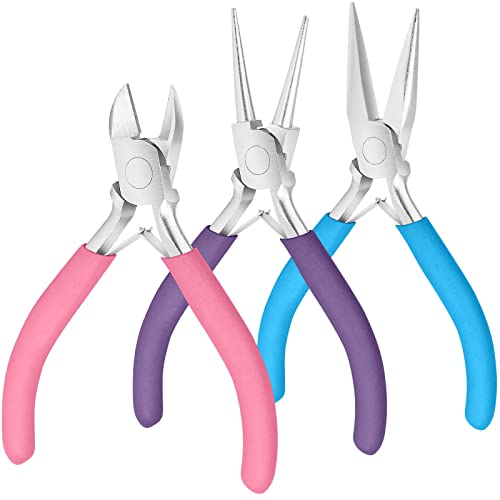 SHYNEK Pliers for Jewelry Making, Shynek Jewelry Pliers Set Includes Needle…
View on Amazon ↗
 SPEEDWOX SPEEDWOX 5-Inch Round Nose Pliers for Jewelry Making Mini Wire…
View on Amazon ↗
 BILLBOTK Round Nose Pliers, Wire Jewelry Making Tools Bead Pliers for…
View on Amazon ↗
Listing names and images come from Amazon and are rechecked against the live listings; last checked Nov 8, 2026. No prices shown; the current price is on the listing.
Scope and limits. This guide is written from general knowledge of how wire wrapping pliers are constructed and used, not from testing any individual model. It cannot tell you whether a specific listing's jaw finish or spring tension matches its photos, so verify those details with the seller before ordering.