Focus on three things: how much the bowl slows eating, how easy it is to clean, and how well it fits your dog's snout. Deep narrow channels slow a gulper most but trap kibble and frustrate flat faced dogs. Wide shallow ridges suit seniors and brachycephalic breeds but barely slow a determined gulper. A heavy nonslip base matters more than the pattern itself.
Why the Bowl's Depth Does the Real Work
The part that actually slows a dog is not the pattern drawn on the bowl. It is how far the kibble sits below the rim and how narrow the gaps between ridges are. A bowl with tall, closely spaced dividers forces a dog to lick around corners instead of scooping a mouthful. A shallow bowl with a few raised dots just moves the kibble around.
Compare the listed bowl depth and the gap width between ridges. For a medium snout, gaps around an inch wide often work. For a small dog, tighter gaps can trap a tongue. For a large gulper, deeper channels with wider spacing slow eating without making the last few pieces impossible to reach.
Match the Bowl to the Dog's Snout, Not the Marketing
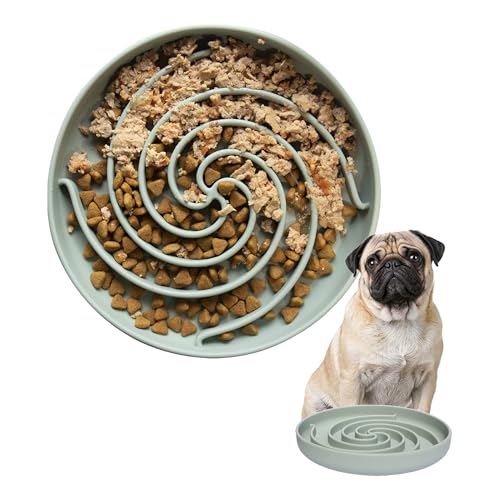
Flat faced breeds such as French Bulldogs, Pugs, and Shih Tzus cannot reach into deep narrow channels. They end up pushing the bowl across the floor or giving up before the meal is done. For these dogs, a slow feeder with shallow ridges, a low raised center, or gentle bumps works better. It will not slow them as much, but it will not frustrate them either.
Senior dogs and dogs with missing teeth also do poorly with deep mazes. They need a bowl they can lick clean without pressing their nose into hard plastic. Look for wide, rounded ridges and a shallow overall depth. A bowl with a removable center insert can help, since you can adjust the difficulty as the dog ages or recovers.
Small Kitchens and Busy Mornings
A slow feeder takes up more counter or floor space than a plain bowl, especially if it has a wide nonslip rim. In a small kitchen, measure the spot where the bowl will sit before buying. Some slow feeders have a smaller footprint than their bowl capacity suggests, but a wide base often improves stability.
For busy owners, the main time cost is not the meal itself. It is the cleaning. Kibble dust and saliva settle into the bottom of ridges and dry into a film. A bowl with too many sharp corners takes longer to scrub. If you feed twice a day, a dishwasher safe bowl saves more time than a slightly slower eating pattern.
Cleanup Effort Changes More Than Any Feature
Compare the ridge layout by how many dead ends and sharp corners it has. A spiral pattern with smooth curves rinses clean faster than a honeycomb or maze with tight pockets. Some bowls are labeled dishwasher safe, but even those can hold water in the ridges after a cycle. Check the listing for a smooth, rounded interior rather than a textured one.
Material matters here too. Stainless steel slow feeders resist scratches and odors better than plastic, but they are heavier and often more expensive. Plastic bowls are lighter and cheaper, but deep scratches can hold bacteria over time. Silicone bowls fold flat for travel but their ridges are usually too soft to slow a strong gulper.
The Base Decides Whether the Bowl Survives the Meal
A dog that gulps usually pushes the bowl across the floor. If the base is smooth plastic, the bowl slides and the dog can flip it, scattering kibble. Look for a nonslip rubber ring or a weighted base. A removable rubber ring is easier to clean than a glued one, but check that it stays put when wet.
For multi pet homes, a sliding bowl creates a second problem. A faster dog can push the slow feeder toward its own spot or tip it over to eat from the floor. A heavy base with a wide footprint reduces this. If two dogs eat side by side, separate them by a few feet so the slower eater does not feel rushed.
Reading the Listing Before You Pay
Start with the dimensions, not the photos. Listings often show the bowl next to a dog, which hides the true size. Check the bowl diameter, depth, and weight. Then check the material and whether the nonslip base is removable. If the listing does not state the gap width between ridges, ask the seller before ordering.
Also check the stated capacity against your dog's meal size. A slow feeder holds less food than a plain bowl of the same diameter because the ridges take up space. If your dog eats a large meal, you may need to refill the bowl or choose a larger size. For wet food, most slow feeders do not work well, since the food sits on top of the ridges instead of between them.
When a Slow Feeder Is the Wrong Tool
Not every fast eater needs a slow feeder. If your dog inhales food because it is anxious around other pets, a slow feeder can make the anxiety worse by turning the meal into a frustrating puzzle. In that case, feed the dog alone in a quiet room first. If the dog still gulps, then try a slow feeder.
For travel, a slow feeder bowl is often too bulky. A collapsible silicone bowl with a simple raised center is easier to pack, but it will not slow a determined gulper much. If you need a bowl for a road trip or a day hike, choose a regular travel bowl and feed smaller portions more often instead. For more on travel bowls, see why a day hike bowl is wrong for a road trip.
Compare the Main Designs
The table below groups slow feeders by how their ridges are shaped. Each design trades slowing power against ease of eating and cleanup.
Table
| Ridge style | Slowing power | Cleanup effort | Best suited for |
|---|---|---|---|
| Deep maze | High | High, kibble traps | Medium to large gulpers |
| Spiral ridges | Medium | Low, smooth curves | Most medium snouts |
| Raised center | Medium | Low | Large dogs, wet or dry food |
| Shallow bumps | Low | Low | Flat faced and senior dogs |
A raised center bowl works for wet food because the food sits around the center, not inside tight gaps. A deep maze is almost always dry food only. Check the listing for whether the bowl is meant for kibble, wet food, or both.
Slow Feeder Questions Worth Asking Before You Buy
Is a slow feeder bowl worth it for a dog that eats fast?
If your dog regularly finishes a meal in under a minute or shows signs like gagging, burping, or throwing up after eating, a slow feeder can help. It forces the dog to lick around ridges instead of gulping. The benefit is real for many dogs, but the bowl must fit the dog's snout. A deep maze on a flat faced breed will just frustrate the dog and waste food.
Which slow feeder dog bowl is best for a French Bulldog?
Look for shallow ridges, a low raised center, or wide gentle bumps. French Bulldogs have short snouts and cannot reach into deep narrow channels. A bowl with a flat, open center and low outer ridges lets them eat without pressing their nose into hard plastic. Stainless steel or smooth plastic is easier to clean than a textured maze.
How do I clean a slow feeder dog bowl?
Rinse it right after the meal, before saliva and kibble dust dry. Use a bottle brush or a small sponge to reach into the ridges. If the bowl is dishwasher safe, place it on the top rack, but check that water does not pool in the ridges after the cycle. For plastic bowls, replace them if deep scratches appear, since bacteria can settle there.
Can a slow feeder bowl be used for wet food?
Most deep maze bowls do not work well with wet food. The food sits on top of the ridges and the dog licks it off the surface, which barely slows eating. A bowl with a raised center or shallow bumps works better for wet food, since the food spreads around the center. Check the listing for a wet food or dual use label.
What size slow feeder bowl should I get?
Match the bowl to your dog's meal volume, not just the dog's weight. A slow feeder holds less food than a plain bowl of the same diameter because the ridges take up space. If your dog eats more than the listed capacity, choose the next size up or plan to refill. For small dogs, a smaller bowl with tighter ridge spacing often works better.
Which Slow Feeder Bowl to Pick First
A dog that gulps dry kibble and has a medium length snout does best with a spiral ridge bowl. It slows the meal without trapping every last piece, and the smooth curves rinse clean in seconds. For a flat faced breed like a Pug or French Bulldog, skip the spiral and choose a shallow raised center bowl instead, even though it slows less.
Real slow feeder dog bowl listings, so you can check the points in this guide against actual products. These are affiliate links: as an Amazon Associate we earn from qualifying purchases, at no extra cost to you.
 OUTWARD HOUND Outward Hound Fun Feeder Slo Bowl Dog Slow Feeder, Notch,…
View on Amazon ↗
 KEEGUD Keegud Slow Feeder Dog Bowls Insert [Octopus Suction Cups] Super…
View on Amazon ↗
 BIFEAW Bifeaw Slow Feeder Dog Bowl, Silicone Puzzle Bowl with Suction…
View on Amazon ↗
Listing names and images come from Amazon and are rechecked against the live listings; last checked Nov 8, 2026. No prices shown; the current price is on the listing.
Scope and limits. This guide draws on general knowledge about slow feeder bowl design, materials, and dog feeding behavior. It does not evaluate any individual model, so you should verify a bowl's dimensions, ridge spacing, and material on the product listing before ordering.