Focus on brake feel, tape or cord width, and handle shape. A wide, flat tape resists tangles and cuts less than a thin cord. Choose a retractable leash only for dogs that already walk calmly; a strong puller or a crowded sidewalk calls for a fixed lead instead.
Brake Feel Tells You More Than the Price Tag
A retractable leash is only as good as its brake. The mechanism should lock the line instantly, without a long squeeze or a second press. When you compare leashes in a store, hold the handle and press the brake button. It should click firmly and stop the spool from turning.
A mushy brake that needs a hard press is a warning sign. In a real situation, like a squirrel darting across the street, a slow brake gives your dog extra line to build speed. A crisp, short throw on the brake button means you can stop the line with a quick thumb motion, even while holding a coffee cup in the other hand.
Some leashes add a secondary lock that keeps the line at a fixed length. This is useful when you want your dog to walk at heel for a block. Check whether that lock is easy to set and release with one hand. A lock that requires two hands is rarely used in practice.
Tape or Cord: The Shape of the Line Decides the Risk
Retractable leashes use either a round cord or a flat tape. A flat tape, especially one wider than half an inch, resists twisting. It is also less likely to wrap around a leg or a finger and cut skin when the dog suddenly pulls. A thin round cord is lighter and cheaper, but it tangles more and can leave a rope burn.
For a small dog under 15 pounds, a thin cord is often fine because the pulling force is low. For a medium or large dog, choose a tape. The wider surface spreads the force if the line snaps against your hand. It also stays visible on the ground, so you are less likely to trip over it in low light.
Check the line material. Nylon is common and durable, but it can fray after months of dragging on pavement. Look for a tape with a reinforced edge or a coating. A frayed line is a failure point, and a retractable leash under tension can recoil violently if the line breaks.
Handle Fit and Grip for Long Walks
The handle is the part you hold for the entire walk. A handle that is too large for your hand forces you to grip hard, which leads to fatigue. A handle that is too small can slip out of your hand when your dog lunges. Try the leash before you buy it, or compare the handle dimensions to a leash you already own.
A rubberized or textured grip helps when your hands are sweaty or wet from rain. A smooth plastic handle is harder to hold. Some handles have a loop for your wrist, which is a backup if the leash gets yanked. But a wrist loop can also catch on a door handle or a fence, so it is a tradeoff.
The angle of the handle matters too. A handle that tilts forward keeps your wrist in a neutral position when the line runs straight ahead. A handle that points straight down forces your wrist to bend, which becomes uncomfortable after a mile. This is a detail you can only judge by holding the leash.
Line Length and the Space You Actually Walk
Most retractable leashes offer between 10 and 26 feet of line. Longer is not always better. A 26 foot line gives your dog room to roam in an open park, but it is a hazard on a city sidewalk. At full extension, your dog can dart into a bike lane or around a corner before you can react.
Match the length to your usual walking route. For a city block with foot traffic, a 10 to 16 foot leash is plenty. For a quiet trail or a large field, a longer line lets your dog sniff and explore without you walking every step. Some leashes let you set a maximum length, which is a useful middle ground.
A longer line also means more line to reel back in. If your dog finds something smelly, you will spend several seconds winding the line while your dog pulls against the brake. A shorter line is faster to recover and keeps your dog closer to your side.
How to Read the Listing Before You Add to Cart
Start with the weight rating. A leash rated for dogs up to 50 pounds should not be used for a 70 pound dog, even if the line looks thick. The internal spring and brake are designed for a specific force. Exceeding that force wears out the mechanism quickly and increases the chance of a sudden failure.
Look for the tape width in the product details. If the listing does not state the width, ask the seller before buying. A width under half an inch is a cord like tape that behaves more like a round cord. A width of three quarters of an inch or more is a true flat tape.
Check what the listing says about the brake type. Some leashes have a one button brake that stops and locks the line. Others have separate buttons for stop and lock. Separate buttons are easier to use correctly in a hurry, but they add bulk to the handle.
| Line style | Brake feel | Best walking spot | Common mistake |
|---|---|---|---|
| Thin cord | Light, quick stop | Small dog, quiet sidewalk | Using for a large puller |
| Flat tape | Firm, easy to find | Medium dog, mixed paths | Ignoring frayed edges |
| Thick tape | Heavy, solid lock | Large dog, open field | Letting it drag on gravel |
| Ribbon with grip | Snappy, textured | Wet or muddy trails | Skipping the wrist loop |
A listing that shows a dog running at full speed tells you nothing about the brake. Look for a close up photo of the brake button and the line width. If the seller cannot provide those details, the leash is probably a generic import with unknown quality control.
The Mistake That Sends a Leash Back
The most common mistake is buying a retractable leash for a dog that pulls. A retractable leash rewards pulling with more line. The dog learns that pulling gets freedom, and the walk becomes a constant tug of war. A fixed length leash or a no pull harness is the better tool for a puller.
Another mistake is letting the line drag on the ground. Dirt and grit get into the spool and wear down the spring. When the line retracts, that grit grinds against the internal parts. Over time, the retraction slows and the brake becomes less reliable. Keep the line off the ground by locking it at a shorter length.
Some buyers choose a retractable leash for a puppy. Puppies need to learn loose leash walking, and a retractable line teaches the opposite. A puppy that learns to pull on a retractable leash will be harder to train later. Use a fixed leash for training and keep the retractable leash for relaxed walks after the puppy has learned to walk calmly.
Who Should Skip the Retractable Leash
Skip a retractable leash if your dog is reactive to other dogs, bikes, or cars. A reactive dog needs a short, fixed leash so you can guide them past a trigger. A retractable leash gives too much slack, and the brake is not fast enough to prevent a lunge.
Skip it if you walk on crowded sidewalks or in busy parks. The line becomes a trip hazard for other people, and your dog can reach a child or another dog before you can react. A fixed leash keeps everyone safer in tight spaces.
For hiking on rough trails, a retractable leash is often a bad match. The line can snag on rocks and roots, and a sudden drop can yank the handle out of your hand. A hands free leash or a fixed leash with a bungee section is more practical. If you want a retractable leash for road trips, look for one with a short lock position so your dog can stretch at a rest stop without wandering into traffic.
An alternative for a dog that needs some freedom but not full extension is a long line. A 15 or 30 foot long line gives your dog room to sniff in an open area, but you control the slack with your hands. It is a simpler tool with fewer moving parts to fail.
Night Walks and Small Dog Specifics
For nighttime walks, a reflective tape or a bright color makes the line visible to drivers and other walkers. A dark cord disappears against the pavement. Some leashes add a small LED light on the handle, but a reflective tape works without batteries.
A small dog needs a lighter leash. A heavy handle and thick tape can weigh more than the dog is comfortable pulling. Look for a leash rated for dogs under 20 pounds. The brake should still be firm, but the spring tension should be lighter so a small dog can extend the line without straining.
A large dog needs the opposite: a strong spring and a wide tape. The handle should be large enough for a two hand grip when the dog pulls. A large dog can generate a lot of force, so check that the tape is rated for at least 25 percent more than your dog's weight.
Care That Keeps the Mechanism Working
After a muddy walk, wipe the line with a damp cloth before it retracts. Let the line dry fully before you retract it. Moisture inside the spool causes rust and weakens the spring. If the line is dirty, extend it fully and clean it with mild soap and water, then let it air dry.
Do not oil the internal mechanism. Oil attracts dust and makes the brake slip. The brake pads inside are designed to work dry. If the retraction feels slow, the problem is usually dirt or a worn spring, not a lack of lubrication.
Check the line for fraying every few weeks. Run your fingers along the tape and look for thin spots or cuts. A damaged line should be replaced, not repaired. A retractable leash with a frayed line is a safety risk because the line can snap under tension.
Questions About Retractable Leash Safety and Fit
Is a retractable dog leash safe?
It is safe for a calm dog on a quiet walk when used correctly. The risks come from a thin cord that can cut skin, a slow brake that lets a dog run too far, and a line that trips other people. Choose a wide flat tape, test the brake before buying, and keep the line off the ground.
Which retractable dog leash is best for a large dog?
For a large dog, pick a leash with a thick flat tape at least three quarters of an inch wide and a weight rating above your dog's weight. The handle should be large enough for a firm two hand grip. Avoid thin cords, which can snap or cut your hand if the dog suddenly pulls.
What is the difference between a retractable leash and a long line?
A retractable leash uses a spring loaded spool to give and take line automatically. A long line is a fixed length of rope or tape, usually 15 to 30 feet, that you hold and manage by hand. A long line has no brake or spring, so it is simpler and more reliable for training or open areas, but it drags on the ground and tangles more.
Can I use a retractable leash for hiking?
A retractable leash is not ideal for rough trails because the line can snag on rocks and roots, and a sudden drop can pull the handle from your hand. For a wide, smooth trail, a retractable leash with a short lock position can work. For rough terrain, use a fixed leash or a long line instead.
How do I stop my dog from pulling on a retractable leash?
You cannot train loose leash walking with a retractable leash because it rewards pulling with more line. Switch to a fixed length leash and train your dog to walk at your side. Once your dog walks calmly on a fixed leash, you can use a retractable leash for relaxed walks where some freedom is fine.
Which Retractable Leash Fits Your Walk
A buyer who walks a calm, medium sized dog on quiet streets and open paths should pick a flat tape leash with a firm, one button brake and a handle that fits their hand. That combination gives control without constant tangling. For a small dog under 15 pounds, a lighter leash with a thin cord and a soft brake is more comfortable for the dog to extend. Skip the retractable leash entirely if your dog pulls or your route is crowded.
Real retractable dog leash listings, so you can check the points in this guide against actual products. These are affiliate links: as an Amazon Associate we earn from qualifying purchases, at no extra cost to you.
 FLEXI FLEXI® Classic Tape Retractable Dog Leash, Small, 16 ft -…
View on Amazon ↗
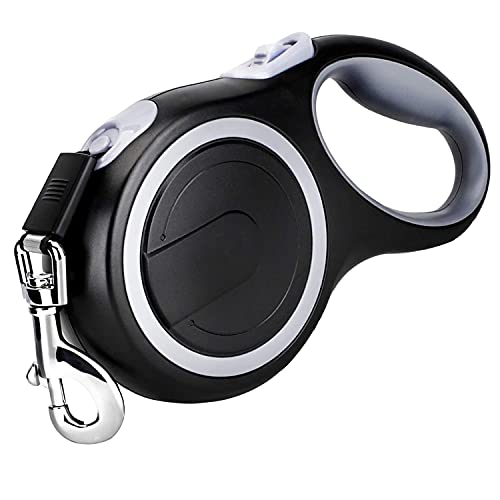 MK DEF 26Ft Retractable Dog Leash, Heavy Duty Great Leash for Dog…
View on Amazon ↗
 PECUTE Pecute 32ft Retractable Dog Leash with Reflective Strips, 360° Tangle-Free,…
View on Amazon ↗
Listing names and images come from Amazon and are rechecked against the live listings; last checked Nov 8, 2026. No prices shown; the current price is on the listing.
How to read this guide. This guide covers the retractable dog leash category as a whole, not any individual model. It is written from general knowledge of how these leashes work, without consulting product documents, reviews, or tests. Always check the tape width and weight rating on the listing before you buy.