Match the saw to your thickest repeated cut first. A 4 1/2 inch blade handles trim and thin sheet goods, while a 5 1/2 or 6 1/2 inch blade cuts framing lumber and plywood in one pass. Corded models suit workshop use; brushless cordless models add freedom for automotive and garage work. The main tradeoff is cut capacity against weight and control.
Match the Blade to Your Thickest Repeat Cut
Start with the material you cut most often, not the one odd job. Compact circular saws take 4 1/2, 5 1/2, or 6 1/2 inch blades. Each size sets a hard limit on depth of cut.
A 4 1/2 inch blade typically cuts about 1 11/16 inches deep at 90 degrees. That clears 3/4 inch plywood, most trim, and thin sheet, but not a 2x4 in one pass. For repeated framing or furniture stock, you would need to flip the board and cut twice, which doubles the chance of misalignment.
A 5 1/2 inch blade usually reaches 1 3/4 to 2 inches, enough for a 2x4 at 90 degrees. A 6 1/2 inch blade often cuts 2 1/8 to 2 3/8 inches, which also handles a 2x4 at a 45 degree bevel. If you build furniture or frames, the larger blade saves time and keeps edges square.
Corded Power Stays Strong, Cordless Moves With You
Power source changes where you can work. A corded compact saw runs as long as the outlet does and costs less for the same cut capacity. It fits a small workshop or a garage bench where the cord reaches.
A cordless model runs on a battery platform, often 18 or 20 volt, and works anywhere: under a car, on a roof, or at the far end of a yard. Brushless motors hold speed better under load and run longer per charge. Check that the listing names the voltage and whether the battery and charger are included, since bare tool listings are common.
If you already own batteries from another tool in the same platform, a bare cordless saw may cost less than a corded one. If not, the battery and charger add to the price.
Cut Control Lives in the Shoe, Guard, and Sight Line
Three parts decide whether the saw follows your line. The shoe, or base plate, should sit flat and resist flexing when you push. A stamped steel shoe is common; a cast shoe holds its shape under more pressure.
The lower blade guard must retract smoothly at the start of a cut and snap back after. A guard that sticks can catch the board edge. Check that the guard pivot is exposed enough to clean sawdust out of it.
A clear sight line to the blade notch matters most for beginners. Some saws place the motor on the left or right, which changes what you see. A dust port or blower that clears the cut line helps more than a laser, which can drift out of alignment.
The Table Separates the Designs
| Design | Cut capacity | Control feel | Suits |
|---|---|---|---|
| 4 1/2 inch corded | Trim and sheet only | Light and easy to steer | Home DIY beginners |
| 5 1/2 inch corded | 2x lumber at 90 degrees | Balanced weight | Small workshops |
| 6 1/2 inch corded | 2x lumber at 45 degrees | Near full size feel | Furniture building |
| Cordless brushless | Varies by blade size | Free movement, heavier | Automotive and garage |
This table shows the natural split: smaller blades favor control, larger blades favor capacity, and cordless trades some weight for mobility. Choose the row that matches your primary workspace, not the biggest number on the box.
A Compact Saw Is Not a Track Saw or a Jigsaw
Buyers sometimes expect one tool to do three jobs. A compact circular saw cuts straight lines in sheet goods and lumber. It cannot follow a tight curve like a jigsaw or make a glue ready edge like a track saw.
If your projects are mostly curved cuts, a jigsaw is the right tool. If you need perfectly straight, splinter free cuts in expensive plywood, a track saw earns its cost. A compact saw sits between them: faster than a jigsaw, less precise than a track saw.
For automotive work, a compact saw cuts plastic trim, hose, and light metal with the right blade, but it is not a replacement for a reciprocating saw in tight engine bay spaces. For other cutting comparisons, see battery angle grinder guides.
Blades Are the Ongoing Cost You Should Plan For
The saw is one purchase; blades are a recurring one. A general purpose carbide tipped blade handles wood, plywood, and light composites. A fine tooth blade leaves a smoother edge in veneered sheet goods. A metal cutting blade is a separate type and wears faster.
Check the arbor size on the saw, usually 10 mm or 3/8 inch, and buy blades that match. A blade with the wrong arbor will not fit even if the diameter is right. Keep a spare on hand so a dull blade does not stop a project halfway.
Blades dull faster when they overheat. Push at a steady pace, let the saw reach speed before the cut, and clear the dust port often. A dull blade forces the motor harder and leaves burn marks on the wood.
Read the Listing for Four Specifics
A compact saw listing can hide what matters behind vague marketing. Look for four numbers and one confirmation.
First, the blade diameter, which sets depth of cut. Second, the depth of cut at 90 degrees and at 45 degrees, stated in inches. Third, the no load speed in RPM, which tells you how the motor behaves. Fourth, the arbor size, so replacement blades fit.
Then confirm the power source: corded amps or cordless voltage, and whether the battery is included. Ask the seller for the depth of cut at 45 degrees if it is missing, since that number drops sharply on small blades.
Ignore phrases like professional grade or heavy duty unless the listing gives the motor wattage or amp draw. A laser guide is not a substitute for a straight edge. Check dimensions against your own workbench, since compact saws vary more in shoe size than in blade size.
Who Should Choose a Different Tool
Skip a compact circular saw if your work is mostly long rip cuts in thick hardwood. A full size 7 1/4 inch saw holds a straighter line with less effort on those cuts. The compact saw's light weight works against you when you push hard through dense stock.
Skip it also if you need finish quality on visible edges. A compact saw can leave tearout on plywood veneer unless you use a fine blade and a straight edge clamp. A track saw or a table saw gives cleaner results for furniture facing.
For renters and travelers who need a small tool for occasional cuts, a compact saw makes sense. For measuring before you cut, digital laser measure guides explain which jobs those tools fit.
Compact Saw Questions That Come Up Before the First Cut
Is a compact circular saw enough for cutting 2x4s?
A 5 1/2 or 6 1/2 inch blade cuts a 2x4 in one pass at 90 degrees. A 4 1/2 inch blade cannot, so you would need to flip the board and cut from both sides, which risks a stepped edge. Check the depth of cut at 90 degrees in the listing before buying.
Which compact circular saw blade size is best for a beginner?
A 4 1/2 inch blade is easiest to control and light enough for one hand, which suits trim and thin sheet. If beginners plan to cut any 2x lumber, a 5 1/2 inch blade is the better starting point because it avoids the two pass problem.
What makes a compact circular saw different from a regular circular saw?
The blade diameter is smaller, usually 4 1/2 to 6 1/2 inches instead of 7 1/4. That reduces weight to roughly half, shrinks the shoe, and lowers the maximum depth of cut. The tradeoff is less capacity and often less motor power.
Can a compact circular saw cut metal?
Yes, with a metal cutting blade and a slow, steady feed. It works for thin sheet, plastic trim, and light automotive parts. It is not suited to thick steel or heavy demolition, where a reciprocating saw or angle grinder is faster and safer.
How do I compare two compact circular saws with the same blade size?
Compare the depth of cut at 45 degrees, the motor wattage or amp draw, the shoe material, and whether a battery and charger are included. A cast shoe and higher wattage generally mean better cut control and less bogging under load.
The Saw to Start With Depends on Your Bench
A home DIY beginner cutting trim and plywood gets the most from a 4 1/2 inch corded saw: light, cheap to run, and easy to steer. A furniture builder or small workshop that cuts 2x stock should move up to a 5 1/2 or 6 1/2 inch corded model for one pass cuts. Garage and automotive users who work away from an outlet get the cordless brushless version, accepting extra weight for the freedom of no cord.
Real compact circular saw listings, so you can check the points in this guide against actual products. These are affiliate links: as an Amazon Associate we earn from qualifying purchases, at no extra cost to you.
 GALAX PRO GALAX PRO Corded Mini Circular Saw with Laser Guide, 2…
View on Amazon ↗
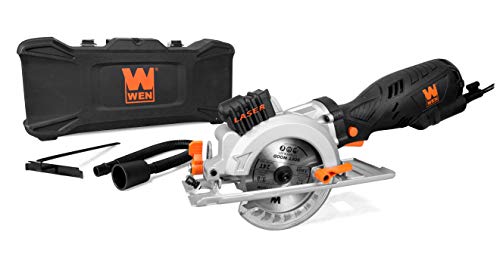 WEN WEN 3625 5-Amp 4-1/2-Inch Beveling Compact Circular Saw with Laser…
View on Amazon ↗
 SEESII SEESII Mini Circular Saw, 4.8A 4000RPM Corded Compact 4-1/2" Saw…
View on Amazon ↗
Listing names and images come from Amazon and are rechecked against the live listings; last checked Nov 8, 2026. No prices shown; the current price is on the listing.
About this guide. This guide covers the compact circular saw category and is written from general knowledge of how these tools work, not from any individual product documents, reviews, or in person testing. No specific units were handled. Check the depth of cut, arbor size, and battery inclusion on the listing for any model you consider.