Match watt hours to what you actually carry: a phone needs far less than a laptop. Check the airline limit before anything else, since carry on rules cap size. Then decide if you need pass through charging and a built in cable, which add bulk.
Watt Hours Are the Number to Compare
Milliamp hours on the box mean little by themselves. A 20,000 mAh bank at 3.7 volts stores about 74 watt hours. A 10,000 mAh bank stores about 37 watt hours.
Watt hours tell you how many full charges you get. Divide the bank's watt hours by your phone's battery watt hours. A 15 Wh phone refills about twice from a 37 Wh bank.
Compare watt hours, not just mAh, when two banks list different voltages. The higher watt hour number is the one that matters for carry on rules and real capacity.
The Airline Limit Caps What You Can Carry
The FAA allows power banks up to 100 watt hours in carry on bags without approval. Most 20,000 mAh and 26,800 mAh banks sit just under this limit.
Banks over 100 watt hours need airline approval and sometimes cannot fly at all. Check the watt hour rating printed on the bank before you buy.
Pack the bank in carry on, never checked luggage. Cabin pressure and cargo rules treat lithium ion packs differently.
- Check the printed Wh rating, not the marketing mAh
- Keep it under 100 Wh for no questions carry on
- Never pack a power bank in checked luggage
How to Read a Listing Before You Buy
Look for the watt hour rating in the specifications, not just the headline. If it is missing, multiply milliamp hours by 3.7 and divide by 1,000.
Check the output wattage. A 10 W port charges a phone slowly; a 30 W port charges a laptop or fast charges a phone.
Ask the seller for the pass through rating if it is not listed. Some banks stop charging devices while they refill, which defeats the purpose.
Pass Through, Built In Cables, and Other Real Features
Pass through charging lets the bank power a phone while the bank itself charges from a wall. This works well on a nightstand or desk.
A built in cable removes one thing to pack. Check which connector it uses, since a Lightning cable does nothing for a USB-C phone.
Fast charging standards matter only if your device supports them. USB-C Power Delivery is the most common for phones and laptops.
- Pass through: powers devices while the bank refills
- Built in cable: convenient but fixed to one connector
- USB-C PD: fast charges most modern phones and laptops
Design Types Split on Pocket Versus Charge Count
| Bank style | Typical watt hours | Best for | Main tradeoff |
|---|---|---|---|
| 5,000 mAh phone bank | About 18 Wh | One partial phone charge | Too small for tablets or laptops |
| 10,000 mAh slim bank | About 37 Wh | One full phone charge | Cannot charge a laptop |
| 20,000 mAh flat bank | About 74 Wh | Two phone charges | Heavier and wider in a bag |
| 26,800 mAh laptop bank | About 99 Wh | One laptop charge | Bulky, near the airline cap |
Phone users do fine with a 10,000 mAh bank. Laptop users need a 20,000 mAh or larger bank with a 30 W output port.
Family households often carry one 20,000 mAh bank to share, but two smaller banks charge more devices at once and split across bags.
Mistakes That Leave You With a Dead Bank
Buying by mAh alone can mislead when banks list different voltages. Always convert to watt hours before comparing.
Ignoring the output wattage means a laptop charges slowly or not at all. A 10 W port cannot power a laptop.
Forgetting the airline cap can strand a large bank at security. Keep it under 100 watt hours or leave it home.
Care and Long Term Costs
Store the bank at partial charge, around 40 to 60 percent, if you will not use it for weeks. Heat and full charge together wear lithium ion cells faster.
Cables wear out before banks do. Budget for a spare USB-C cable, since a frayed cable makes any bank useless.
Banks lose a few percent of capacity each year with heavy use. Expect to replace a daily use bank every two to three years.
When a Different Charger Makes More Sense
A desk setup with a permanent outlet works better with a charging station for a nightstand or desk. No battery to wear out, no airline limit.
Long flights with only a phone need a small bank, but a laptop plus phone on a long haul flight needs a 20,000 mAh bank with USB-C PD.
Campers away from outlets should look at a solar charger for a camp table, which trades speed for sunlight.
Questions Travelers Ask Before Buying a Power Bank
Is a 20,000 mAh power bank allowed on a plane?
Yes, in carry on luggage. A 20,000 mAh bank stores about 74 watt hours, under the 100 watt hour FAA limit. Keep it in your carry on bag, not checked luggage, and have it accessible for security screening.
What watt hour power bank can I take on a flight?
Up to 100 watt hours flies without airline approval. That covers most banks up to about 26,800 mAh. Banks between 100 and 160 watt hours need airline permission. Anything over 160 watt hours is banned.
How many times will a 10,000 mAh power bank charge my iPhone?
A 10,000 mAh bank stores about 37 watt hours. A recent iPhone battery holds about 12 to 15 watt hours, so expect one full charge plus a little extra. Fast charging and heat reduce that slightly.
Does pass through charging damage a power bank?
Pass through creates more heat than charging alone, which can wear cells slightly faster over years. For occasional desk or travel use, the convenience outweighs the small long term effect.
Which power bank is best for a long flight?
A 20,000 mAh bank with at least one USB-C Power Delivery port covers a phone and a tablet, or a phone plus a partial laptop charge. Check the airline allows it, and carry a short cable.
Which Travel Power Bank Should You Pick
A traveler with one phone and a short flight gets by with a 10,000 mAh slim bank that fits in a jacket pocket. A traveler carrying a laptop, tablet, and phone on a long haul flight should choose a 20,000 mAh bank with USB-C PD and pass through charging. That second bank also works for a family sharing one pack across a day of sightseeing.
Real travel power bank listings, so you can check the points in this guide against actual products. These are affiliate links: as an Amazon Associate we earn from qualifying purchases, at no extra cost to you.
 INIU INIU Portable Charger, Smallest 20000mAh 22.5W Fast Charging Power Bank…
View on Amazon ↗
 ANKER Anker Power Bank, 20,000mAh Travel Essential, Built-in USB-C Cable(Black) |…
View on Amazon ↗
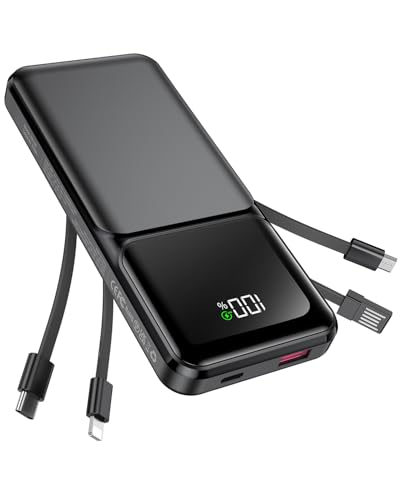 RONEGN Portable Charger with Built in Cable 20000mAh Fast Charging |…
View on Amazon ↗
Listing names and images come from Amazon and are rechecked against the live listings; last checked Nov 8, 2026. No prices shown; the current price is on the listing.
Scope and limits. This guide is written from general category knowledge about travel power banks. It does not draw on individual product documents, reviews, or tests, so verify any capacity or dimension on the listing before you buy.