Two factors decide most running armband purchases: whether the sleeve stays put on your arm and whether your phone stays dry. Runners who carry a phone for music, safety, or tracking benefit from a snug, low bounce design. Walkers and gym users may prefer a belt or pocket. The main tradeoff is between a secure, sweaty fit and quick phone access.
Who Should Skip the Armband
If you run with a watch that stores music and tracks GPS, an armband adds bulk you may not need. A phone on the arm also shifts your natural arm swing, which some runners notice after a mile or two.
Gym users who move between machines often prefer a belt or a pocket. Lifting, stretching, and floor work can push a sleeve down or twist it. Road cyclists and commuters usually want a handlebar mount instead, since arm movement is limited.
Long flights and office desks rarely call for an armband. A desk stand or an airplane mount keeps the screen visible without strapping anything to your body.
Sleeve, Strap, or Pouch: What Changes
Three main designs exist. A full sleeve covers most of the upper arm and holds the phone in a sealed pocket. A strap only design uses one or two bands with a phone cradle. A pouch with a flap is a hybrid, often with a zipper or hook and loop closure.
Full sleeves distribute weight over a larger area, so they bounce less. They also trap more heat and sweat. Strap designs breathe better but rely on tension, which can pinch or slide on thin arms.
Open top sleeves let you pull the phone out quickly, useful for checking a map or changing a song. That speed costs security, since the phone can work its way up during a sprint or a downhill section.
| Design | Bounce control | Sweat buildup | Phone access | Suits |
|---|---|---|---|---|
| Full sleeve | Strong | High | Slow, two hands | Long runs, rainy days |
| Strap only | Moderate | Low | Quick, one hand | Short runs, hot weather |
| Pouch with flap | Moderate | Moderate | Moderate | Trail runs, interval work |
| Open top sleeve | Weak | Moderate | Fastest | Walkers, casual use |
A full sleeve often includes a key slot and a headphone port, but those extras do not fix a poor fit. Check the width of the strap and the material before you trust the pocket count.
Fit for the Workouts You Actually Do
Cycling commuters sit still enough that a handlebar mount beats an armband. An armband on a bike twists with every signal and can catch on a jacket. Gym users lift, bend, and lie down, so a sleeve tends to ride up or pinch during bench work.
For running, the armband earns its place. A snug fit keeps the phone from swinging, and a sweat resistant pocket protects it on hot days. Road trips and long flights are better served by a vent mount or a tray stand, where the phone stays visible and charged.
Features That Matter and Ones That Do Not
Sweat resistance matters most. Look for a water resistant rating like IPX4 or a sealed seam, not just a splash proof claim. A touch sensitive window lets you change songs without removing the phone, but thick plastic can make swipes less reliable.
Reflective trim helps at night, but a small strip on the back does little if your shirt covers it. A key pocket is useful only if it closes securely. Extra card slots rarely work well because sweat and motion push cards out.
Ignore claims about universal fit. A sleeve that fits a compact phone may not hold a larger model with a case. Check the maximum phone dimensions in the listing, not the phone model names.
Read the Listing Before You Buy
First, check the arm circumference range. A sleeve for a 9 to 13 inch arm will not fit a 14 inch bicep. Second, compare the phone pocket interior dimensions to your phone with its case on. Many listings give the phone size without a case, which leads to returns.
Third, look at the strap or sleeve material. Neoprene stretches and holds, but it holds sweat. Lycra breathes but may slip. Fourth, ask the seller about the closure type if it is not clear. A hook and loop strap lasts longer than a cheap elastic band.
Finally, confirm whether the headphone port lines up with your phone. A port at the bottom of the pocket is useless if your headphone jack sits at the top.
Care and Long Term Costs
Armbands collect salt and skin oils. Rinse the sleeve or strap after sweaty runs and air dry it, since machine drying shrinks elastic. A hook and loop closure loses grip if lint builds up, so pick it clean occasionally.
Expect to replace an armband every year or two with regular use. The elastic stretches, the plastic window yellows, and the seams can split. A budget armband that fails in three months costs more over a year than a mid range one that lasts two.
No consumables are required, but a screen protector on your phone is wise. Constant pressure and sweat against the armband window can scratch a bare screen over time.
Mistakes That Send Armbands Back
Buying by phone model alone is the biggest mistake. Case thickness and arm size matter more. A sleeve that fits a bare phone may not close over a rugged case.
Choosing the largest pocket for a future phone upgrade backfires. The extra space lets the phone slide inside, which causes bounce and wear. Pick the size that matches your current phone and case.
Wearing the armband too low on the forearm is another common error. It should sit on the upper arm, just below the shoulder, where muscle mass damps motion. A low placement swings more and can hit your hip.
What Decides the Result, in Order
Sleeve fit comes first. A band that slides or pinches ruins every run, no matter how good the pocket is. Second is phone security: the pocket must hold the phone through sweat, arm swing, and accidental bumps.
Third is strap bounce. A heavy phone on a thin strap bounces with every step, which is tiring and can damage the phone over time. Features like key slots and card pockets rank last because they do not affect comfort or safety.
For most runners, a full sleeve with a sealed pocket and a wide strap solves the core problems. If you need quick phone access for interval workouts, a pouch with a flap or an open top sleeve trades some security for speed.
Running Armband Questions, Answered Straight
How do I know if a running armband will fit my arm?
Measure your upper arm at the widest point with your arm relaxed. Compare that number to the arm circumference range in the listing. A range of 9 to 13 inches fits most adults, but larger or smaller arms need a specific size. If you fall between sizes, choose the smaller one, since elastic stretches over time.
Can I use a running armband with a phone case?
Yes, but only if the pocket interior dimensions exceed your phone with the case on. Measure the length, width, and thickness of your cased phone. Then check the listing for the maximum phone size the pocket accepts. Many armbands list the bare phone size, so add your case thickness before comparing.
Is a running armband waterproof or just sweat resistant?
Most armbands are sweat resistant, not waterproof. A sweat resistant pocket repels light moisture but will not survive a downpour or a full dunk. Look for an IPX4 rating or higher if you run in heavy rain. For extra protection, put your phone in a thin plastic bag inside the pocket.
What is the difference between a sleeve and a strap armband?
A sleeve covers most of the upper arm like a compression band, which spreads weight and reduces bounce. A strap uses one or two bands with a phone cradle, which breathes better but can slip. Sleeves suit long runs and larger phones; straps suit short runs and hot weather.
Which arm should I wear a running armband on?
Wear it on the arm you move less. Most runners swing their dominant arm more, so the nondominant arm feels more stable. If you carry a water bottle in one hand, put the armband on the other arm. The key is to avoid adding weight to the arm that already does more work.
The Armband Pick for Most Runs
A runner who logs three or more miles at a time and carries a cased phone should pick a full sleeve with a sealed pocket, a wide strap, and a touch sensitive window. That design controls bounce and protects against sweat. For hot weather or short interval sessions where you grab the phone often, an open top sleeve or a pouch with a flap is the smarter trade. It sacrifices some grip for breathability and one hand access.
Real running phone armband listings, so you can check the points in this guide against actual products. These are affiliate links: as an Amazon Associate we earn from qualifying purchases, at no extra cost to you.
 HIRUI HiRui Universal Sports Armband Cell Phone Armband Sleeves Running Armband…
View on Amazon ↗
 HAISSKY Running Armband with Earphone Pouch Fits Phones up to 6.9"…
View on Amazon ↗
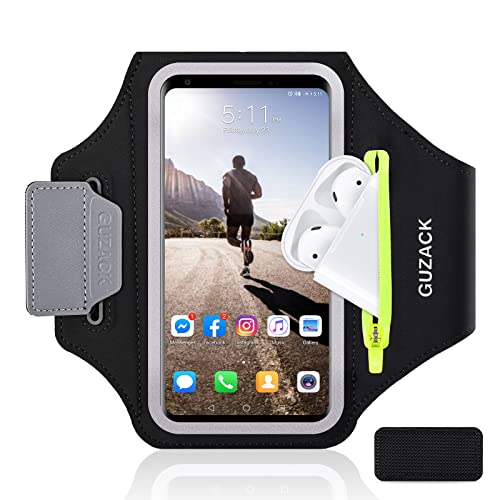 GUZACK GUZACK Running Armband for iPhone 18 Pro Max 17 16…
View on Amazon ↗
Listing names and images come from Amazon and are rechecked against the live listings; last checked Nov 8, 2026. No prices shown; the current price is on the listing.
How to read this guide. This guide covers running phone armbands as a category, based on general product knowledge rather than any individual listing or user review. It cannot tell you how a specific armband fits your phone or arm, so check the dimensions and closure on the product page before ordering.