Focus on fill, fabric, and size. A quieter fill suits small nurseries and calm play, while crinkle or squeak fills hold attention during tummy time. Fabric should be washable and free of loose parts. Size should fit a six month old's grip. Skip sets with hard frames or tiny attachments if a baby still mouths everything.
What the Fill Does to a Baby's Attention
The fill is the first thing to check on a listing. Crinkle paper makes a sound like crumpled tissue and often gets a six month old to turn toward the block. A rattle or bell gives a sharper noise that works well during tummy time, when a baby is on the floor and needs a reason to lift their head. A plain fiberfill block is quiet and better for a small nursery where a parent wants calm play.
Compare the listing's description of the sound. Some blocks have a removable sound insert, which makes washing easier but can get lost. Others have the crinkle sewn into a hidden pouch, which keeps the block thin enough for small hands. If the listing only says "sensory" without naming the fill, ask the seller what is inside before buying.
Fabric Decides Whether the Set Survives
Fabric should be machine washable. Soft blocks end up in a baby's mouth, on a nursery floor, and under a high chair. A block with a removable cover and a separate inner pillow washes more thoroughly than a fully sewn block, but the cover can stretch out of shape. A sewn shut block is simpler to grab but may hold moisture inside if it gets soaked.
Check the fabric type in the listing. Cotton or polyester fleece dries faster than minky or plush, which can trap spit up. Avoid blocks with glued on felt or foam letters that peel after a few washes. A block with embroidered details or sewn on ribbons lasts longer than one with painted or ironed on decorations.
Size and Grip for Six Month Old Hands
A six month old can usually hold a cube that is 4 to 6 inches across. A smaller cube, around 3 inches, works for a younger baby but may disappear under a play gym. A larger cube, over 7 inches, is hard for a baby to pick up and better as a floor cushion or a tummy time prop.
Look at the block's shape. A cube with rounded corners is easier to grip than a ball or a cylinder. Some sets include a block with a built in handle or a loop, which helps a baby who is still working on coordination. If the block is meant for tummy time, a flatter shape with a crinkle side can sit under a baby's chest and still make noise when they press down.
Quiet Play Versus Tummy Time Blocks
| Block style | Sound level | Cleanup effort | Best use |
|---|---|---|---|
| Quiet plush cube | Very low | Easy, machine wash | Small nurseries, calm play |
| Crinkle cube | Low to medium | Easy if crinkle is sewn in | Tummy time, stroller |
| Multi texture block | Low | Harder, ribbons catch debris | Sensory development, gift |
| Squeak or rattle block | High | Moderate, check for sealed noisemaker | Tummy time, floor play |
The tradeoff is between how easy a block is to clean and how much it stimulates a baby. A quiet plush cube is the easiest to wash and the least likely to overstimulate, but it may not hold a baby's attention for long. A squeak or rattle block does the opposite. A crinkle cube sits in the middle and is often the most practical choice for a six month old.
What Matters More Than a Brand Name
Listings often lead with words like "Montessori inspired" or "developmental toy," but those do not tell you how the block behaves. Check the fill, fabric, and size first. A block with a high contrast black and white pattern can help a younger baby focus, but by six months a baby responds more to sound and texture than to pattern alone.
Some sets advertise a number of blocks, like six or eight, but a six month old only needs two or three at a time. A smaller set with better fabric and a mix of fills is more useful than a large set of identical quiet cubes. If the set includes a storage bag, check whether it is washable and whether it has a zipper a baby could catch a finger in.
Mistakes That Make a Set Unused
A common mistake is buying a set that is too loud for the room where it will be used. A rattle block in a small nursery can become annoying after the first week, and a parent may put the whole set away. Another mistake is choosing a block with small attached parts, like plastic eyes or a sewn on teether ring, that a baby can chew off or that make the block unsafe to wash.
Some buyers pick a block that is too big for a six month old to lift, then wonder why the baby ignores it. Check the dimensions in the listing rather than relying on a photo, which can make a block look smaller than it is. If the block is meant for tummy time, a flat crinkle mat with a few attached blocks often works better than a tall stack of cubes.
Gift Giving Without the Guesswork
A set of soft sensory blocks is a common gift for a baby shower or a first birthday, but the wrong set can sit in a closet. For a gift, choose a set with a mix of fills, like one crinkle, one rattle, and one quiet block, so the baby has variety without a parent needing to buy more. A neutral fabric color works in most nurseries, while a bright set may clash with a specific decor.
If you are buying for a small nursery, skip the large floor block sets. A three piece set with a storage bag takes up less room and is easier to pack away. Check whether the blocks are safe to machine wash on a normal cycle, since a gift that needs hand washing is less likely to be used.
When to Skip Soft Blocks Entirely
A baby who is already crawling and pulling up may get more from a push toy or a set of stacking cups. Soft blocks do not stack well because they are pliable, so a baby who wants to build a tower will knock it over and get frustrated. A baby who is starting to teeth may prefer a dedicated teether with a firmer surface, since a soft block does not give the same gum pressure.
If the baby has a play gym with hanging toys, adding soft blocks may be redundant. A play gym gives a baby something to bat and grab while lying on their back, while blocks work better when a baby is sitting or on their tummy. Consider whether the baby already has a tummy time mat with built in textures before buying a separate block set.
Soft Block Questions Before You Buy
What makes a soft sensory block different from a regular plush toy?
A soft sensory block is shaped like a cube and usually has a specific fill, like crinkle paper or a rattle, that makes sound when a baby squeezes it. A regular plush toy may have no sound or texture. The block shape is easier for a six month old to grip and stack than a soft animal shape.
Are soft sensory blocks safe for a six month old to mouth?
Yes, if the block has no small attached parts that can come off. Check that any ribbons, tags, or teether rings are sewn securely and that the block has no plastic eyes or buttons. A block with a removable sound insert is safe only if the insert is too large to swallow and the pocket closes securely.
How do I clean soft sensory blocks with crinkle paper inside?
Most crinkle paper is made from a plastic film that can survive a gentle machine wash, but check the label. A block with a removable crinkle insert should have the insert taken out before washing. Air dry the block instead of using a dryer, since heat can melt the crinkle film or make it stop crinkling.
Is it worth buying a large set of soft blocks?
For a six month old, a set of two or three blocks with different fills is usually enough. A large set of six or eight identical quiet cubes does not add much play value and takes up nursery space. A smaller set with one crinkle, one rattle, and one quiet block gives more variety for less money.
Which soft sensory block is best for tummy time?
A flat crinkle block or a cube with a crinkle side works well because a baby can press on it and hear a sound. A block with a mirror or a high contrast pattern on one side can also hold attention. Avoid a tall, firm rattle block that a baby cannot reach while lying on their stomach.
The Block Set That Fits Most Six Month Olds
A parent setting up a small nursery for a six month old should start with a three piece set: one crinkle cube, one quiet plush cube, and one multi texture block with ribbons. That mix covers tummy time, calm play, and sensory variety without taking up much space. For a baby who needs a stronger reason to lift their head during tummy time, pick a flat crinkle mat with a built in rattle instead of a cube set.
Real soft sensory blocks listings, so you can check the points in this guide against actual products. These are affiliate links: as an Amazon Associate we earn from qualifying purchases, at no extra cost to you.
 BABY EINSTEIN Baby Einstein Alpha Stacks Baby Learning Blocks, Soft, Multisensory Stacking…
View on Amazon ↗
 JYUSMILE Jyusmile Baby Toys 6-12 Months, Montessori Toy for Babies 6-12…
View on Amazon ↗
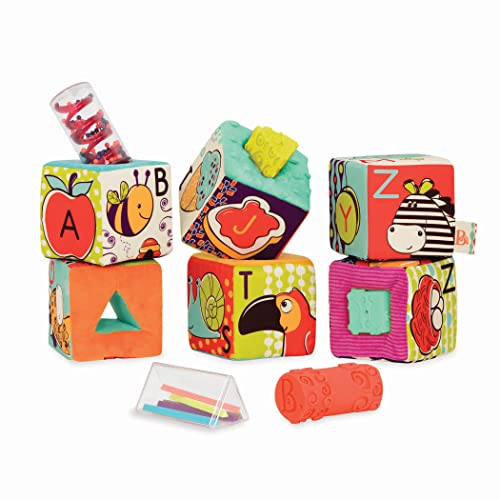 B. TOYS B. toys Soft Fabric Building Blocks, ABC Block Party, Baby…
View on Amazon ↗
Listing names and images come from Amazon and are rechecked against the live listings; last checked Nov 8, 2026. No prices shown; the current price is on the listing.
About this guide. Use this guide as a checklist to hold against any soft sensory block listing. It is written from general knowledge of the category, not from testing individual models, so verify any dimension or fill detail on the product page before you buy.