Focus on three factors: how securely the earbuds stay on during your activities, how much sound they leak to people nearby, and how long the battery lasts between charges. Runners and cyclists need a firm, stable fit above all. Office and classroom users need low sound leakage. Anyone who wants deep, isolated bass should skip this category entirely.
Fit Security Decides Whether You Keep Them
Open ear earbuds do not seal the ear canal. They rest on or near the ear, so a secure fit is the first thing to check. If the earbuds shift while you move, the sound changes and the comfort drops.
Look for designs that wrap around the ear or clip onto the rim. These hold position during running, gym work, or a long walk. Compare the weight and the contact points in the listing photos. A lighter build with a broad contact area often stays put better than a small, heavy body.
If you wear glasses or a hat, check how the earbud arms interact with them. Some hook styles press against the temple or the frame. Read the product images from the side to see where the arm sits. A design that leaves space for glasses arms is easier to live with.
Sound Leakage Sets the Social Limit
Open ear designs let sound escape by nature. The amount of leakage varies with how far the speaker sits from the ear canal and how the drivers are angled. Check the listing for terms like 'directional audio' or 'reduced leakage', but treat them as clues, not guarantees.
In a quiet office or a shared study room, leakage can annoy people nearby. If you plan to use these for calls or study, choose a design that positions the driver close to the ear opening. Neckband style open ear earbuds often leak less than hook styles because the speaker sits closer.
Test the leakage in a quiet room after purchase if the retailer allows returns. Play a voice track at medium volume and have someone stand a few feet away. If they can follow the words, the leakage is too high for library or cubicle use.
Battery Life Matches Your Longest Stretch
Open ear earbuds are often used for long periods: a full workday of calls, a cross country flight, or a marathon training run. Check the case battery as well as the earbud battery. The case recharges the buds between uses, so the total listening time is what matters for travel.
Compare the claimed playtime at a realistic volume. Many listings quote battery life at 50 percent volume. If you listen louder or take calls, expect shorter run time. Look for a quick charge feature if you often forget to top up the case.
Battery life also declines with age. A design with a replaceable battery is rare in this category, so consider the warranty period. For long term use, a case that holds several full charges gives you more usable life before the whole set needs replacing.
Design Types Trade Stability for Privacy
Three main shapes dominate open ear earbuds. Ear hook styles wrap around the back of the ear and stay put during hard movement. Clip on styles clamp onto the ear rim and are easier to take on and off. Neckband styles connect the two buds behind the neck and keep the drivers near the ear canal.
Your activity picks the shape. Runners and gym goers usually prefer ear hooks because they do not bounce loose. Office workers who sit still may prefer clip ons for quick removal when a colleague stops by. Neckband styles suit listeners who want less leakage and do not mind the band on the collar.
Each shape has a tradeoff. Hooks are the most stable but leak the most sound. Neckbands leak the least but feel less secure during head movement. Clip ons sit in between. The table below lays out the differences for quick comparison.
| Design type | Stability during movement | Sound leakage | Best for |
|---|---|---|---|
| Ear hook | High | Higher | Running, cycling, workouts |
| Clip on | Medium | Medium | Office, walking, casual use |
| Neckband | Lower | Lower | Quiet rooms, calls, study |
Think about where you will wear them most. A hook style on a quiet train may draw glares. A neckband style on a trail run may slip with every stride. Match the shape to the main use case, not the marketing image.
Read the Listing Like a Checklist
Ignore lifestyle photos and focus on the specification block. Check the weight of each earbud. Check the Bluetooth version: newer versions improve connection stability and battery efficiency. Check the water resistance rating if you sweat or run in rain. An IPX4 rating handles sweat and light rain; IPX7 handles a full dunk but is rare in open ear designs.
Look for the driver size and the audio codec support. Larger drivers often produce fuller sound, but the open ear design limits bass regardless of driver size. Codecs like AAC and aptX affect audio quality on different phones. If the listing does not name the codec, assume basic SBC and expect some latency on video.
Ask the seller about the charging port and the case dimensions. A USB-C port is standard now, but some budget models still use micro USB. Check the case size against your pocket or bag. If you plan to use the earbuds for calls, confirm the microphone placement and whether it has noise reduction for your voice.
For long flights, check if the earbuds can connect to two devices at once. Multipoint lets you switch between a laptop and a phone without repairing. If the listing does not mention multipoint, assume single device connection.
Calls and Study Need a Different Check Than Running
For office calls and online classes, microphone quality and background noise handling matter more than fit security. Look for a boom mic or a dual mic array that points toward your mouth. Open ear earbuds without a boom mic often pick up more room noise because the mic sits near the ear.
Check the call quality in the product description. Terms like 'AI noise reduction' or 'cVc' indicate some processing, but the real test is how your voice sounds in a noisy kitchen or a shared office. If the listing shows call audio samples or a frequency graph, use those as a guide.
For school study, comfort over long sessions is key. A clip on or neckband style that does not press on the ear cartilage may be easier to wear for three hours than a hook style. Check the earbud weight in grams. Anything under 10 grams per bud is light; over 15 grams may cause fatigue.
Podcast recording is a different use case. Open ear earbuds are not studio monitors. They do not isolate your voice from the recording environment, so the audio track will include room reflections. If you record podcasts, choose a closed back headphone or an in ear monitor instead. Open ear earbuds work only as a monitoring tool, not as the recording device.
Who Should Skip Open Ear Earbuds
Skip this category if you want deep bass or total immersion. Open ear designs cannot produce the low end of a sealed in ear bud. The bass response is thin because the sound wave has no enclosed air volume to pressurize.
Skip them if you work in a very loud environment. Open ear earbuds do not block external noise. You will turn up the volume to hear over machinery or traffic, which increases leakage and may damage your hearing over time. For loud offices or flights, consider noise isolating earbuds or over ear headphones instead.
Skip them if you need privacy. Anyone within a few feet can hear your audio at moderate volume. This makes open ear earbuds a poor choice for confidential calls in a cubicle or for watching videos next to a sleeping partner.
If any of these apply, look at alternatives like bone conduction headsets for situational awareness with less leakage, or standard in ear buds for isolation. The headphone guides for office and travel cover closed back options.
Long Term Costs Hide in the Battery and the Fit
Open ear earbuds have no ear tips to replace, but other parts wear out. The ear hooks or clips can crack if you stuff them into a tight pocket. The charging case hinge is a common failure point. Check the case material: a metal hinge lasts longer than a plastic one.
Battery degradation is the main long term cost. After two years of daily use, the earbud battery may hold only 70 percent of its original charge. The case battery also degrades. A design with a replaceable case is cheaper to maintain than one where the whole set must be replaced.
Some models have foam pads or silicone sleeves on the contact points. These wear out and may need replacement. Check if the manufacturer sells spares. If not, the earbuds become less comfortable as the pads flatten.
Software support matters too. Firmware updates can fix connection bugs or add features like multipoint. Check if the brand has a companion app and a history of updates. A model without an app may become outdated faster.
Open Ear Earbud Questions Before You Add to Cart
Is open ear earbuds good for running?
Yes, if you choose an ear hook design. The hook wraps around the back of the ear and keeps the bud in place during hard strides. Check the water resistance rating: IPX4 handles sweat. Expect more sound leakage than in ear buds, so keep the volume moderate on shared paths.
Which open ear earbuds leak the least sound?
Neckband style open ear earbuds usually leak the least because the driver sits closer to the ear canal. Clip on styles leak more, and ear hook styles leak the most. Look for listings that mention directional audio or reduced leakage, but verify in a quiet room after purchase.
What is the difference between open ear and bone conduction?
Open ear earbuds use small speakers that fire sound into the ear canal from outside. Bone conduction headsets vibrate the cheekbones to send sound to the inner ear. Open ear earbuds generally have better sound quality and bass, while bone conduction leaves the ear canal completely open. For a deeper comparison, see the bone conduction guide for running and calls.
Should I buy open ear earbuds for office calls?
Only if the office is quiet and you do not mind some sound leakage. Choose a model with a boom mic or dual mic array for clearer voice pickup. If you take calls in a shared space, closed back headphones or in ear buds with a mic will keep your conversation private.
How long do open ear earbuds last on a charge?
Most open ear earbuds last 6 to 12 hours on a single charge, with the case providing 2 to 4 extra charges. Actual time depends on volume and call use. For long flights, look for a case that holds at least 24 hours of total playtime and supports quick charging.
Which Open Ear Style Fits Your Day
A commuter who walks to work and takes calls at a desk gets the most from a clip on open ear earbud with multipoint and a charging case that lasts a full workweek. That style balances easy removal, decent stability, and moderate leakage. A trail runner who sweats through a daily 10K needs a different pick: an ear hook design with IPX5 or higher water resistance and a secure over ear band, accepting more sound leakage for a fit that never slips.
Real open ear earbuds listings, so you can check the points in this guide against actual products. These are affiliate links: as an Amazon Associate we earn from qualifying purchases, at no extra cost to you.
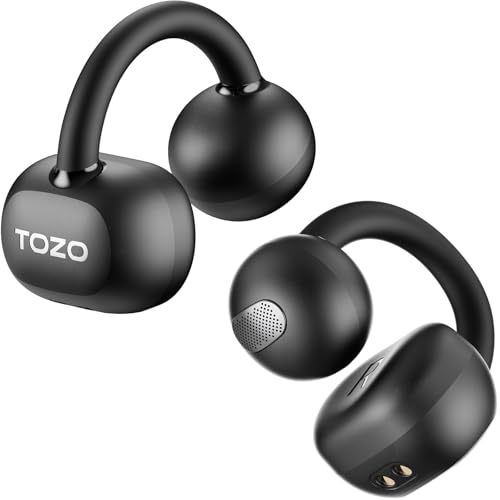 TOZO TOZO OpenEarRing Open Ear Earbuds 40H Bluetooth 5.4 Lightweight Comfort…
View on Amazon ↗
 SOUNDCORE Soundcore C50i by Anker Open Ear Earbuds, Clip On Earbuds,…
View on Amazon ↗
 KINGLUCKY Kinglucky Clip-On Earbuds Gen 3, Open-Ear Wireless Bluetooth 6.0 Headphones…
View on Amazon ↗
Listing names and images come from Amazon and are rechecked against the live listings; last checked Nov 8, 2026. No prices shown; the current price is on the listing.
About this guide. Use this guide as a checklist to hold against any open ear earbud listing before you buy. It covers the product category in general, not individual models, and no product documents, reviews, or tests were used. Always verify dimensions and battery claims on the listing itself.