Two factors decide most mandoline purchases: the cut style you repeat most and how much cleanup you will tolerate. Straight blades suit firm vegetables and precise slabs, while V blades power through dense produce with less wrist strain. Hand guards and non slip bases matter more than extra blade inserts. If you cook one or two portions at a time, a sharp chef knife may serve you better.
Blade Style Changes the Work More Than the Result
A straight blade runs across the frame at a fixed angle. You push food down and forward, and the slice lands below. This style gives you a clear view of the cut and tends to produce very even slabs from firm produce like potatoes, cucumbers, and zucchini.
A V blade has two edges meeting at a point, like a shallow arrow. Food meets both edges at once, which spreads the force and lets the blade enter dense vegetables with less downward pressure. Carrots, sweet potatoes, and cabbage move through a V blade with noticeably less wrist effort.
Some frames accept interchangeable blades that switch between straight, julienne, or waffle cuts. The promise is versatility, but each swap adds setup time and another sharp edge to handle. For most home cooks, one reliable straight or V blade beats six blades that sit in a drawer.
Safety Design Is the Real Feature List
A mandoline is a stationary blade you slide food across. That makes the hand guard the most important part you never think about until it is missing. A guard with deep spikes holds wet or curved produce without slipping. A shallow guard lets a zucchini twist, and your palm is the next surface.
A non slip base or fold out legs keep the frame still on a counter. Rubber feet work on dry stone and laminate. Suction bases grip glass and tile but can slide on oiled or floured surfaces. Check how the feet sit when the blade is under pressure, not just at rest.
A cut resistant glove is a useful backup but not a replacement for a guard. Gloves protect against a glancing edge, not a full force slide. Treat any mandoline as a tool that requires a guard every single pass, even for the last slice of an onion.
Cleanup Effort Hides in the Frame
Food gets trapped where the blade meets the frame. A model with a removable blade or a wide gap around the edge rinses clean under a tap. A frame with narrow channels, fixed rivets, or a non removable blade holds starch and onion juice, and you will scrub it with a brush every time.
Adjustable thickness dials add small crevices. Look for a dial that sits outside the food path or a frame that disassembles fully. Dishwasher safe parts help, but plastic frames can warp at high heat, so check the care note on the listing.
The cut itself also affects cleanup. Julienne teeth create many small gaps that trap fibers. A plain straight or V blade has fewer hiding spots. If you use the mandoline twice a week, choose the simplest blade that does the job.
Thickness Control: Where the Dial Actually Matters
Most mandolines adjust from paper thin to about a quarter inch. The mechanism matters more than the number of steps. A dial with positive clicks holds its setting while you push. A smooth slider can drift down mid batch, so your last potato slice is thinner than your first.
For gratins and chips, you want repeatable thin slices at the same setting. For pickles and slaws, a thicker setting with more tolerance works fine. If the dial is hard to read or reach while the guard is in place, you will set it once and live with whatever thickness you get.
Some frames use interchangeable plates instead of a dial. That adds a step but removes drift entirely. If you only cut two thicknesses, plates may be simpler than a dial with twenty positions you never use.
Long Term Costs Are Mostly Blades and Patience
Blades dull eventually, and not every mandoline has a replaceable blade. A fixed blade that loses its edge turns a fast tool into a dangerous one, because you push harder and the food slips. Check the listing for replacement blade availability before you buy.
Plastic frames can crack at the hinge or the feet after a few years of hard use. Stainless steel frames cost more upfront but handle drops and drawer knocks better. If the mandoline lives in a crowded drawer, a steel frame pays for itself.
The hidden cost is time. A mandoline that takes five minutes to set up and ten to clean will not get used. A simple frame with one blade and a guard you can grab in one motion gets used for a quick cucumber salad after work.
How to Read a Listing Before You Buy
Start with the blade material. Stainless steel resists rust and holds an edge longer than carbon steel, which needs drying after every wash. Ceramic blades stay sharp for years but chip if dropped, and they cannot be resharpened.
Check the frame material and the feet. A listing that says 'non slip base' without saying what the base is made of tells you little. Rubber and silicone grip dry counters. Suction cups need a smooth surface. Fold out legs need a lip or edge to brace against.
Ask the seller two questions before checkout: is the blade removable for sharpening or replacement, and which parts are dishwasher safe. If the answer is vague, the cleanup section above tells you what to expect.
Dimensions matter more than they seem. A mandoline that is too wide for your cutting board forces you to work over the sink or the counter edge. Measure your widest board and compare it to the frame width in the listing.
| Blade style | Best for | Cleanup effort | Common mistake |
|---|---|---|---|
| Straight blade | Even slabs from firm produce | Low, one edge to rinse | Pushing too hard on wet food |
| V blade | Dense vegetables and big batches | Medium, two edges and a point | Skipping the guard on the last slice |
| Julienne or waffle | Slaws, garnishes, decorative cuts | High, many teeth trap fibers | Buying it for daily thin slices |
| Adjustable dial | Families who vary thickness | Medium, dial crevices | Dial drifting mid batch |
One more check: hold the listing photo next to the description. If the photo shows a hand guard but the text never mentions one, ask whether it is included or sold separately. A guard is not an accessory.
Small Kitchens, Seniors, and Beginners Face Different Pressures
In a small kitchen, a mandoline competes with a knife block, a cutting board, and a food processor for drawer space. A compact frame with a folding stand or a wall mount hook earns its place. A wide professional frame that needs a dedicated shelf will get buried and forgotten.
Seniors often benefit from a mandoline because it reduces repetitive knife motion, but only if the guard is easy to grip and the dial is large enough to read. A stiff adjustment wheel or a slippery handle turns a helpful tool into a frustration. Look for oversized grips and positive click settings.
Beginners should start with a straight blade and a thick setting. The slower pace builds the habit of using the guard every pass. A V blade with julienne teeth is a fast way to lose focus and a fingertip. Learn the rhythm first, then add speed.
Family dinners change the math. A mandoline shines when you need a pound of uniform onion slices for a gratin or a pile of cabbage for slaw. For small portions, a chef knife is faster because setup and cleanup eat the time you saved.
Marketing Features That Do Not Matter Much
Blade insert sets with ten or twelve pieces sound impressive but most home cooks use one or two. The rest sit in a box and get lost. Pay for the blade you will actually use, not the set.
A storage case or sheath is useful only if you will put the mandoline back in it every time. Most people will not, and the case becomes another drawer item. A simple blade cover or a fixed guard position is more practical.
Claims about 'professional' or 'restaurant grade' mean little for a home tool. Restaurants value speed and volume, which often means a larger, heavier frame that is harder to store. A home mandoline should be light enough to grab with one hand and small enough to fit your board.
Ice cream scoops with a mandoline? No. Some listings bundle unrelated tools to inflate the perceived value. Judge the mandoline itself, not the bonus peeler or spiralizer attachment.
When a Chef Knife or Food Processor Is the Better Tool
A mandoline is a specialist. It does thin, repeatable slices faster than a knife, but it does not chop, mince, or dice. If your cooking leans on rustic stews and stir fries, a sharp chef knife is more versatile and faster to clean.
A food processor with a slicing disc handles large batches of cabbage, onions, or potatoes with almost no technique. It takes up more space and makes more noise, but for a family slaw or a big batch of scalloped potatoes, it wins on volume.
Skip the mandoline if you have limited hand strength or grip issues. The pushing motion requires steady downward and forward pressure, and a guard can be hard to hold for someone with arthritis. A food processor or a knife with a rocker handle may be safer.
Also skip it if you cook mostly soft, delicate produce. Tomatoes, ripe peaches, and soft cheese squish under a mandoline blade. A very sharp knife gives you more control and less waste on those.
Mandoline Questions Home Cooks Actually Ask
How do I use a mandoline slicer without cutting myself?
Always use the hand guard, even for the last slice. Keep your fingers curled behind the guard and push with steady, even pressure. Place the frame on a dry, non slip surface and stand so your forearm moves straight forward, not at an angle. If the food gets stuck, stop and reset rather than pushing harder.
Which mandoline slicer is best for thin potato chips?
A straight blade with a reliable thickness dial gives the most even chips. Set it to the thinnest setting that holds without tearing, usually around one to two millimeters. A V blade also works but can leave a slight center ridge. Dry the potato slices on a towel before frying to keep the oil from spitting.
Is a mandoline slicer worth it if I already have a good chef knife?
It depends on how often you need very thin, uniform slices. A chef knife can make thin slices but not as quickly or as consistently across a whole batch. If you make gratins, chips, pickles, or slaws at least twice a month, a mandoline saves real time. For occasional thin slices, a knife is fine.
Can a mandoline slicer cut sweet potatoes?
Yes, but dense sweet potatoes need more force than cucumbers or zucchini. A V blade handles them better than a straight blade because the two edges spread the pressure. Cut the sweet potato into smaller chunks that fit the guard, and use a firm, steady push rather than a hard jab.
What is the difference between a straight and a V blade mandoline?
A straight blade is one edge across the frame. It gives a clear view and very even slabs. A V blade has two edges meeting in the middle, which enters dense food with less effort and keeps round produce from rolling. V blades are faster for big batches but slightly harder to clean around the point.
Which Mandoline Fits a Busy Home Kitchen
A home cook making weekly gratins, slaws, or pickles should pick a simple straight blade model with a removable stainless steel blade, a deep hand guard, and rubber feet. That covers the most common cuts with the fewest cleanup traps. If you process dense root vegetables in big batches, a V blade frame is the better call, even though it needs more careful cleaning around the point.
Real mandoline slicer listings, so you can check the points in this guide against actual products. These are affiliate links: as an Amazon Associate we earn from qualifying purchases, at no extra cost to you.
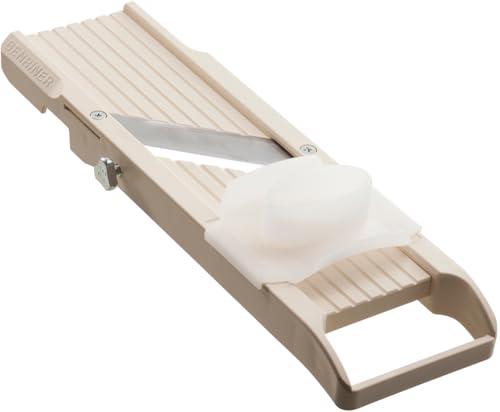 BENRINER Benriner Mandoline Slicer with 4 Blades, Japanese Stainless Steel, BPA…
View on Amazon ↗
 GILINIMY Handheld Mandoline - Japanese Style Slicer for Vegetables, Cabbage, Cucumber…
View on Amazon ↗
 OXO OXO Good Grips Handheld Mandoline Slicer with Non-Slip Handle for…
View on Amazon ↗
Listing names and images come from Amazon and are rechecked against the live listings; last checked Nov 8, 2026. No prices shown; the current price is on the listing.
About this guide. This guide covers the mandoline category in general, not any specific model. It is written from broad knowledge of how these tools work in a home kitchen, without reading individual product reviews or testing any units. Check the listing for the exact dimensions, blade material, and included safety parts before you buy.