Pick a keyboard stand by matching its base width, weight capacity, and folded size to your keyboard's dimensions and your room. Single X and table stands suit home learners and small bedrooms, while double X and Z stands handle heavier stage keyboards. The main tradeoff is between a low, stable footprint for rehearsals and a collapsible frame that fits in a car.
Match the Stand to the Board, Not the Brand
Start with the keyboard's width, depth, and weight. A 76 key board can be 45 to 55 inches wide, while an 88 key board often runs 50 to 60 inches. Check the stand's listed support width and compare it to your keyboard's underside, not just the top surface.
Weight capacity matters because a board that sits near the limit will wobble more as you play. A stand rated for 100 pounds will hold a 20 pound keyboard, but a 70 pound stage piano needs a stand rated for at least 120 pounds for steady, quiet playing.
Depth matters less than width, but a deep keyboard on a shallow stand shifts its center of gravity forward. If the board extends more than two inches past the front arms, it will tip or bounce during hard passages.
Four Frame Types Split by How Often You Move Them
Single X stands fold flat and weigh under 10 pounds, which suits a bedroom corner or a weekly lesson. The tradeoff is stability: the crossing arms create a narrow support point, so a heavy keyboard rocks from side to side.
Double X stands add a second crossing point and a wider base, which calms the rocking for stage pianos and heavier synths. They still fold, but they are bulkier and take a few more seconds to set up.
Z stands use a rigid rectangular frame with two side braces. They are the most stable for hard playing and they free up leg room underneath, but they are heavier and do not fold as small.
Table stands put a flat board across two legs, which works for light keyboards in a home studio. They are easy to assemble but offer less height adjustment and less support for a heavy, deep instrument.
| Frame type | Best for | Stability under load | Folded size | Leg room |
|---|---|---|---|---|
| Single X | Light keyboards, small rooms | Low to medium | Very compact | Center cross brace can hit knees |
| Double X | Heavy keyboards, stage use | Medium to high | Bulky | Two cross braces limit knee space |
| Z stand | Hard players, studio desks | High | Long and flat | Clear space under the board |
| Table stand | Light boards, seated practice | Medium | Flat but wide | Open, but legs can catch feet |
For a church musician who plays the same spot every week, a Z stand or double X makes sense because the stand never moves. For a bedroom player who stores the keyboard after each session, a single X is easier to live with.
The Height Check That Prevents Wrist and Back Pain
A stand set too high forces your shoulders up; too low bends your wrists. The rule of thumb is that your forearms should be parallel to the floor when your fingers rest on the keys. That puts most players' keyboard surface at 28 to 30 inches, but your seated or standing posture moves that number.
Check whether the stand's height adjustment uses pins, knobs, or a lever. Pin systems are secure but slow to change. Knobs allow fine tuning but can loosen over time. Levers are quick but often have fewer locked positions.
If you alternate between sitting and standing, look for a stand with a wide height range and clear markings. A stand that adjusts from 24 to 38 inches covers most players, but any number is only useful if you can set it without tools.
Read the Listing for These Three Numbers, Then Ask
Listings often lead with accessory arms, cable clips, and headphone hooks. Those are secondary. First find the three numbers that decide fit: support width, weight capacity, and folded length.
Support width tells you whether your keyboard fits between the arms without overhang. Weight capacity tells you whether the stand will hold the board without flexing. Folded length tells you whether it fits in your closet, trunk, or under a bed.
If a listing omits one of these numbers, ask the seller before buying. A vague answer like 'fits most keyboards' is a warning sign, because most keyboards are not the same width or weight.
Also check the feet. Rubber caps keep a stand from sliding on hardwood or tile. If the listing shows bare metal feet, plan to buy adhesive rubber pads or set the stand on a rug.
- Support width: compare to your keyboard's underside width, not top width.
- Weight capacity: leave at least a 20 percent margin above your keyboard's weight.
- Folded length: measure your storage spot before ordering.
- Feet: rubber caps prevent floor scratches and sliding.
Mistakes That Turn a Stand Into a Wobbly Shelf
The most common mistake is buying a stand for the keyboard you hope to own, not the one you own. A stand sized for an 88 key workstation will swallow a 49 key controller and leave its arms poking out.
Another mistake is ignoring the floor. A stand with a narrow base on thick carpet will lean and shift. On hardwood, a stand with smooth feet will creep during playing. The floor is part of the stability equation.
Overloading a single X stand is a quiet failure. It does not collapse suddenly; it adds a side to side sway that you feel as a vague unsteadiness. By the time you notice, you have already developed a habit of playing softly to avoid the movement.
Finally, do not use a keyboard stand as a desk for a laptop and monitor unless the stand is a table type with a flat, deep surface. Most X and Z stands are too shallow for a monitor arm and will tip if you lean on them.
Who Should Skip a Stand Altogether
A stand is the wrong answer for a few setups. If you play a 25 key or 37 key controller on a desk, a laptop stand or a simple angled wedge keeps the keyboard at the right height without a floor footprint.
If you only play while sitting on a sofa or bed, a stand puts the keyboard too far away and too high. A lap board or a foam wedge on your legs works better.
If you need to move between rooms several times a day, even a light single X stand becomes a chore. A folding table or a rolling cart with a locking top can be faster and more stable for that pattern.
For a permanent home studio where the keyboard never moves, a purpose built studio desk with a slide out tray beats a stand for cable management and monitor placement. See what to check on a beginner keyboard before you buy for related setup decisions.
Small Bedrooms, Lessons, and Church Sets Change the Priority
A small bedroom rewards a stand that folds flat and slides into a closet or under a bed. Single X stands do this best, but check the folded length against the space between your bed and the wall.
Adult beginners practicing at home often sit for long sessions, so height adjustment and leg room matter more than portability. A table stand or a Z stand with a clear underside lets you sit close without banging your knees.
Music lessons mean the stand travels every week. A single X or a light double X with a carry bag is the practical choice. If lessons happen at the teacher's studio, ask what stand they use and whether your keyboard fits it.
Church musicians usually play standing, often with a second tier for a synth or module. A double X or Z stand with a second tier attachment handles that. Check that the second tier's arms are included, not sold separately.
For home studios, cable routing and floor space decide. A table stand with a shelf underneath holds pedals and an audio interface. See what separates a quiet audio interface from a humming one before you bolt one to the stand.
Long Term Costs Hide in the Accessories
A stand itself needs little care beyond tightening bolts and checking rubber feet. The ongoing costs come from accessories that do not come in the box.
A second tier for a module or small synth often costs as much as a budget stand. A carry bag protects the stand's joints during car trips and is worth it for weekly lessons.
Pedal boards, cable ties, and headphone hooks add up. Before buying a stand with a built in accessory rail, check whether the attachments use a common size or a proprietary clamp.
Replacement feet are cheap but hard to find in the right diameter. If a stand's feet wear out, a roll of adhesive rubber tape can restore grip for a season.
Keyboard Stand Questions Buyers Ask Before They Measure
Is a keyboard stand necessary for a beginner at home?
For most adult beginners, yes. A stand puts the keyboard at a height that lets your wrists stay straight and your shoulders relax. A keyboard on a dining table is almost always too high, and a keyboard on a coffee table is too low. If you practice on a sofa, a lap board may work better than a stand, but for seated practice at a normal chair, a stand is the single best upgrade after the keyboard itself.
What is the most stable type of keyboard stand?
Z stands are the most stable for heavy keyboards and hard playing because they have a rigid rectangular frame and two wide side braces. Double X stands are a close second and fold more compactly. Single X stands are the least stable under a heavy board, but they are fine for keyboards under 20 pounds as long as the support width matches the keyboard's underside.
How do I choose a keyboard stand for a small bedroom?
Measure your storage spot first. A single X stand folds flat and often fits under a bed or behind a door, but some are still over 40 inches long when folded. Then check the stand's footprint when open: a narrow base takes less floor space but wobbles more. If you play seated, look for a stand with clear leg room and a height that drops to about 24 inches.
Can I use a keyboard stand for a heavy 88 key stage piano?
Only if the stand's weight capacity is at least 20 percent above your piano's weight and the support width matches the piano's underside. A double X or Z stand is the right choice. Avoid single X stands for stage pianos over 40 pounds, because the narrow crossing point lets the board rock and sway during loud or fast passages.
Which keyboard stand is best for standing and sitting?
Look for a stand with a height range from about 24 to 38 inches and a quick adjustment mechanism. Knob or lever systems change height faster than pin systems. Z stands and table stands often have a wider usable range than single X stands, but the exact numbers vary, so check the listing's minimum and maximum height before buying.
The Stand Most Bedroom Players Should Buy First
A player with a light keyboard, a small bedroom, and a weekly lesson should start with a single X stand rated for at least 50 pounds and sized to the keyboard's width. It folds small, sets up in seconds, and costs the least while teaching you what you actually need. A church musician or gigging player with a 50 pound stage piano should instead buy a double X or Z stand, because the extra weight and width of that board will make a single X sway during every service.
Real keyboard stand listings, so you can check the points in this guide against actual products. These are affiliate links: as an Amazon Associate we earn from qualifying purchases, at no extra cost to you.
 GLEAM GLEAM Keyboard Stand - Digital Piano Stand, Single X Style,…
View on Amazon ↗
 AOIAUTE Aoiaute Keyboard Stand, Single X Style Folding Digital Piano Stand…
View on Amazon ↗
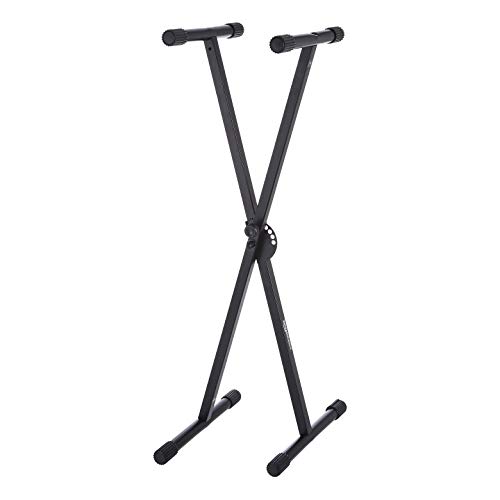 AMAZON BASICS Amazon Basics Keyboard and Piano Stand, Adjustable Height, Portable Single-X-Shape,…
View on Amazon ↗
Listing names and images come from Amazon and are rechecked against the live listings; last checked Nov 8, 2026. No prices shown; the current price is on the listing.
What this guide is. This guide covers keyboard stands as a product type, from frame designs to the measurements that decide fit. It does not evaluate individual models or brands, and no product reviews or in person tests were used. Check the listing for your keyboard's exact dimensions and the stand's folded length before ordering.