Decide by hair texture first: fine hair needs lower, adjustable heat and gentler bristles, while thick or curly hair needs a wider barrel and higher consistent temperature. The second factor is the look you want: smooth waves versus defined curl. The main tradeoff is between gentle, frizz free styling and strong, long lasting curl hold.
Hair Texture Decides the Safety Margin
Fine hair heats quickly and burns at temperatures that thick hair tolerates. Look for a brush with a low setting around 250 to 300 degrees Fahrenheit and variable control. A fixed high temperature on fine hair risks breakage at the root and frizz along the shaft.
Thick or curly hair needs more heat to reshape the hydrogen bonds that hold curl. A brush that reaches 400 degrees Fahrenheit or higher, with a wide barrel to distribute that heat, works better than a narrow barrel that only heats the outer layer.
Short hair does not need a large barrel. A smaller barrel, around 1 inch, lets you work close to the scalp and style the ends without pulling. For short hair, bristle density matters more than heat range.
Barrel Width Sets the Shape, Not the Volume
A 1 inch barrel creates tighter curls and works on short or fine hair. A 1.5 inch barrel gives looser waves and more lift at the root. A 2 inch barrel straightens more than it curls and suits long, thick hair that needs smoothing.
The barrel shape also matters. A round barrel wraps hair evenly. An oval or flat barrel reaches the root more easily and can add volume at the crown, but it creates a softer, less defined curl.
Check the barrel material. Ceramic and tourmaline coatings distribute heat evenly and reduce hot spots. Titanium heats faster and suits thick hair, but can scorch fine hair if the temperature is not controlled.
Bristle Type Is the Real Styling Tool
Nylon bristles are flexible and glide through hair, which reduces breakage on fine or damaged hair. They polish the cuticle for shine but do not grip hair firmly, so curls fall faster.
Boar or mixed bristles grip hair better and create more tension, which makes a stronger curl. They can pull on tangles and feel harsh on fine hair. Some brushes combine short firm bristles with longer soft bristles to balance grip and glide.
Bristle length and density determine how much hair the brush holds. Dense, short bristles wrap more hair per pass and create tighter curls. Sparse, long bristles let hair slip through, which suits smoothing and detangling.
Heat Settings That Prevent Burned Ends
| Heat control | Best for | Damage risk | Curl hold |
|---|---|---|---|
| Fixed high heat | Thick, coarse hair | High on fine hair | Strong but harsh |
| Variable low to high | Mixed or fine hair | Low with correct setting | Adjustable |
| Digital temperature | Precision styling | Lowest when set right | Depends on setting |
| No heat indicator | Any hair with caution | High in practice | Unpredictable |
A brush with a digital display and precise temperature control lets you repeat the same result every time. Without a display, you rely on feel and experience, which is risky on fine or color treated hair.
Look for a heat ready indicator or a fast heat up time. A brush that reaches temperature in under a minute is convenient for daily use. A longer heat up time is acceptable for occasional styling.
Travel Brushes Trade Barrel Size for Portability
A travel heated curling brush is often narrower and lighter than a full size model. The smaller barrel means tighter curls and less coverage per pass, so styling takes longer on long hair.
Check the voltage range before buying for travel. A dual voltage brush works on 110 and 220 volt outlets, which covers most international trips. A single voltage brush may need a converter and can overheat if used abroad.
A travel brush with a folding handle or a heat resistant cap is easier to pack. The cap protects the bristles from bending in a bag and prevents the hot barrel from touching other items.
Ionic Generators Sound Better Than They Work
Many heated curling brushes advertise negative ion technology that claims to seal the cuticle and reduce frizz. In practice, the effect is mild on most hair types. The ions reduce static, but they cannot repair damage or replace heat protectant.
The main marketing claim to ignore is that a brush can curl and straighten equally well. A heated curling brush is best at creating waves and soft curls. It cannot create the flat, sleek finish of a flat iron, and it cannot create the tight, springy curls of a curling wand.
Another marketing term is 'infrared heat.' This claims to heat hair from the inside out, but the effect on styling time and damage is minimal. Focus on the temperature range and bristle design instead.
Long Term Costs Hide in the Bristles
Heated curling brushes do not need replacement parts like filters or blades, but the bristles wear down over time. Nylon bristles can melt or bend if the brush is stored while hot. Bent bristles grip hair unevenly and cause tangles.
Use a heat protectant spray before every pass. The spray is an ongoing cost, but it reduces breakage and extends the life of the brush. Without it, the barrel coating can degrade faster and hair becomes more damaged.
Clean the barrel after each use once it cools. Hair product residue builds up on ceramic and tourmaline coatings, which reduces heat transfer and makes the brush pull. A soft cloth and a little rubbing alcohol remove buildup without scratching the surface.
How to Read a Listing Before Buying
Check the barrel width in inches or millimeters. If the listing does not state it, ask the seller. A brush that looks large in a photo may be only 1 inch in reality.
Confirm the temperature range and whether it is adjustable. A listing that says 'high heat' without a number is a red flag. You need to know the lowest and highest setting to judge safety for your hair type.
Ask about the bristle material specifically. 'Ionic bristles' or 'heat resistant bristles' are vague. You want to know if they are nylon, boar, or a mix, because that determines grip and shine.
Check the cord length and swivel. A short cord or a fixed cord tangles during styling. A 6 to 9 foot cord with a 360 degree swivel is easier to maneuver around the head.
- Barrel width stated in inches
- Temperature range with numbers
- Bristle material named
- Cord length and swivel
- Dual voltage if traveling
Who Should Skip a Heated Curling Brush
If you want tight, defined ringlets, a curling wand or iron is a better tool. A heated curling brush creates loose waves and volume, not the springy curls of a wand.
If you have very thick, coarse, or tightly coiled hair, a heated brush may not get hot enough or grip enough hair to style it in one pass. A flat iron or a specialized curling iron with a clamp works faster.
If you style your hair only for special occasions, a heated brush is not worth the counter space. A basic curling iron costs less and does the same job for occasional use.
For a comparison of ceramic styling tools, see other ceramic straightener guides.
Heated Curling Brush Questions Before You Buy
Is a heated curling brush better than a curling iron?
A heated curling brush is better for loose waves, volume, and a smooth, frizz free finish. A curling iron is better for tight, defined curls and holds them longer. Choose based on the look you want, not on which tool is newer.
What barrel size should I get for fine hair?
For fine hair, a 1 to 1.25 inch barrel works best. A smaller barrel creates tighter curls that add the appearance of volume. A larger barrel pulls fine hair too straight and the curl falls quickly.
Can I use a heated curling brush on wet hair?
No. A heated curling brush is designed for dry hair. Using it on wet hair causes the water to boil inside the hair shaft, which leads to severe damage and breakage. Blow dry your hair completely before styling.
Does a heated curling brush damage hair?
Any heat tool can damage hair if used incorrectly. A heated curling brush with adjustable temperature and a ceramic or tourmaline barrel is less damaging than a flat iron because it distributes heat more evenly. Always use a heat protectant and avoid the highest setting on fine hair.
Which Heated Curling Brush Fits Your Hair
A person with fine or medium hair who wants soft waves should choose a 1 to 1.25 inch barrel with variable heat and mixed nylon bristles. That combination gives shine and volume without burning the ends. For thick, curly hair that needs real hold, pick a 1.5 inch or larger barrel with dense, firm bristles and a high temperature ceiling. If you travel often, narrow the choice to a dual voltage, compact brush with a heat resistant cap.
Real heated curling brush listings, so you can check the points in this guide against actual products. These are affiliate links: as an Amazon Associate we earn from qualifying purchases, at no extra cost to you.
 DAN TECHNOLOGY DAN Thermal Brush,Heated Round brush, 1.5 Inch Ceramic Curling Brush…
View on Amazon ↗
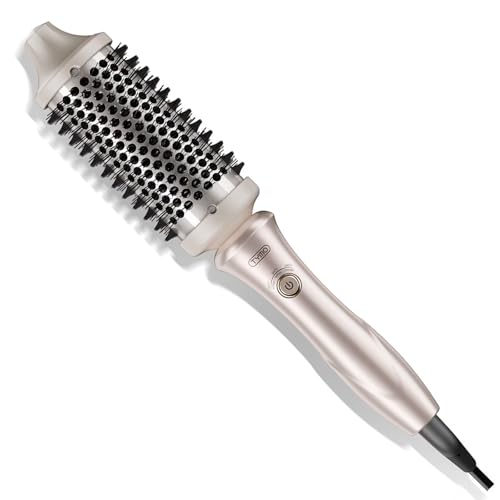 TYMO TYMO Thermal Brush Curling Brush, STYLUX 1.7" Heated Round for…
View on Amazon ↗
 ALURE Alure Heated Styling Brush, 3-in-1 Ionic Hair Curler and Straightener…
View on Amazon ↗
Listing names and images come from Amazon and are rechecked against the live listings; last checked Nov 8, 2026. No prices shown; the current price is on the listing.
Scope and limits. This guide covers the heated curling brush category in general, written from knowledge of how these tools work. It does not draw on reviews of individual models or in person testing, so confirm the barrel width, temperature range, and bristle material on the product listing before you buy.