Start with your cookware and your outlet. Induction only heats magnetic pans, so confirm compatibility before anything else. Next, match power to your circuit: most countertop burners need a dedicated 15 amp outlet. Finally, decide if you need simple knob controls or precise temperature settings. The main tradeoff is speed and safety versus the need for specific pans and enough electrical capacity.
Your Pans Decide If This Works at All
Induction heats the pan directly through a magnetic field, so the burner only works with cookware a magnet will stick to. Cast iron, enameled cast iron, and most stainless steel pans with a magnetic base work well. Aluminum, copper, glass, and some ceramic pans will not heat up.
Check your existing pans before you buy. Hold a fridge magnet to the bottom of each pan. If it holds firmly, the pan will work. If the magnet slides off or barely clings, that pan will not heat on induction.
Many listings say 'induction compatible' but that only means the pan has a magnetic layer, not how well it heats. Pans with a thin magnetic disc can heat unevenly or make noise. Thicker, fully clad stainless or cast iron gives the most even results.
Power Draw Is the Hidden Gatekeeper
Most countertop induction burners draw between 1300 and 1800 watts. A standard US kitchen outlet is 15 amps, which safely delivers about 1800 watts at 120 volts. Plugging a high power burner into an outlet shared with a microwave or toaster can trip the breaker.
Check the outlet you plan to use. If it is on a circuit with other appliances, look for a burner with a lower wattage setting or plan to use only one appliance at a time. Some burners let you limit maximum power in the settings, which helps in older homes.
A burner that lists 1800 watts often pulls that only at the highest setting. Lower settings use less power, so you can cook at medium heat even on a shared circuit if you do not max it out.
Extension cords are a common mistake. Most manuals say to plug the burner directly into a wall outlet. A thin cord can overheat and reduce power to the burner.
The Three Control Styles and What They Change
| Control style | How it feels | Cleanup effort | Suits |
|---|---|---|---|
| Single knob or dial | Familiar, quick to adjust | Low, one smooth surface | Simple one pan meals |
| Touch panel with levels | Precise steps, slight learning | Medium, flat glass to wipe | Sauces and simmering |
| Preset programs and timer | Set and forget, less flexible | Medium to high, more buttons | Meal prep and busy cooks |
| Commercial style with probe | Exact temperatures, complex | High, many parts to clean | Technique focused cooking |
Knob controls are the easiest to use without looking, but they rarely offer exact temperatures. Touch panels give you wattage or temperature steps, which matters for melting chocolate or keeping a sauce just below a boil. Preset programs for boil, simmer, or warm can save time but lock you into the manufacturer's idea of each setting.
A temperature probe or external sensor adds precision for frying or sous vide style water baths, but it is one more item to store and clean. For most home cooking, a power level knob or a simple touch panel is enough.
Small Kitchens and Tight Counters
A countertop induction burner earns its place by replacing a full stove or adding a second cooking zone where space is short. Look at the footprint: many models are around 11 to 14 inches wide, but the cord and clearance for airflow add a few more inches.
The burner needs air space on all sides, especially underneath and at the vents. Do not set it on a towel or directly against a backsplash. A smooth glass top is easy to wipe, but it scratches if you slide rough cast iron across it.
For studio apartments or dorm rooms, check whether the building allows cooking appliances. Some dorms ban open coil burners but allow induction because the surface stays cool. A burner with a child lock or auto shutoff adds safety in tight shared spaces.
Weight matters less than you might expect. A heavier unit feels stable when you stir, but a light one is easier to move into a cabinet after cooking. If you plan to store it away, look for a cord that wraps neatly or detaches.
Meal Prep, Families, and One Person Meals
A single induction burner is naturally limited to one pot at a time, so it suits one person meals and small batches best. For a family dinner, you can still cook in stages: sear meat, set it aside, then cook vegetables in the same pan. The fast heat recovery makes this less painful than on a weak electric coil.
Weekly meal prep works if you plan one pot dishes: soups, stews, rice bowls, or a large batch of sauce. If you need to boil pasta and simmer sauce at the same time, you will want two burners or a full range.
Busy families often use a countertop burner as a second cooking zone during holidays or when the main stove is full. It can keep a pot of soup warm on the counter while the oven finishes a roast. Just make sure the outlet can handle the load.
College students and renters benefit from the portability. A burner can move from a dorm desk to a shared kitchen, but it should not be the only heat source if you cook large meals regularly.
What to Check in a Listing Before You Buy
Start with the wattage and the plug type. A 1800 watt burner needs a standard grounded outlet, but a 1500 watt burner is easier on old wiring. The listing should state the voltage, usually 120 volts for the US.
Look for the pan detection feature. Most induction burners only turn on when a compatible pan is on the surface, and they shut off when you lift the pan. This is a safety feature, but some cheap burners have a delay or a small minimum pan size that excludes tiny milk frothing pitchers.
Check the maximum pan diameter. Many burners list a minimum and maximum, often 4 to 10 inches. A 12 inch skillet may overhang and heat only the center, leaving cool edges. If you cook with a wide pan, confirm the listed coil size.
Noise is rarely in the listing but follows from the design. The internal fan runs whenever the burner is on, and some pans buzz at high power. Thinner pans and higher settings make more noise. A burner with a quiet fan mode or a lower default fan speed helps in open kitchens.
Care and Long Term Costs
The glass top needs a non abrasive cleaner and a soft cloth. Burnt on sugar or melted plastic should be scraped off while warm with a razor scraper made for glass cooktops. Do not use steel wool or heavy scrubbing pads.
The air vents collect dust and grease over time. Wipe them with a dry cloth or a vacuum brush attachment every few weeks. Blocked vents cause the burner to overheat and shut down mid cook.
There are no consumables like filters or coils to replace in most home burners. The main long term cost is electricity, which is often lower than a traditional electric coil because induction wastes less heat. The burner itself may last many years if the electronics stay cool.
Some burners have a replaceable power cord, which is worth checking if you move often or have pets that chew cords. Most cords are fixed, so treat the cord gently and unplug by the plug, not the cord.
Features That Matter and Marketing That Does Not
Features that genuinely change your cooking: power levels with fine steps, a timer that shuts off the heat, pan detection, and a stable, flat surface. A timer is especially useful for boiling eggs or simmering stock while you do something else.
Marketing that matters less: 'digital display with 20 presets' often just means the same power levels relabeled as food types. 'Fast boil' is true of all induction, not a special feature. 'Energy saving' is also inherent to the technology, not a differentiator.
A countdown timer that beeps is useful, but a timer that only flashes a light is easy to miss. Check whether the timer turns the burner off or just alerts you. Auto shutoff after a set time is a safety feature worth having for forgetful cooks.
Child lock and overheat protection are standard on most units, but the quality varies. A child lock that requires holding two buttons for three seconds is less annoying than one that resets every time you lift the pan.
Mistakes That Lead to a Return
The most common mistake is buying the burner before checking the pans. A beautiful set of copper or anodized aluminum cookware will not work, and the buyer blames the burner. Test every pan you plan to use with a magnet first.
Another mistake is expecting the burner to run on a shared outlet at full power. A 1800 watt burner on a circuit with a toaster oven will trip the breaker every time. Find the outlet's circuit or choose a lower wattage model.
Some buyers buy the smallest, cheapest burner and then complain it is slow. Power level matters more than size. A 1300 watt burner takes noticeably longer to boil a large pot of water than an 1800 watt one.
Finally, do not assume a burner with a 'temperature' setting actually measures the pan temperature. Most use a power level estimate, so a '250 degree' setting may not hold a real 250 degrees. A separate infrared thermometer or a probe model gives true control.
Countertop Induction Burner Questions Before You Buy
Is a countertop induction burner worth it for a small kitchen?
Yes, if you have magnetic cookware and a reliable outlet. It adds a fast, safe cooking zone without the heat and bulk of a full range. It is not a full replacement for a stove if you cook multiple dishes at once, but it works well as a primary burner for one or two people.
Which countertop induction burner is best for a college dorm?
Look for a compact 1300 to 1500 watt burner with a child lock and auto shutoff. Check your dorm rules first: some ban all cooking appliances, while others allow induction because the surface stays cool. A lighter unit with a short cord is easier to store on a desk shelf.
What is the minimum pan size for a countertop induction burner?
Most burners require a pan at least 4 to 5 inches in diameter to activate. Anything smaller, like a tiny butter warmer or espresso milk pitcher, may not trigger the sensor. Check the listing for the stated minimum and maximum pan diameter before buying.
Can I use a countertop induction burner on a 15 amp circuit?
Yes, but do not run another high wattage appliance on the same circuit at the same time. A 1800 watt burner uses the full capacity of a 15 amp circuit. A 1500 watt burner leaves a little headroom for a refrigerator or lights on the same circuit.
Does a countertop induction burner make noise?
Most burners have an internal cooling fan that runs while cooking, and some pans buzz or hum at high power. Thinner pans and higher settings make more noise. A burner with a quiet fan mode or a heavier pan can reduce the sound, but some fan noise is normal.
Which Countertop Induction Burner to Pick
Someone cooking for one or two in a small kitchen should pick a simple 1500 to 1800 watt burner with a knob or basic touch panel and no extra probes. It will heat fast, clean easily, and fit a standard outlet. If you regularly boil large pots of water or cook for a family, choose a higher wattage model with a timer and a wider coil area, and plan to use it on a dedicated outlet.
Real countertop induction burner listings, so you can check the points in this guide against actual products. These are affiliate links: as an Amazon Associate we earn from qualifying purchases, at no extra cost to you.
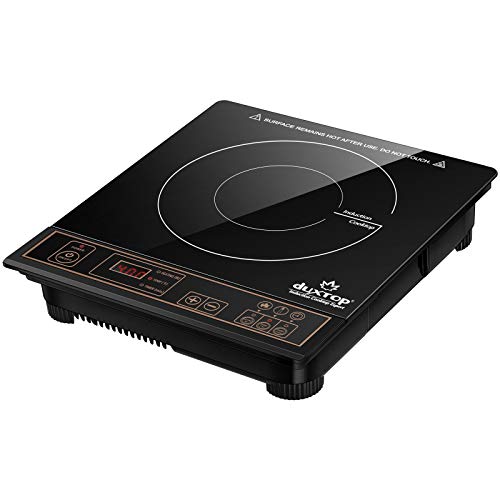 DUXTOP Duxtop 1800W Portable Induction Cooktop Countertop Burner, Gold 8100MC |…
View on Amazon ↗
 CHANGBERT ChangBERT Portable Induction Cooktop 1800W NSF Certified Commercial Range Powerful…
View on Amazon ↗
 NUWAVE Nuwave Double Pro Cooktop Induction Countertop Burner, Portable, 50°F-575°F |…
View on Amazon ↗
Listing names and images come from Amazon and are rechecked against the live listings; last checked Nov 8, 2026. No prices shown; the current price is on the listing.
About this guide. This guide covers the countertop induction burner category as a whole, not any specific model. It is written from general knowledge of how induction cooking works and what affects the experience; no individual product documents, reviews, or tests were used. Always verify the listed wattage, pan size range, and plug type on the product page before buying.