Focus on three things: glaze quality, wall thickness, and base shape. A fully glazed, medium thick dish with flat sides resists thermal shock and cleans easily. Thin or unevenly glazed dishes crack under broilers or sudden temperature changes. Buy for your oven size and how you cook, not for a brand name.
Glaze Is the First Thing to Check
Look for a listing that says fully glazed, inside and out. A glaze seals the porous ceramic body. Without it, the dish absorbs water, oils, and odors, and it stains after one lasagna.
Check the bottom edge. Many dishes have an unglazed rim where they sat in the kiln. That is normal, but the unglazed strip should be narrow and smooth. Wide rough patches catch grease and become impossible to clean.
Crazing is a network of fine cracks in the glaze. It can happen over time, but a new dish should not show it. Crazing traps bacteria and weakens the surface. If a listing photo shows a crackled finish, treat that as decorative, not functional.
A shiny glaze is easier to wipe clean, but a matte glaze hides scratches. Neither is better. The key is that the glaze covers the entire cooking surface without pinholes or thin spots.
Wall Thickness Decides Thermal Shock Resistance
Ceramic breaks when one part heats faster than another. Thicker walls hold heat longer but are more prone to thermal shock if heated unevenly. Very thin walls heat quickly but chip and crack under a broiler.
Look for a medium, even thickness, around 6 to 10 millimeters. Run your finger along the rim in a store, or compare side views online. A dish that is thick at the base but thin at the walls will crack where the thickness changes.
Avoid dishes with dramatic thickness changes, like a heavy base attached to thin decorative walls. That junction is a stress point. Handles should be solid, not hollow, because hollow handles crack off after repeated oven cycles.
Thermal shock resistance is not about the clay alone. It is about how evenly the whole dish expands. A dish with uniform walls can go from freezer to a preheated oven more safely, though no ceramic dish should go straight from freezer to broiler.
Base Shape Changes How Food Browns
A wide, flat base exposes more food to the oven's heat. That means crispier edges on a gratin or roasted vegetables. A deep, narrow dish steams food because moisture cannot escape fast enough.
For casseroles, a depth of 5 to 8 centimeters works well. Anything deeper and the middle stays wet while the top burns. Anything shallower and the dish behaves like a baking sheet, which is fine for roasting but not for saucy dishes.
Corners matter. Rounded corners are easier to clean by hand and less likely to crack because stress spreads evenly. Sharp square corners look neat but trap food and concentrate stress, which is where cracks often start.
Oval dishes brown food in the center more slowly than rectangular ones because the distance from the edge varies. If you often reheat single portions, a small square or round dish gives more even results than a large oval.
How to Read a Listing Without Seeing the Dish
First, check the dimensions, not just the capacity. A 2 quart dish can be shallow and wide or narrow and deep. The photo often makes the dish look bigger than it is, so compare the stated length and width to a pan you already own.
Look for the words 'fully vitrified' or 'high fired'. Vitrified ceramic has been fired hot enough that the clay particles fuse into glass. That makes it less porous and stronger. If the listing does not mention firing temperature or says 'earthenware', expect a softer, more fragile dish.
Ask the seller two questions if the listing is vague: 'Is the bottom fully glazed?' and 'What is the maximum safe oven temperature?' A good ceramic dish is safe to at least 230 degrees Celsius. If the seller cannot answer, move on.
Weight is a useful signal. A heavy dish for its size usually means thicker walls and denser clay. A very light dish is either thin or made from a lower fired clay. Neither is automatically bad, but weight tells you what kind of thermal behavior to expect.
| Design | Glaze coverage | Wall thickness | Browning | Best for |
|---|---|---|---|---|
| Glazed stoneware | Full inside and out | Medium, even | Good, with hot spots | Everyday casseroles |
| Unglazed terracotta | None or partial | Thick, uneven | Excellent, but sticks | Slow roasting, bread |
| Porcelain | Very smooth, full | Thin, even | Fair, edges may scorch | Light gratins, reheating |
| Deep casserole | Full, but corners rough | Medium to thick | Top browns, middle steams | Layered dishes, braises |
The table shows why two dishes with the same capacity can cook differently. A glazed stoneware dish is the safest starting point because it balances cleanup and browning.
What Actually Matters Versus What Is Marketing
Lead free and cadmium free labels matter, but only if the dish is imported from a region with weak safety rules. In the US and EU, any dish sold as food safe must meet lead limits. If the listing emphasizes 'lead free' as a headline feature, treat it as a basic requirement, not a differentiator.
Oven to table is a real feature, but it means the dish looks good enough to serve from. That is about shape and color, not performance. If you always decant food onto plates, skip the premium you pay for a pretty exterior.
Freezer safe and microwave safe are useful but not universal. A dish can be oven safe but crack in a microwave if it has metallic glaze accents. Check each use case separately rather than assuming one safe label covers all.
Dishwasher safe is convenient, but frequent dishwasher cycles dull the glaze and speed up crazing. Hand washing with a non abrasive pad keeps the surface intact longer, which matters more for a dish you use weekly.
Who Should Skip Ceramic and Use Something Else
If you cook on an induction cooktop, a ceramic baking dish will not work directly on the burner. Ceramic is not ferromagnetic. You need a metal pan or an induction interface disc, and even then the dish heats slowly and unevenly.
For high heat searing or broiling at maximum temperature, cast iron or carbon steel is a better tool. Ceramic is for moderate, even heat. It cannot handle direct flame or a stovetop burner, and it will crack if you try.
If you drop things often or have a cramped kitchen with stone countertops, consider a metal or enameled steel baking dish. Ceramic is heavy and brittle. One knock against a faucet can chip the rim and create a sharp edge.
For very large batches or meal prep, glass or metal pans are lighter and easier to stack. Ceramic dishes take up more cabinet space for the same capacity, which matters in a small apartment kitchen.
Mistakes That Shorten a Ceramic Dish's Life
The biggest mistake is putting a cold ceramic dish into a hot oven. Always let the dish come to room temperature first, or put it in a cold oven and let it heat together. Sudden temperature change is the number one cause of cracks.
Never put a hot ceramic dish on a wet countertop or a cold metal trivet. The thermal shock from the bottom can crack the base. Use a dry wooden board or a folded towel instead.
Do not use metal utensils on a glazed surface. Metal leaves gray marks that are almost impossible to remove and can chip the glaze. Use wood, silicone, or nylon tools.
Avoid drastic temperature swings in the other direction too. Do not run cold water over a hot dish to cool it quickly. Let it cool naturally on a dry surface before washing.
Long Term Costs Are Mostly About Replacement
A good ceramic baking dish has no consumable parts. It does not need seasoning like cast iron or replacement seals like a pressure cooker. The only ongoing cost is your time spent hand washing if you want to extend its life.
The real long term cost is replacement. A cheap dish that crazes or cracks after a year costs more per use than a mid range dish that lasts a decade. Compare the price to how often you bake, not to the sticker alone.
Storage matters. Stacking heavy dishes directly on top of each other can chip the glaze at contact points. If cabinet space is tight, place a thin cloth or paper towel between stacked dishes.
Small Kitchens and Apartment Use
Measure your oven before you buy. A dish with handles can be 5 to 8 centimeters wider than its stated baking surface. In a small apartment oven, that extra width can block air circulation and cause uneven browning.
A square dish is more space efficient than an oval or round one in a small oven. It uses the corners of the rack and leaves more room for a second dish. If you often cook for one or two, look for a dish in the 1 to 1.5 quart range.
For beginners, a single medium rectangular dish around 2 quarts is more useful than a set of three. It handles most casseroles, gratins, and roasted vegetables. You learn how ceramic behaves before you invest in more shapes.
If counter space is tight, look for a dish with low sides that can double as a serving platter. It saves you from washing a separate serving dish, which matters when you have a small sink.
Ceramic Baking Dish Questions Worth Asking Before You Buy
Is ceramic baking dish safe for the oven?
Yes, if the listing says oven safe and you follow the temperature limit, usually around 230 degrees Celsius. Do not put a cold dish in a hot oven or use it under a broiler at maximum heat. Check for metallic accents, which can spark in a microwave or overheat in a conventional oven.
What is the difference between stoneware and earthenware?
Stoneware is fired at a higher temperature, which makes it denser, less porous, and stronger. Earthenware is fired lower, so it is lighter, more porous, and more likely to chip or absorb water. For a baking dish that sees frequent use, stoneware or porcelain is the safer choice.
How do I know if a ceramic baking dish is good quality?
Check three things: full glaze coverage inside and out, even wall thickness with no sharp transitions, and a flat, wide base. A heavy dish for its size usually means dense clay and thick walls. Avoid dishes with visible pinholes in the glaze or rough unglazed patches on the cooking surface.
Can I use a ceramic baking dish on an induction cooktop?
No. Ceramic is not magnetic, so an induction burner will not heat it directly. You could use an induction interface disc, but the dish heats slowly and unevenly that way. For induction cooking, use a metal pan and reserve the ceramic dish for the oven.
Which ceramic baking dish size is best for a small family?
A 2 to 2.5 quart rectangular dish is the most flexible size for two to four people. It handles a casserole, a gratin, or roasted vegetables without being too heavy. If you often cook for one, a 1 to 1.5 quart square or round dish is easier to store and heats more evenly.
Which Ceramic Baking Dish to Pick for Your Kitchen
For a home cook who bakes a casserole or gratin once or twice a week, a medium weight, fully glazed stoneware dish in a rectangular shape around 2 quarts is the safest starting point. It browns evenly, cleans without much effort, and tolerates normal oven use. If you roast vegetables at high heat more than you bake saucy dishes, choose a shallow, wide porcelain dish instead, because it gives crisper edges without the weight.
Real ceramic baking dish listings, so you can check the points in this guide against actual products. These are affiliate links: as an Amazon Associate we earn from qualifying purchases, at no extra cost to you.
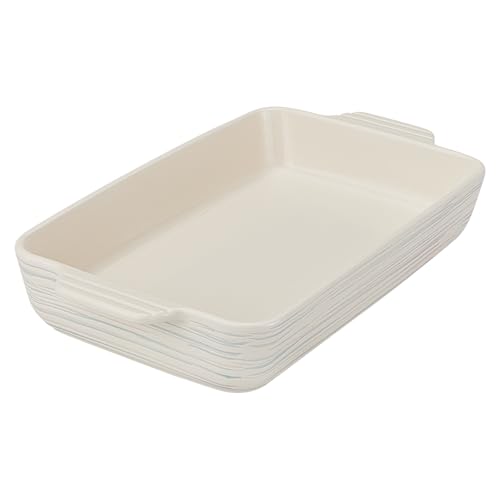 PYREX Pyrex 2QT (7" x 11") Rectangular Ceramic Baking Dish with…
View on Amazon ↗
 LIUYWYHCF LIUYWYHCF Ceramic Casserole Baking Dish, 2 Quarts Baking Dish for…
View on Amazon ↗
 DOWAN DOWAN 8x8 Baking dish, Square Baking Pan, Ceramic Casserole Dishes…
View on Amazon ↗
Listing names and images come from Amazon and are rechecked against the live listings; last checked Nov 8, 2026. No prices shown; the current price is on the listing.
What this guide is. Use this guide as a checklist to hold against any listing you open, not as a verdict on a particular model. It is written from general knowledge of ceramic bakeware, not from testing individual products, so always confirm the dimensions and glaze details on the product page.