Focus on sensor placement, reading speed, and how you will use it at night. Rectal readings stay the reference for infants under three months, while ear and forehead models trade a little accuracy for speed and less fuss. The main tradeoff is convenience versus the confidence to act on a borderline number.
Sensor placement changes what the number means
A temperature is not one number. The reading changes with where you measure. For a baby under three months, rectal is the standard doctors refer to because it tracks core temperature most closely. Ear and forehead readings are quicker, but they measure surface or canal heat, so a normal range can differ by a degree or more.
Check what range the listing uses for fever alerts. Some devices adjust the displayed number to a rectal equivalent, others do not. If the listing does not say, ask the seller. A forehead reading of 100.4°F may mean something different from a rectal reading of the same number.
For a crawling baby, a forehead or ear model avoids the need to hold still. For a newborn, the extra minute a rectal reading takes is usually worth it. First time parents often do best with one rectal option for the first months and a faster forehead or ear model for later toddler checks.
Read speed matters more than extra memory slots
Marketing often lists memory slots, color coded fever indicators, and app syncing. Those rarely change the result. What changes the result is how long the sensor needs to get a stable reading. A slower device can give a wrong number if the baby moves before it finishes.
Compare the listed read time. Forehead and ear models often read in one to three seconds. Oral and rectal models can take longer, especially if the tip needs to sit in place. For night time use, a fast read means fewer wake ups.
Ignore features that do not affect the reading: fever history apps, multiple user profiles, or voice prompts. A backlit display and a quiet mode do more for a tired parent than any app.
Night time use decides the design you will actually reach for
At 2 a.m. You want a display you can read without turning on a lamp, a probe that does not need much aiming, and no loud beep that wakes the room. Some models have a silent mode or a soft glow. Others beep at full volume and light up like a flashlight.
Check the listing for a backlit display and a mute option. If it does not mention either, assume they are not there. A forehead model is often the easiest for a dark room because you do not need to insert anything. An ear model needs a steady hand and a clear view of the canal.
For rental homes or travel, a compact forehead model with a hard case is simple to pack. For a nursery, a wall mounted or bedside holder can keep the device where you expect it. The design should match the room where you will use it most.
Probe shape and tip cover affect consistency
A flexible tip on a rectal model is easier to insert safely. A rigid tip can be uncomfortable and may give a lower reading if it touches the wall of the rectum instead of resting in the center. For ear models, the probe shape decides whether it fits a small ear canal or sits too far out.
Disposable tip covers are a recurring cost and a hygiene factor. A model that works without them saves money over time, but you then need to clean the tip after every use. Check whether the listing includes a starter pack of covers and what a refill costs.
This is the part most likely to be cleaned incorrectly. A probe wiped with a dry cloth can carry residue that changes the next reading. Follow the cleaning method in the listing. Some tips can be rinsed, others only wiped with alcohol.
Compare the design types before you pick one
| Design | Best age | Read speed | Night ease | Main limit |
|---|---|---|---|---|
| Rectal | Under 3 months | Slow | Poor | Needs a calm, still baby |
| Ear | 6 months and up | Fast | Fair | Aiming and wax can skew it |
| Forehead | Any age | Fast | Good | Reads surface, not core |
| Oral | 4 years and up | Medium | Poor | Must stay under the tongue |
For a first time parent, a rectal model plus a forehead model covers the newborn and toddler stages well. For a toddler who fights every check, a forehead model is the least stressful. For a rental home or travel kit, pick the one that is easiest to clean without a full sink setup.
The listing checks that catch a misleading model
Look for the stated accuracy range, not just the read time. A listing that says 'accurate to within 0.2°F' tells you more than one that says 'clinically accurate'. Check whether the accuracy applies to all modes or only one sensor position.
Ask the seller two things: what is the recommended age range for each mode, and does the display show a rectal equivalent or a raw reading? If they cannot answer, the listing is likely thin on real information.
Also check the battery type. A model with a common coin cell or AAA battery is easier to replace at night than one with a sealed rechargeable cell. If the battery dies and you cannot swap it quickly, the device is useless until it charges.
If you already use other baby health tools, the same approach applies to choosing a nasal aspirator or a baby nail trimmer: check the part that touches the baby and the effort to clean it.
When a baby thermometer is the wrong tool
If your baby is under three months and has a fever, a home reading is only a first step. You should call a doctor rather than rely on repeated checks. A thermometer cannot tell you how serious the illness is, only whether the number is above a threshold.
For a child who will not stay still for any inserted probe, a continuous wearable monitor may suit better, but it tracks trends, not a single clinical reading. For a quick check before daycare or a visit, a forehead model is enough. For a medical decision, use the method your pediatrician recommends.
Also skip a thermometer that requires a smartphone app to show the reading if you are often without your phone nearby. A standalone display is more reliable at night and in a rental home with unfamiliar Wi-Fi.
Care and recurring costs few buyers plan for
Tip covers are the main consumable. A pack of 40 may last a few months if you check twice a day during an illness. If the model needs its own brand of covers, you are locked into that cost. Check the refill price before you buy.
Cleaning is the other long term cost. A model with a sealed, waterproof tip can be rinsed under running water. A model with a seam or a battery door near the tip may only tolerate a wipe. A cracked or fogged display after cleaning is a common failure.
Batteries are a small but real cost. A model that uses a standard AAA cell is cheaper to run than one with a specialty cell. A rechargeable model saves battery purchases but adds a charging cable to keep track of.
Baby Thermometer Questions Parents Ask at 2 A.M.
What is the most accurate way to take a baby's temperature?
For a baby under three months, a rectal reading is the most accurate and the one doctors typically ask for. For older babies, an ear or forehead reading is close enough for a quick check, but the number is not the same as a core temperature. Use the same method each time so you can compare changes.
Is a forehead thermometer accurate for a baby?
A forehead thermometer measures surface heat, so it can read lower or higher than a core temperature. It is accurate for spotting a trend, but not for a borderline fever decision. Room temperature, sweat, and distance from the skin all change the result. Check the listing for the stated accuracy range.
Which baby thermometer is best for night time use?
A forehead model with a backlit display and a silent mode is the easiest to use in a dark room. You do not need to insert anything or hold the baby still. Look for a soft glow rather than a bright light, and check that the buttons are easy to find by touch.
Can I use the same thermometer for a baby and an adult?
Yes, but the normal range and the best sensor placement change with age. A rectal tip for a baby should not be used orally for an adult without thorough cleaning, and vice versa. Many families keep two devices: one for the baby and one for everyone else.
How do I know if a baby thermometer reading is a real fever?
The threshold depends on the method. A rectal reading of 100.4°F or higher is a fever for a baby under three months. A forehead or ear reading may have a different threshold, often listed in the device manual. When in doubt, confirm with a rectal reading and call your pediatrician.
The Thermometer Pick That Fits Your Baby's Stage
A parent with a newborn needs a rectal model for the first months, even if it is slower. Add a forehead model for quick night checks and toddler tantrums. If you live in a rental or travel often, a compact forehead model with a hard case and standard batteries is the one to pack. For a toddler who fights every check, skip the inserted probes and keep a forehead model on the changing table.
Real baby thermometer listings, so you can check the points in this guide against actual products. These are affiliate links: as an Amazon Associate we earn from qualifying purchases, at no extra cost to you.
 BRAUN Braun Sensian 7 Forehead 3-in-1 Non-Contact Infrared Thermometer | Age…
View on Amazon ↗
 @AL21 @AL21 Baby Thermometer, Digital Ear & Forehead Thermometer for Adults,…
View on Amazon ↗
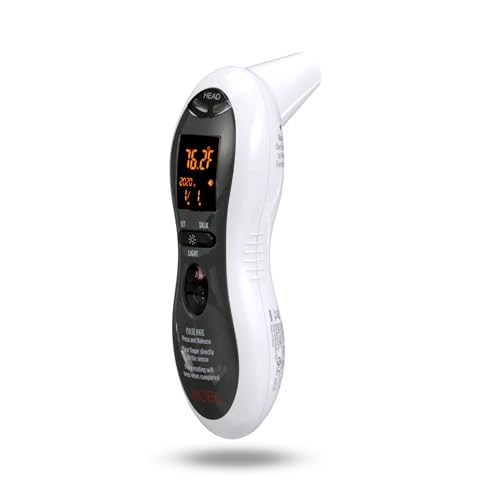 MOBI Digital Ear Forehead Thermometer for Baby, Kids & Adults |…
View on Amazon ↗
Listing names and images come from Amazon and are rechecked against the live listings; last checked Nov 8, 2026. No prices shown; the current price is on the listing.
Scope and limits. This guide comes from general knowledge of how baby thermometers work, not from testing specific models or reading individual product documents. Check the listing for the stated accuracy, cleaning method, and tip cover refill cost before you buy.