Start with where you sit: tabletop easels suit miniatures and small works, floor stands handle large canvases. Then check tilt range and grip strength, because watercolor needs near flat angles while acrylic wants vertical reach. The main tradeoff is stability versus portability: heavy wood holds big canvases steady, light aluminum folds down for outdoor sketching.
Where You Paint Decides the Height
Measure the height of your chair, desk, or standing spot before you compare easels. A tabletop easel raises the canvas only 12 to 18 inches above the table, so your eye line stays low. That works for miniatures, small panels, and kids crafts at a kitchen table.
Floor easels put the canvas center between roughly 45 and 70 inches from the floor. If you stand while painting, look for a maximum canvas height near your eye level. Sitting painters need a lower range, often 40 to 55 inches.
Outdoor sketching changes the height question. A field easel with telescoping legs works on uneven ground and folds to a short bundle. But those legs often have a narrow stance, so a big canvas catches wind and wobbles.
Check the listed maximum canvas height, not just the easel height. Some floor stands claim 72 inches but only hold a 24 inch canvas. Compare that number to the canvas size you actually use.
Tilt Range Follows Your Medium
Watercolor and gouache need a nearly flat board, often 0 to 20 degrees from horizontal. A steep easel makes wet washes run down the page. If you paint loose washes, skip easels whose minimum tilt is already 30 degrees.
Acrylic and oil painters usually work at 60 to 90 degrees, nearly vertical. That keeps the canvas at eye level and reduces glare from a window. A vertical position also changes brush control, so try a few angles if you switch media.
Mixed media artists should look for a tilt range that covers both ends. Some easels offer ratcheted notches, others a continuous friction lock. Continuous adjustment gives more control, but notches hold position better over a long session.
Check whether the tilt lock is a knob, a wing nut, or a ratchet. Knobs are easiest to adjust one handed. Ratchets are quick but only stop at fixed angles.
For pastel work, a slight forward tilt helps dust fall away from the painting. For oil, a slight backward tilt can reduce glare from overhead lights.
Clamps and Ledges Hold the Canvas Still
The bottom ledge carries most of the canvas weight. It should be at least as wide as your thickest stretcher bar, usually 1.5 to 2 inches. A narrow ledge lets a heavy canvas tip forward.
Top clamps or sliding brackets grip the canvas edge. Spring loaded clamps work for thin panels and watercolor blocks. Screw clamps hold thicker stretchers more firmly.
For tabletop miniatures, a flat board with a lip is often enough. For a 30 by 40 inch canvas, look for a top clamp that adjusts at least 4 inches vertically.
Some easels use a center mast instead of side clamps. That frees the sides of the canvas, but a heavy panel can torque the mast. Check the mast thickness on the listing.
If you paint on cradled wood panels, make sure the clamp opens wide enough for the panel depth. Many clamps top out around 1 inch.
Studio Frames Versus Field Tripods
H frame studio easels have four legs and a wide base. They hold 48 inch canvases without shaking, and many include a crank for height. The tradeoff is weight: a solid H frame often weighs 25 to 40 pounds and takes up floor space.
A-frame wood easels are lighter but still stable for medium canvases. They fold flatter than H frames and usually cost less. Their rear leg extends to change the tilt.
Aluminum field easels prioritize weight. Some weigh under 3 pounds and fold to 20 inches. The legs are thin, so they suit watercolor blocks, small panels, and quick sketches rather than heavy acrylics.
Tabletop box easels combine storage and support. They open into a small easel with drawers for brushes and tubes. That is convenient for a small desk, but the canvas height is limited to about 16 inches.
Hybrid convertible easels adjust from tabletop to floor height. They offer flexibility for a shared space, but the joints add play. Tighten every knob before you buy if the listing shows one.
| Easel style | Canvas height | Stability | Portability | Best medium |
|---|---|---|---|---|
| Tabletop box | Up to 16 in | Good on a desk | Very high | Miniatures, kids crafts |
| Aluminum field | Up to 24 in | Low on uneven ground | Very high | Outdoor watercolor |
| A-frame wood | Up to 36 in | Good for medium work | Moderate | Acrylic, oil |
| H frame studio | Up to 48 in | Excellent | Low | Large canvas, oil |
Pick the frame style after you know your canvas size and whether you travel. A studio H frame is overkill for a 9 by 12 inch watercolor block, and a field tripod is frustrating under a 30 inch canvas.
Materials That Matter and Specs That Do Not
Solid beech or oak resists flex and lasts for decades. Pine is lighter and cheaper, but the clamp threads can strip if you overtighten them. Check the listing for the wood species rather than just 'hardwood'.
Powder coated aluminum resists rust, which matters for outdoor sketching. Bare steel hardware can corrode near the coast or in a damp studio.
Ignore marketing phrases like 'professional grade' or 'museum quality'. They do not describe a measurable feature. Instead, look for a stated maximum canvas weight or height.
A built in drawer or tray is useful, but it adds weight to a field easel. For studio use, a separate rolling cart often works better than a cramped easel drawer.
Quick release leg locks matter more than the number of leg sections. Cheap flip locks slip over time. Twist locks hold better but take longer to set up.
The carry weight listed often excludes the tray and clamps. Weigh the extras mentally before you assume a field easel is light.
Mistakes That Send an Easel Back
Buying for the largest canvas you hope to paint someday, not the one you use now. A 48 inch H frame in a small apartment dominates the room and rarely gets set up.
Ignoring the minimum tilt. Watercolor painters who buy a vertical only easel end up propping the board with books.
Assuming all floor easels adjust for sitting. Some only go down to 50 inches at the canvas center, too high for a chair.
Choosing a field easel for indoor acrylic work. The light legs and small ledge cannot hold a heavy stretched canvas without shaking.
Skipping the clamp range check. A 2 inch deep cradled panel will not fit a clamp that opens only 1 inch.
Forgetting door widths. A wide H frame may not fit through a 28 inch doorway, which matters if you move it between rooms.
When to Skip an Easel Entirely
Kids crafts on a kitchen table rarely need a dedicated easel. A simple tabletop drawing board or a non slip mat costs less and stores flatter.
Some adult beginners paint small watercolor postcards or sketchbook pages. A lap board or a 9 by 12 inch clipboard style support may be enough for the first months.
If your main goal is tabletop miniatures, a painting handle or a small angled stand often beats a full easel. Miniatures are painted close up, often under a magnifier, and a tall easel puts them too far away.
Consider an alternative when you paint only occasionally and space is tight. A wall mounted panel with a ledge can hold a canvas, and it folds against the wall when not in use.
For outdoor oil painting, a pochade box mounted on a camera tripod offers a palette, brush holder, and panel support in one. It replaces a field easel if you paint small panels.
See the arts and crafts department overview for related storage and workspace ideas.
Read the Listing Like a Painter
Check the maximum canvas height and the minimum and maximum tilt in degrees. If those numbers are missing, ask the seller before you buy.
Look at the clamp type in the photos. Spring clamps are quick for thin boards. Screw clamps hold heavy stretchers. A center mast changes how the canvas balances.
Ask the seller for the weight of the easel with all parts attached, not the boxed shipping weight. A 3 pound field easel can become 5 pounds with a tray and clamps.
Check the folded length if you plan to carry it. Some field easels fold to 20 inches, others to 26. That difference decides whether it fits a backpack.
Look for the wood species or metal type in the specifications. 'Solid wood' can mean soft pine. 'Aluminum alloy' can be thin tubing.
Compare the base width, not just the height. A 24 inch wide H frame resists tipping better than a 16 inch wide A-frame at the same canvas height.
For studio use, check whether the casters or floor pads are included. Rubber feet protect wood floors. Casters help if you move the easel daily.
Long Term Costs Beyond the Frame
A wood easel needs occasional tightening of bolts and clamps. Keep a small wrench nearby, because seasonal humidity shifts the joints.
Replaceable parts matter. If the clamp or ledge is riveted on, a broken part means a new easel. Bolted parts can be swapped.
For outdoor use, wipe aluminum legs dry after a session and store the easel out of a damp shed. Salt air and dew shorten the leg locks.
Some easels use proprietary knobs or springs. Check whether the seller lists replacement hardware. Generic parts from a hardware store fit many wood easels.
A separate brush tray or side table adds cost but protects the easel finish from solvent spills. Oil painters especially benefit from a tray that lifts off for cleaning.
If you paint with heavy body acrylics, a sturdier easel keeps its clamps longer. Lightweight easels develop play in the tilt lock after repeated heavy loading.
Art Easel Questions Buyers Ask
What is the best angle for an art easel?
Watercolor and gouache work best at 0 to 20 degrees from flat so washes do not run. Acrylic and oil painters usually prefer 60 to 90 degrees, nearly vertical, to reduce glare and keep the canvas at eye level. Look for an easel with a tilt range that covers your medium, and prefer a continuous lock if you switch angles often.
Should I buy a tabletop or floor easel?
Choose a tabletop easel if you paint miniatures, small watercolors, or kids crafts at a desk or table. Choose a floor easel if you work on canvases larger than about 16 by 20 inches or prefer to stand. Measure your chair height and the canvas center height before deciding, because some floor easels do not lower enough for sitting.
How do I compare art easels?
Compare four numbers: maximum canvas height, minimum and maximum tilt angle, clamp opening depth, and folded length or weight. Then check the base width, because a wider stance resists tipping. Ignore vague labels like professional grade and focus on the stated materials and hardware type.
Is a field easel worth it for indoor painting?
Usually not. Field easels are light and compact, but their thin legs and small ledges struggle with heavy stretched canvases. They suit outdoor watercolor and small panels. For indoor acrylic or oil work, an A-frame or H frame studio easel gives more stability for the same canvas size.
Which art easel works for tabletop miniatures?
A tabletop box easel or a small angled painting stand works best. Miniatures are painted close up, so a tall floor easel puts them too far from your eyes. Look for a low profile, a flat or slightly tilted board, and a lip that holds small bases steady without clamps pressing on the figure.
Which Easel Fits Your Painting Spot
A painter working at a desk on miniatures, small watercolors, or kids crafts should start with a tabletop box easel that folds flat and has a shallow tilt. It stores easily and costs less than a floor stand. A painter who stands at a large canvas with acrylics or oils needs an H frame studio easel instead, accepting the weight and floor space for a steady, tall support.
Real art easel listings, so you can check the points in this guide against actual products. These are affiliate links: as an Amazon Associate we earn from qualifying purchases, at no extra cost to you.
 CHUANGDI Chuangdi 12 Pcs 5 Inch Black Mini Easel Stands Wood…
View on Amazon ↗
 EBOOT EBOOT 12 Pack 6.25 Inch Black Mini Wood Easels Stand…
View on Amazon ↗
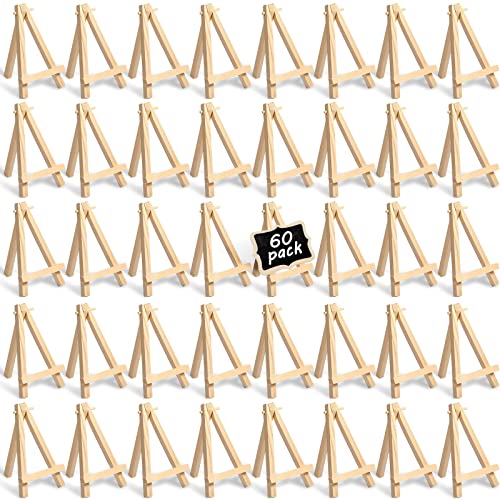 MIMOROU Mimorou 60 Pack Natural Wood Color Mini Easels for Display…
View on Amazon ↗
Listing names and images come from Amazon and are rechecked against the live listings; last checked Nov 8, 2026. No prices shown; the current price is on the listing.
Scope and limits. This guide is written from general knowledge of how art easels are built and used, not from reviews or in person experience with individual models. No specific product documents were checked, so verify canvas height, clamp depth, and folded size on the listing before buying.