Two numbers decide most WiFi 6 router purchases: how many devices connect at once and how far the signal must travel through walls. A standalone unit with good antenna design suits apartments and smaller homes. Large or thick walled houses usually need a mesh system, which trades a little peak speed for consistent coverage. Skip WiFi 6 unless your phone, laptop, and internet plan all support it.
Read the Walls Before the Spec Sheet
WiFi 6 does not change how radio waves behave. Plaster lathe, brick, concrete, and foil backed insulation still absorb or reflect the 5 GHz band that carries most of the speed benefit. A router cannot fix a wall, it can only choose a band or a beam that loses less energy on the way through.
Count the walls between the router and the farthest room. One drywall wall is rarely a problem. Two walls, a floor, or any masonry usually drops a 5 GHz signal enough that a single unit will deliver far less than its rated speed at the far end.
For thick walls, the practical answer is more access points, not more power. Mesh nodes placed in hallways or open doorways give the signal a shorter path through each obstacle. A mesh system for thick walls and garden offices typically beats a single high powered router in these homes.
Device Count Changes the Upgrade Math
The biggest WiFi 6 improvement over WiFi 5 is not raw speed on one device, it is how the router shares airtime when many devices talk at once. OFDMA and MU MIMO work best in a home with twenty or thirty active clients: phones, laptops, cameras, smart speakers, thermostats, and a game console all competing for the same channel.
With only a handful of devices, those features stay mostly idle. A WiFi 5 router that already covers the house will feel nearly identical. The upgrade pays off in busy households, not in a quiet apartment.
Remote work and gaming benefit less from the standard itself and more from a stable connection. A wired Ethernet backhaul to a satellite, or a direct cable to the desk, removes more lag than a newer radio generation ever will.
What the Internet Plan Actually Allows
A router cannot speed up a slow internet connection. If the plan delivers 100 Mbps, a WiFi 6 router will still pass only 100 Mbps to the internet. The local network may move files faster between devices, but streaming and browsing stay capped by the service tier.
Check the WAN port speed on the router. Some budget models pair WiFi 6 radios with a gigabit WAN port, while premium models offer 2.5 Gbps or faster. That only matters if the modem and the plan can exceed one gigabit.
For most households, a mid range WiFi 6 router with gigabit ports is enough. Paying for multigig WAN or link aggregation makes sense only for heavy local file transfers or a fiber plan above one gigabit.
Standalone, Mesh, or a Router With an Extender
| Design | Coverage approach | Peak speed near router | Speed at far end | Suits |
|---|---|---|---|---|
| Standalone router | One strong radio, best placement in center of home | Highest | Drops sharply through walls | Apartments, small homes, one floor |
| Mesh system | Multiple nodes share one network name | Moderate | Stays consistent with wireless backhaul, better wired | Large homes, thick walls, garden offices |
| Router plus extender | Extender repeats the signal on a second network or same SSID | High | Often half the speed on the repeated band | Filling one dead spot, not whole home |
A mesh system with wired backhaul is the only option that keeps high speed at the far end without a second router. Wireless backhaul is easier to install but shares radio time with the clients it serves.
For a single dead spot, such as a garden office, a point to point wireless bridge or a powerline adapter with an access point can beat an extender. The extender repeats everything it hears, including noise and collisions.
Features That Matter and Features That Are Noise
Look for OFDMA, MU MIMO, and WPA3. These are the core WiFi 6 features with a measurable effect on busy networks and security. Beamforming helps focus signal toward a client, which matters at the edge of coverage.
Ignore most marketing around 'gaming' routers. Game traffic is small and latency sensitive, but a router cannot prioritize packets once they leave your home. A wired connection to the console does more than any QoS label.
Beware of claims about combined speed. A router advertised as 'AX5400' adds up the theoretical maximum across all bands and channels. No single device will ever reach that number. Compare the speed rating on one band, usually 5 GHz, instead.
The Mistake of Buying for the Wrong Room
The most common error is placing the router where the internet enters the house, which is often a corner of the basement or a closet. That location wastes half the signal on the yard or a foundation wall.
Move the router to a central, open spot if the cabling allows. Even a few feet changes coverage. Keep it off the floor, away from metal shelves, aquariums, and microwaves.
A second common error is upgrading the router when the problem is the client. An older laptop with a WiFi 5 card will not get faster just because the router broadcasts WiFi 6. Check the client device before spending.
What to Check on a Listing Before You Pay
Confirm the number of Ethernet ports and their speed. Many WiFi 6 routers have only one multigig port and the rest are gigabit. If you need several wired devices, count the ports on the exact model.
Ask the seller whether the router supports bridge or access point mode if you plan to use it with an existing modem router. Not all models expose that setting.
Check the firmware update policy. A router that stopped receiving security updates is a risk on your network. Look for a support page with a recent date, and confirm WPA3 is enabled in the settings, not just listed on the box.
Long Term Costs Beyond the Box
Routers have no consumables, but they age through firmware and security support. Budget models often receive updates for a few years, while mid range and premium units get patches longer.
A mesh system adds a hidden cost: each satellite needs power. Plan the outlet locations before buying. Some nodes also need an Ethernet run for wired backhaul, which may mean hiring a low voltage installer.
Replacement cycles are longer than for phones or laptops. A good router can last five to seven years. Paying a little more for a model with a strong update history is cheaper than replacing a budget unit every three years.
WiFi 6 Router Questions That Come Up Before Buying
Is WiFi 6 worth it over WiFi 5 for a small apartment?
Usually not if the current WiFi 5 router already covers the space and the internet plan is under 500 Mbps. The multidevice features of WiFi 6 matter more in busy homes. Save the money and upgrade when the router fails or the device count grows.
What is the difference between WiFi 6 and WiFi 6E?
WiFi 6E adds a new 6 GHz band that is wider and less crowded, but only newer phones and laptops can use it. The range on 6 GHz is shorter than 5 GHz, so it works best in the same room. Buy 6E only if you have compatible devices and want that extra band.
Can a WiFi 6 router fix thick walls?
No single router can defeat physics. A WiFi 6 router may use beamforming to aim the signal, but brick, concrete, and plaster still absorb it. The fix is a mesh system or additional access points placed so the signal goes around or through fewer walls.
How many devices can a WiFi 6 router handle?
There is no single number because it depends on what the devices do. A router that handles fifty idle smart sensors may struggle with ten devices streaming video at once. OFDMA helps more with many small, intermittent connections than with a few heavy users.
Which WiFi 6 router is best for gaming?
The router matters less than the connection type. A wired Ethernet cable to the console or PC removes more lag than any wireless feature. If you must use WiFi, choose a router with a strong 5 GHz radio and place it in the same room as the gaming device.
The WiFi 6 Router That Fits Your Walls
A household in a typical wood frame home with a dozen devices and a 500 Mbps plan gets the most from a mid range standalone WiFi 6 router with gigabit ports, placed centrally. A house with brick or concrete walls, a garden office, or more than two floors should instead buy a tri band mesh system with wired backhaul where possible. That second pick sacrifices a little peak speed in the same room for a signal that actually reaches the far room.
Real wifi 6 router listings, so you can check the points in this guide against actual products. These are affiliate links: as an Amazon Associate we earn from qualifying purchases, at no extra cost to you.
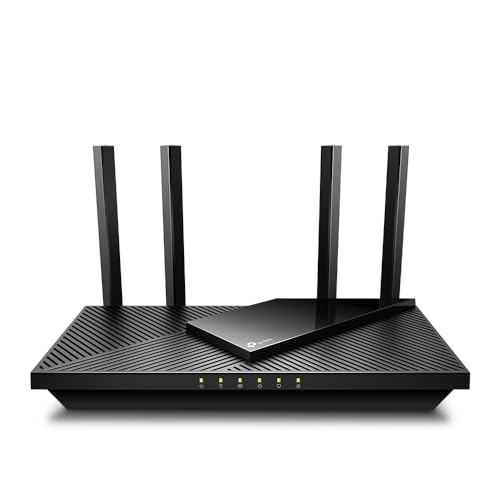 TP LINK TP-Link AX1800 WiFi 6 Router (Archer AX21 V5) | Dual…
View on Amazon ↗
 ASUS ASUS RT-AX1800S Dual Band WiFi 6 Extendable Router, Subscription-Free Network…
View on Amazon ↗
 NETGEAR NETGEAR Nighthawk WiFi 6 Router R6700AX, Up to 1,500 sq…
View on Amazon ↗
Listing names and images come from Amazon and are rechecked against the live listings; last checked Nov 8, 2026. No prices shown; the current price is on the listing.
Scope and limits. This guide is written from general knowledge of how WiFi 6 routers work as a category, not from testing individual models. It cannot tell you how a specific listing performs in your home, so check the port speeds, firmware support, and return policy before buying.