Start with battery life in GPS mode, then satellite tracking quality, then wrist comfort. Runners who record long workouts need a watch that will not die at mile 18. Hikers and trail runners should favor multi band tracking over slim designs. The main tradeoff is a bigger, longer lasting watch against a lighter one you forget you are wearing.
Read the Battery Spec, Not the Smartwatch Spec
Listings often put a big battery number up front, but that number is usually for smartwatch mode with GPS off. You need the GPS mode figure, sometimes called training mode or activity tracking mode. Compare that number across watches, because it can range from under 10 hours to over 30.
Check whether the listing states a separate battery life for multi band or dual frequency tracking. That mode uses more power and may cut the runtime by a third or more. If you run trails under tree cover, that is the number that matters.
Ask the seller how long the watch lasts with GPS and heart rate both active, and whether music playback or always on display reduces it further. A watch that promises 14 days of smartwatch life may still die during a six hour hike.
Satellite Tracking Decides Your Trail Line
A watch can use GPS alone, or GPS plus other satellite systems like GLONASS, Galileo, or QZSS. More satellite systems help in cities and valleys, but the real step up is multi band or dual frequency tracking. That feature reads two signals from each satellite, which reduces errors near cliffs, trees, and tall buildings.
For road running, single band GPS is often accurate enough. For trail running or hiking beginners who wander off marked paths, multi band keeps your recorded track closer to where you actually walked. Check the listing for the words multi band, dual frequency, or L1 and L5.
Some watches let you switch satellite modes to save battery. That is a useful option: single band for a road marathon, multi band for a wooded trail. If the listing does not say which satellite systems it uses, ask before you buy.
Band and Case Fit Matter More Than the Screen
A sports GPS watch sits against your wrist for hours while you sweat. A wide, stiff band or a thick case can press into the wrist bone and chafe by mile five. Look for a band with plenty of adjustment holes and a soft, flexible material rather than a hard plastic strap.
Case thickness also affects how the watch slides under a jacket cuff or a long sleeve shirt. A slim watch disappears during daily wear but may have a smaller battery. A thick adventure watch survives multi day hikes but feels heavy on a short jog.
If you wear the watch for sleep tracking or all day recovery data, case size matters even more. Try to check the case width and weight in the listing, and compare them to a watch you already find comfortable.
Which Features Earn Their Place on Your Wrist
Some features genuinely change how you train. A barometric altimeter records elevation gain and loss on hilly routes, which a GPS only watch estimates poorly. An optical heart rate sensor on the wrist is convenient, though a chest strap still gives cleaner data for interval training.
Other features are mostly marketing. Blood oxygen or SpO2 readings are slow to take and rarely useful during a run. Stress scores and body battery estimates are interesting but do not help you pace a marathon. Onboard music sounds nice until you realize it drains the battery faster than anything else.
Consider what you will actually use. Marathon training benefits from accurate pace, lap splits, and a long battery. Hiking beginners need reliable track recording and maybe a compass. Long walks in hot weather need a readable screen in sunlight, not a touchscreen that fogs up with sweat.
Compare the Main Design Types by How You Train
| Watch style | Battery in GPS mode | Tracking accuracy | Best fit | Tradeoff |
|---|---|---|---|---|
| Large adventure watch | Often 30 to 90 hours | Multi band, altimeter | Hiking, trail running, ultras | Heavy and bulky on small wrists |
| Mid size runner watch | Often 15 to 30 hours | Single or multi band | Marathon training, road runs | May lack a barometric altimeter |
| Slim everyday GPS watch | Often 8 to 15 hours | Single band GPS | Long walks, short runs, daily wear | Battery dies on long hikes |
| Hybrid smartwatch with GPS | Often 5 to 10 hours | Single band GPS | Casual fitness, commutes | Weak tracking under tree cover |
A mid size runner watch is the safest starting point for most people. It covers a full marathon with battery to spare and is light enough for daily wear. Move to a large adventure watch only if you hike or run for more than a few hours at a time.
Marathon Training Needs a Watch That Will Not Die at Mile 18
A marathon takes most runners four to six hours. That means you want a watch with at least 8 to 10 hours of GPS battery life, and more if you use heart rate tracking or music. A watch that promises exactly 8 hours will be dead before you cross the finish line if you started with less than a full charge.
Pace accuracy matters more than any training load score. Look for a watch that updates pace quickly and lets you set lap alerts. If you train on a track or a measured course, check whether the watch lets you calibrate the foot pod or use a chest strap for better pace data.
Marathon training reviews often mention battery anxiety, but the fix is simple: compare the GPS mode runtime before you buy. A watch that lasts 20 hours in GPS mode will still be running when your legs are not.
Hiking Beginners Should Favor Tracking Over Smart Features
A hiking beginner needs a watch that records where you went, not one that sends texts from your wrist. Look for a watch with a barometric altimeter so your elevation profile is close to reality. A compass and a back to start feature help more than a touchscreen.
Battery life in GPS mode matters even more on a hike, because a day hike can last six to ten hours. A watch with 20 hours of GPS battery lets you record the whole day without carrying a charger. Check whether the listing states a battery life for multi band mode, since trails often sit under trees.
If you also want a watch for daily wear, a mid size runner watch with an altimeter is a good compromise. It will not have the multi day battery of a large adventure watch, but it will handle a day hike and still look normal at work.
Hot Weather and Long Walks Reward a Readable, Breathable Watch
In hot weather, sweat and sunlight expose the weak points of a sports GPS watch. A screen that washes out in direct sun is useless when you try to check your pace on a long walk. Look for a transflective memory in pixel display, which stays readable in bright light without draining the battery.
A band that traps sweat against your skin will cause a rash by the end of a long walk. Choose a band with drainage channels or a quick dry material. If the watch supports it, a nylon or woven band breathes better than silicone in high heat.
Long walks rarely need multi band tracking, but they do need a battery that lasts. A slim everyday GPS watch with 10 to 15 hours of GPS mode is plenty for a three hour walk in the sun, as long as you turn off always on display.
Mistakes Buyers Make With a Sports GPS Watch
The biggest mistake is buying for the smartwatch features and then discovering the GPS battery is too short for your longest workout. A watch that dies during a marathon or a day hike is not a sports watch, it is a bracelet.
Another mistake is ignoring the band and case size. A watch that looks fine in a product photo may dig into your wrist after an hour of running. If you cannot try it on, check the case width and band material against a watch you already own.
Some buyers pay extra for multi band tracking and then run only on open roads, where single band GPS is already accurate. That money would be better spent on a chest strap heart rate monitor or a spare charging cable.
Long Term Costs Are Mostly the Charging Cable and the Band
A sports GPS watch has no consumables, but the band will wear out long before the case. Check whether the band is replaceable and how much a replacement costs before you buy. A watch with a proprietary band that cannot be swapped will be useless when the strap cracks.
The charging cable is the other long term cost. Some watches use a standard USB-C port, which is easy to replace. Others use a magnetic puck or a clip that is easy to lose and expensive to replace. If you travel often, buy a spare cable at the same time as the watch.
Battery capacity fades slowly over years of charge cycles. A watch that started with 20 hours of GPS battery may drop to 15 hours after two or three years. If you need a watch for ultra distances, buy one with a bigger battery than you think you need.
Questions to Ask Before You Buy a Sports GPS Watch
Is a sports GPS watch worth it for a beginner runner?
For a beginner runner who just wants to track distance and time, a phone app does the job for free. A sports GPS watch earns its price when you want pace on your wrist without carrying a phone, or when you run trails where a phone battery dies quickly. If you run three times a week and care about splits, a watch is worth it.
Which sports GPS watch is best for trail running?
For trail running, look for multi band or dual frequency satellite tracking and a barometric altimeter. Those two features keep your track accurate under tree cover and record elevation gain properly. A large adventure watch with a long GPS battery life is the safest choice if you run for more than three hours.
What is the difference between GPS and multi band GPS?
Standard GPS reads one signal from each satellite, which can be thrown off by trees, cliffs, or tall buildings. Multi band or dual frequency GPS reads two signals from each satellite, which lets the watch correct those errors. The tradeoff is that multi band mode uses more battery, so check the runtime in that mode.
Should I buy a watch with a touchscreen or buttons?
Buttons are more reliable when you sweat, wear gloves, or run in the rain. A touchscreen is nicer for daily use but can be triggered by a wet sleeve or fail to respond to a sweaty finger. For a sports watch, prioritize physical buttons for start, stop, and lap, even if the screen also supports touch.
How long should a sports GPS watch battery last?
In GPS mode with heart rate tracking on, a watch should last at least 10 hours to cover a marathon for most runners. For day hikes or trail ultras, look for 20 hours or more. Ignore the smartwatch mode number on the listing, because that is measured with GPS off.
Which Sports GPS Watch Fits Your Training
A runner training for a marathon on roads should pick a mid size runner watch with at least 15 hours of GPS battery, a comfortable band, and reliable pace alerts. It covers race day and daily training without the bulk. A hiker who spends full days on wooded trails should instead choose a large adventure watch with multi band tracking and a barometric altimeter, even though it feels heavy on the wrist.
Real sports gps watch listings, so you can check the points in this guide against actual products. These are affiliate links: as an Amazon Associate we earn from qualifying purchases, at no extra cost to you.
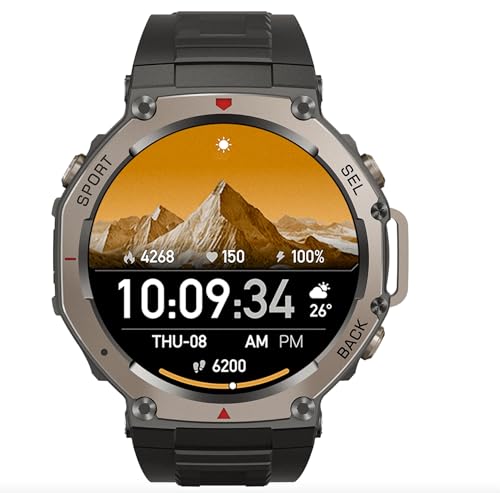 GENERIC Mivrass GPS Sports Smartwatch (Black)
View on Amazon ↗
 DEKELIFE Military Smart Watches for Men Built-inGPS,2.02Fitness Tracker Watch forMen |…
View on Amazon ↗
 TIWAIN Military Smart Watch for Men, Built-in GPS, 30-day standby, 1.43"…
View on Amazon ↗
Listing names and images come from Amazon and are rechecked against the live listings; last checked Nov 8, 2026. No prices shown; the current price is on the listing.
About this guide. Use this guide as a checklist to hold against any sports GPS watch listing you open. It covers the product type in general, not specific models, so verify the battery life, satellite modes, and case size on the listing before you buy.