Pick a small wine cooler by matching its cooling style to your noise tolerance and its real bottle capacity to your habits. Thermoelectric units run quietly but struggle in hot rooms, while compressor units cool reliably and hum slightly. The main tradeoff is silence versus dependable cooling in a warm spot.
Cooling style sets the ceiling
Small wine coolers use one of three cooling systems. Thermoelectric units move heat with a small electric plate and a fan. They have no compressor, so they barely make noise, but they can only pull the inside temperature roughly 15 to 20 degrees below the room. Put one in an 80 degree kitchen and the wine sits near 65 at best, which is fine for short term storage but not a true cellar.
Compressor units use the same vapor cycle as a full size refrigerator. They hold a steady 55 degrees even when the room reaches 85, and they recover faster after the door opens. The tradeoff is a low hum and a little vibration. If the cooler sits under a desk or beside a bed, that hum may matter more than the cooling power.
Absorption units are rare in small sizes. They run silently and use no moving parts, but they cool less than thermoelectric and need to sit perfectly level. For most buyers, the real choice is thermoelectric versus compressor, and the room temperature decides it.
The bottle count on the box is a best case
Listed capacity usually assumes standard Bordeaux bottles and no extra shelves. Pinot, Champagne, and Riesling bottles are wider or taller, so a 12 bottle cooler may hold 8 or 9 mixed bottles. Check the listing for a diagram of the interior layout, not just the number in the title.
Shelves matter as much as the box. Wire shelves let air move but can tip skinny bottles. Flat shelves hold shapes better but block airflow if they are packed tight. Slide out shelves make it easier to reach the back without pulling everything forward, which matters in a narrow dorm or office spot.
If you buy mostly half bottles or cans, a unit with adjustable or removable shelves will use the space better than a fixed layout. A cooler with a fixed top shelf wastes height that a taller bottle could have used.
Vent clearance is the hidden size
| Cooling style | Clearance needed | Best placement | Main weakness |
|---|---|---|---|
| Thermoelectric | 2 to 4 inches on sides and back | Open shelf, desk, counter | Weak in hot rooms |
| Compressor | 3 to 5 inches on back, open front | Under counter with open toe kick | Audible hum |
| Absorption | Open air on all sides | Level floor, no cabinet | Very low cooling power |
Check the manual before you buy, not after. A built in or under counter spot needs a front venting unit, and many small coolers vent from the back. Blocked vents force the cooler to run constantly, which shortens its life and raises the inside temperature.
Measure the spot with the door open, too. A cooler that fits the shelf can still hit the wall or a cabinet handle when you open the door. Leave at least the door swing plus an inch for your hand.
Dual zone is worth it only for mixed storage
A dual zone cooler keeps two compartments at different temperatures. That helps if you store reds and whites at the same time, since whites taste better colder. For a single type of wine, a single zone unit costs less and uses the space more efficiently.
In a small cooler, the temperature gap between zones is often only 8 to 12 degrees. Check the listing for the actual range of each zone. Some budget units call themselves dual zone but both zones drift toward the same temperature, which defeats the purpose.
If you mostly keep wine for a few weeks and serve it at room temperature, a single zone set near 55 degrees is enough. If you want a white ready to pour and a red that is not too cold, dual zone earns its price.
Where the cooler lives changes what you need
A dorm room cooler usually sits close to a bed, so a thermoelectric unit wins on noise even though it cools less. A family kitchen gets warm from the oven, so a compressor unit holds temperature better despite the hum. An office break room falls between: a thermoelectric unit works if the room stays under 78 degrees.
Tiny homes and RVs have another constraint: power. A thermoelectric cooler draws less current and starts gently, which matters on a small circuit or an inverter. A compressor unit pulls more at startup and may trip a shared outlet when the microwave is on.
Sunlight and heat sources shorten the life of any cooler. Keep it away from a window, a radiator, or the back of a refrigerator. The cooler has to fight that extra heat, and thermoelectric units lose that fight first.
UV glass and humidity do more than a charcoal filter
A glass door shows the bottles but lets in light. UV coated glass slows the light damage that makes wine taste flat, so it matters if the cooler faces a window or a bright kitchen. A solid door blocks light completely but hides the collection, which some buyers dislike.
Humidity control keeps corks from drying out, but most small coolers do not add moisture. They just trap some of what the bottles release. Check whether the unit has a water tray or a humidity setting; if not, a small cup of water inside helps in dry climates.
Charcoal filters and active carbon are marketing on most small units. They can reduce odors, but they do not fix temperature swings or light damage. Spend the budget on UV glass or a better compressor before paying extra for a filter.
Who should skip a small wine cooler
If you drink wine within a week of buying it, a regular refrigerator or a cool dark cabinet works fine. A wine cooler is for bottles that sit for months, or for keeping a serving temperature without tying up the kitchen fridge.
If you collect more than two cases or buy large format bottles, a small cooler will frustrate you. The shelves will not fit magnums, and the capacity will force you to rotate bottles constantly. A full size wine refrigerator or a cellar rack is the better route.
If the room regularly passes 85 degrees, a thermoelectric unit will not protect the wine. Either choose a compressor model or move the storage spot. No small cooler fixes a hot room.
Read the listing for these four checks
First, find the minimum and maximum temperature range, not just the word 'wine cooler'. A unit that bottoms out at 54 degrees is fine for reds but not for a crisp white served at 45.
Second, look for the actual interior dimensions in inches. Compare them to your tallest and widest bottles. A cooler that fits standard Bordeaux may not fit a Burgundy or a Champagne bottle standing up.
Third, check the vent location and the clearance the manual requires. If the listing does not show it, ask the seller before buying. A back venting unit cannot go into a closed cabinet.
Fourth, confirm the door swing direction and whether it is reversible. Many small coolers open only one way, and a wrong swing can block a drawer or a walkway in a tight kitchen.
Small wine cooler questions, answered straight
Is a small wine cooler worth it for a dorm room?
For a dorm, a thermoelectric small wine cooler is worth it if you value quiet and only store a few bottles for a few weeks. It cools less than a compressor unit, but dorm rooms rarely stay hot enough to matter. Check the room temperature first: if it stays under 78 degrees, thermoelectric works. If the room gets hot, skip it or choose a compressor model and accept the hum.
What is the difference between a wine cooler and a beverage cooler?
A wine cooler holds a steady temperature between 45 and 65 degrees and has shelves shaped for bottles on their sides. A beverage cooler gets colder, often below 40 degrees, and uses flat shelves for cans and bottles standing up. Wine stored too cold for months can lose its aroma, while a beverage cooler is fine for drinks you open within days.
Can a small wine cooler go under a counter?
Only if it vents from the front and the manual lists built in or under counter installation. Most small coolers vent from the back or sides and need open air, so a cabinet traps heat and makes the unit fail early. Check the vent location and clearance in the listing, and measure the toe kick area if the cooler sits on the floor.
How many bottles does a 12 bottle small wine cooler really hold?
Usually fewer, because the count assumes standard Bordeaux bottles and no wide shapes. Pinot, Champagne, and Riesling bottles take more shelf space, so a 12 bottle unit often holds 8 to 10 mixed bottles. Look for an interior diagram in the listing and compare your tallest and widest bottles to the shelf spacing before buying.
Does a small wine cooler need a dedicated outlet?
A compressor unit can pull a surge at startup, so it may trip a shared circuit that also runs a microwave or a kettle. A thermoelectric unit draws less and starts gently, which is safer on a dorm or RV circuit. Check the listing for the wattage or amperage, and avoid plugging a compressor cooler into an already loaded outlet.
The small wine cooler pick for most kitchens
A buyer who keeps a mixed case of reds and whites in a warm kitchen should choose a compressor single zone cooler with at least 12 listed bottles and front or side venting. It holds 55 degrees even near the oven and accepts the low hum. If that same buyer sleeps next to the cooler in a dorm or studio, switch to a thermoelectric unit under 78 degrees and accept the weaker cooling.
Real small wine cooler listings, so you can check the points in this guide against actual products. These are affiliate links: as an Amazon Associate we earn from qualifying purchases, at no extra cost to you.
 FEELFUNN Feelfunn 12 Bottle Wine Cooler Refrigerator, Freestanding Wine Fridge,Black |…
View on Amazon ↗
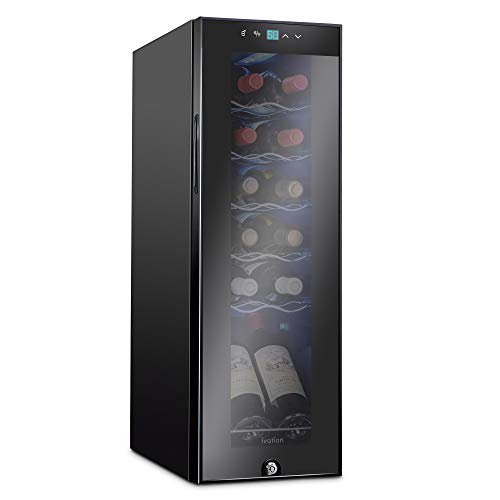 IVATION Ivation 12 Bottle Compressor Wine Cooler, Freestanding Fridge w/Lock, Black…
View on Amazon ↗
 EYPKAOL Eypkaol 8 Bottle Wine Fridge, Small Wine Fridge Freestanding with…
View on Amazon ↗
Listing names and images come from Amazon and are rechecked against the live listings; last checked Nov 8, 2026. No prices shown; the current price is on the listing.
How to read this guide. This guide draws on general knowledge of how small wine coolers work, including their cooling systems, capacity limits, and installation needs. It does not evaluate any specific model, so check the listing for the exact temperature range, interior dimensions, and vent clearance before you buy.