Start with two numbers: battery capacity in watt hours and inverter output in watts. Capacity decides how long it runs your gear; output decides which gear it can start at all. Choose a station whose capacity covers your longest expected outage and whose output exceeds your biggest device's starting surge. The main tradeoff is weight and price against stored energy.
Read the Watt Hour Number First
Battery capacity is listed in watt hours, often written as Wh. A higher number means the station stores more energy, so it runs the same device longer or runs a bigger device at all.
To compare two stations, check the Wh rating on the listing, not the milliamp hour rating. Milliamp hours mean nothing without knowing the internal battery voltage.
For a home office, a station with around 500 Wh often keeps a laptop, router, and monitor running through a short outage. For a fridge overnight, expect to need 1,000 Wh or more depending on the fridge's draw.
A station rated in watt hours is not perfectly efficient. Expect 85 to 90 percent of the listed capacity to reach your devices after inverter losses.
Inverter Output Decides What You Can Plug In
The inverter converts stored DC battery power to AC household power. Its output is rated in watts and often has two numbers: continuous and peak or surge.
Continuous output is what the station can supply for hours. Peak output is a short burst for devices that draw extra power when they start, like a fridge compressor or a power tool.
Check the starting wattage of any appliance with a motor. A fridge that runs at 200 watts can draw 600 to 900 watts for a second when the compressor kicks on.
If a station's peak output is below that starting surge, the station will shut off or trip its protection when you plug the appliance in.
Match the Station to the Outage Length
Think about your longest realistic power outage. In many areas that is 6 to 12 hours; in storm prone regions it can be 24 hours or more.
Add up the watt hours your essential devices use in that period. A 10 watt LED light running 6 hours uses 60 Wh. A 60 watt laptop running 6 hours uses 360 Wh.
Choose a station with at least 20 percent more capacity than your total, because batteries lose capacity over time and in cold weather.
For multi day outages, look for a station that supports solar charging or can be recharged from a car, or plan to ration devices heavily.
Output Ports Shape What You Can Run at Once
A station's ports determine how many devices you can use simultaneously and whether you need adapters.
USB-C ports with power delivery can charge modern laptops directly. USB A ports handle phones, tablets, and small accessories. AC outlets run appliances that need household power.
Some stations include a DC car style output for devices like coolers or air compressors. If you camp with a 12 volt fridge, check for this port.
The total port count is less important than the total continuous output. Three AC outlets still cannot exceed the inverter's watt rating.
| Station size | Typical capacity | Best for | Realistic runtime |
|---|---|---|---|
| Mini power bank | 100 to 300 Wh | Phones, tablets, small USB lights | A few phone charges |
| Compact station | 300 to 700 Wh | Laptop, router, small fan, camping lights | 4 to 10 hours of light loads |
| Mid size station | 700 to 1,500 Wh | Fridge, CPAP, TV, power tools | 8 to 24 hours of mixed loads |
| Large station | 1,500 Wh and up | Full home office, microwave, sump pump | A full day or more |
Use the table as a starting range. A fridge uses more power in summer, and a CPAP with a humidifier uses more than the base machine.
When in doubt, buy one size larger than you think you need. A station at 90 percent capacity runs hot and may shut down early.
Recharge Speed Changes How Useful a Station Is
A station is only useful if it is charged when you need it. Check the input wattage and the charging method.
Most stations charge from a wall outlet. Some can also charge from a car's 12 volt socket, which is much slower, or from solar panels, which depends on sunlight.
A station that charges at 300 watts refills a 600 Wh battery in about 2 hours. At 60 watts, the same battery takes 10 hours or more.
If you plan to use the station daily for camping or job sites, fast charging matters more. For emergency backup that sits charged, a slower overnight charge is fine.
Battery Chemistry Decides Lifespan and Safety
Most portable power stations use lithium ion cells, often lithium iron phosphate, written as LiFePO4 or LFP. LFP cells tolerate more charge cycles and are more stable at high temperatures.
A standard lithium ion battery often lasts 500 to 800 full cycles before capacity drops noticeably. An LFP battery can last 2,000 to 3,000 cycles or more.
Check the cycle life in the listing if you plan to use the station daily. For occasional emergency use, any modern chemistry will last for years.
Storing a station fully charged in a hot car or shed can shorten battery life. Store it at 50 to 80 percent charge in a cool, dry place when not in use.
Weight and Shape Decide Where It Actually Goes
A station's weight and handle design matter more than most buyers expect. A 1,500 Wh station can weigh 30 to 50 pounds.
For camping, a compact station with a folding handle or a shoulder strap is easier to move from car to tent. For home backup, a larger station can live on a shelf or in a closet.
Check the physical dimensions against the space where you plan to store it. Some stations are tall and narrow; others are wide and flat.
If you need to move the station between rooms during an outage, look for one with a sturdy top handle and a shape that fits through doorways easily.
Who Should Choose a Different Backup
A portable power station is not the right tool for every outage or every buyer. If you need to run a whole house heater, central air, or a well pump, a stationary home battery or a generator is a better fit.
For frequent multi day outages with high loads, a propane or dual fuel generator costs less per watt hour and refuels in minutes instead of hours.
If you only need to keep a phone and a small light running, a large USB power bank does the job for a fraction of the weight and price.
International travelers should check airline rules. Most airlines limit lithium batteries to 100 Wh per battery, and many stations are far above that limit.
Portable Power Station Questions That Decide the Purchase
How many watt hours do I need for a power outage?
Add up the wattage of the devices you must run and multiply by the hours you expect the outage to last. A laptop, router, and LED light might use 100 watts total, so a 600 Wh station runs them about 5 to 6 hours. Add 20 percent for inverter losses and battery aging.
What is the difference between a portable power station and a power bank?
A power bank is a small battery with USB ports, usually under 100 Wh, meant for phones and tablets. A portable power station has a larger battery and an inverter that produces AC household power, so it can run laptops, fridges, power tools, and medical devices.
Can a portable power station run a refrigerator?
Yes, if the station's peak output exceeds the fridge's starting surge and its capacity matches the runtime you need. A typical fridge runs at 100 to 200 watts but can surge to 600 to 900 watts on startup. Check both numbers on the fridge's label or in its manual.
Is a portable power station worth it for camping?
It is worth it if you camp with devices that need AC power, like a CPAP machine, a portable fridge, or camera batteries. For only phones and small lights, a large USB power bank is lighter and cheaper. For car camping, a station with solar input extends your trip without a generator.
How long does a portable power station last?
Battery lifespan depends on chemistry and cycles. A lithium iron phosphate battery often lasts 2,000 to 3,000 full charge cycles, or roughly 7 to 10 years with weekly use. A standard lithium ion battery lasts 500 to 800 cycles. Store it at 50 to 80 percent charge in a cool place to extend its life.
Which Portable Power Station Fits Your Outage and Your Gear
A buyer who wants backup for a home office during short outages should look for a compact station around 500 to 700 Wh with at least one USB-C power delivery port and a 300 watt or higher inverter. That runs a laptop, router, and monitor for several hours without weighing down a closet shelf. A different buyer, someone camping for days with a 12 volt fridge and a CPAP, should step up to a mid size station with 1,000 Wh or more, solar input, and a peak output above 1,200 watts.
Real portable power station listings, so you can check the points in this guide against actual products. These are affiliate links: as an Amazon Associate we earn from qualifying purchases, at no extra cost to you.
 GRECELL Portable Power Station 500W (Peak 1000W), 519.48Wh Outdoor Solar Generator…
View on Amazon ↗
 BLUETTI BLUETTI Elite 30 V2 Portable Power Station 288Wh 600W LFP…
View on Amazon ↗
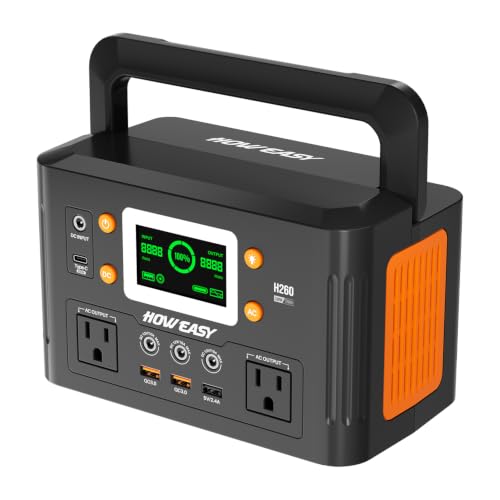 HOWEASY HOWEASY Portable Power Station,260W(500W peak) Solar Generator with PD 65W…
View on Amazon ↗
Listing names and images come from Amazon and are rechecked against the live listings; last checked Nov 8, 2026. No prices shown; the current price is on the listing.
About this guide. This guide explains how to choose a portable power station based on general category knowledge. It does not evaluate individual models or read owner reviews, and no units were handled, so check the dimensions and watt ratings on any listing before buying.