Match the dryer to your air path first: a vented unit moves moisture outside and dries faster, while a condenser unit collects water internally and needs no window or duct. Then check drum capacity against your typical load and wattage against your outlet. Small flats and RVs usually get more usable drying from a compact vented model with a window kit, while a condenser suits rooms with no outside wall.
The vent choice decides where you can put it
Portable dryers split into two main designs. A vented dryer pushes warm, humid air through a hose and out a window, a wall vent, or a drop ceiling panel. Because the moisture leaves the machine, the air inside the drum stays drier and the cycle finishes sooner. The tradeoff is placement: the dryer must sit within reach of an opening and the hose must not kink.
A condenser dryer collects the moisture in a removable tank or tray instead of venting it outside. That means you can set it in a hallway, a closet, or a bathroom with no window. The cost is speed and heat. Condenser units often run cooler to avoid overheating the room, so a full load can take noticeably longer and come out feeling slightly damp if you overload it.
Some small units are called drying cabinets or air dryers. They use a gentle stream of warm air inside a hanging compartment. They are quiet and safe for delicates, but they are the slowest option and work best for a few items at a time. Check the listing for the words vented, condenser, or cabinet before anything else.
Capacity is about the biggest single item, not the total load
Portable dryer drums typically hold between 3 and 15 pounds of dry laundry. A 3 pound drum dries a couple of shirts or one pair of jeans. A 10 pound drum handles a small bed sheet and a few towels. The number that matters most is whether your largest regular item, like a bath towel or a lightweight blanket, can tumble freely.
A common mistake is comparing capacity to the weight of wet clothes. A wet towel can weigh twice as much as a dry one, but the drum rating refers to dry weight. Another mistake is filling the drum to the top. Tumbling needs open space, so a 10 pound drum usually dries best with 6 to 8 pounds inside.
If you wash in a compact washer, match the dryer to that load size rather than to your full laundry basket. A dryer that holds less than your washer forces you to split every load, which doubles the time and the electricity.
Wattage sets the pace and the outlet
Portable dryers in the US usually draw between 800 and 1,500 watts on a standard 120 volt outlet. Higher wattage means a hotter heating element and a shorter cycle, but it also pushes closer to the limit of a 15 amp circuit. If the dryer shares a circuit with a microwave, a space heater, or an air conditioner, a 1,500 watt unit can trip the breaker.
Check the listing for the rated wattage and compare it to the other appliances on the same circuit. In an RV or an older apartment, a 1,200 watt dryer is often safer than a 1,500 watt one. Some models have a low heat setting that draws less power, which helps when the outlet is shared.
Wattage also affects the room. A high watt vented dryer sends most of its heat outside, while a high watt condenser dryer warms the room around it. In a small studio, that extra heat can be welcome in winter and uncomfortable in summer.
Read the listing for the hose and the filter
Two details on a product page tell you more than the marketing photos. The first is the vent hose: its length, its diameter, and whether a window adapter is included. A hose under 4 feet limits where the dryer can sit. A 4 inch diameter hose fits most standard window kits, while a smaller hose may need a proprietary adapter.
The second is the lint filter. A removable filter that slides out from the front is easy to clean after each load. A filter buried behind a panel or inside the drum gets skipped, and a clogged filter slows drying and can overheat the machine. Check the listing photos for the filter location.
If the listing does not show the hose length or the filter, ask the seller before buying. Also confirm whether the dryer needs a drain hose for condenser models, and whether the water tank is at the front or the back. A rear tank is awkward to empty when the dryer sits against a wall.
- Vent hose length and included window adapter
- Lint filter location and how it removes
- Condenser tank position and drain option
Small flats and studios need a plan for the air
In a small flat, the dryer usually lives in the kitchen, a hallway, or a wardrobe. A vented dryer needs a window within hose reach, so measure the distance from the intended spot to the nearest opening before you choose. A condenser dryer avoids that constraint but adds humidity to the room, which matters in a tightly sealed flat.
For a studio apartment, noise and heat shape the decision as much as drying power. A condenser dryer runs quieter because it does not push air through a long hose, but it can run for two to three hours. A vented dryer finishes faster but the blower is audible from across the room.
Shared housing changes the calculation. A dryer in a common area should be simple to empty and clean, because different people will use it. A front mounted lint filter and a front mounted water tank reduce the friction. Also check whether the dryer has a child lock or a simple start button, since shared machines see rougher handling.
RV living favors low wattage and a short hose
An RV runs on limited power, often 30 amps for the whole vehicle. A 1,500 watt dryer leaves little room for the water heater or the air conditioner. A dryer rated at 1,000 to 1,200 watts is more practical, even if it adds 20 to 30 minutes to each cycle.
Venting in an RV is easier through a small window or a roof vent, but the hose must be short and well sealed. A loose hose leaks humid air into the cabin, which leads to condensation on windows and walls. Condenser dryers avoid the hose but add heat and moisture to a small space, so they work best in an RV with good roof ventilation.
Weight also matters in an RV. A portable dryer can weigh 40 to 70 pounds, and that weight sits in a cabinet or a closet while you drive. Check the listed weight and make sure the storage spot can hold it without sagging.
The hidden cost is the filter and the tank
Portable dryers need little ongoing care, but the care they do need is easy to skip. A lint filter should be cleared after every load. On a vented dryer, the hose should be checked every few months for lint buildup and kinks. A kinked hose reduces airflow and can cause the dryer to shut off on a thermal sensor.
Condenser dryers add a second task: emptying the water tank. Most tanks hold 1 to 2 liters, which means emptying after every load or two. Some models offer a drain hose that runs to a sink or a floor drain, which removes that chore entirely.
There are no consumable filters or special detergents for most portable dryers. The long term cost is electricity, which depends on wattage and cycle length. A lower watt dryer that runs longer can cost the same as a higher watt dryer that runs shorter, so compare the estimated cycle time on the listing rather than the wattage alone.
When a portable dryer is the wrong tool
A portable dryer is a poor fit for a household that washes full size loads. If you regularly wash a 15 pound load of towels and jeans, a portable drum will split it into three or four cycles. The time and electricity add up quickly, and a full size dryer or a laundromat becomes cheaper in the long run.
Limited plumbing is not a reason to buy a portable dryer by itself. The dryer does not need a water connection, so the washer is the real constraint. If you wash by hand or use a portable washer, a dryer helps. If you already use a laundromat for washing, a portable dryer at home means carrying wet clothes back, which is rarely worth it.
Skip a portable dryer if you have no reliable way to vent or tolerate humidity. A condenser dryer in a tiny, unventilated bathroom will make the room damp and can encourage mold. In that situation, a heated drying rack or a dehumidifier may serve better than a tumble dryer.
Compact washers and spin dryers change the picture
The dryer decision starts with what comes before it. A compact washing machine that holds 8 pounds of laundry pairs well with a 8 to 10 pound portable dryer. A mini spin dryer that removes most of the water by centrifugal force can cut the dryer time in half, because the clothes enter the dryer damp rather than wet.
If you already own a spin dryer, a lower watt portable dryer may be enough. The spin dryer does the heavy lifting on water removal, so the tumble dryer only needs to finish the job. That combination uses less electricity than a high watt dryer working alone.
For more on matching the washer to the dryer, see the guide on compact washers for small spaces and the one on mini spin dryers that pull water.
Compare the main designs side by side
| Design | Drying speed | Placement | Moisture goes | Best for |
|---|---|---|---|---|
| Vented drum | Fast | Near a window or vent | Outside | Small flats with a window |
| Condenser drum | Moderate | Any dry room | Internal tank | Rooms with no outside wall |
| Compact vented | Moderate | Tight spots near a vent | Outside | RVs and studios |
| Drying cabinet | Slow | Anywhere | Into the room | Delicates and a few items |
A vented drum is the default choice when a window or vent is available. A condenser drum is the fallback when the room cannot vent. A drying cabinet is a specialty tool, not a replacement for a tumble dryer.
Portable dryer questions before you buy
Is a portable clothes dryer worth it?
It is worth it if you wash small loads at home and have a place to vent or tolerate humidity. A portable dryer saves trips to a laundromat and dries clothes faster than air drying. It is not worth it if you wash full size loads, because splitting them into many small cycles eats up time and electricity.
What is the difference between vented and condenser portable dryers?
A vented dryer blows humid air outside through a hose, so it dries faster but must sit near a window or vent. A condenser dryer collects the moisture in a tank, so it can sit anywhere but runs slower and adds some heat and humidity to the room.
Which portable clothes dryer is best for an apartment?
For an apartment with a window, a compact vented dryer around 8 to 10 pounds capacity dries a small load in about an hour. For an apartment with no window or vent, a condenser dryer of similar capacity works, but expect longer cycles and empty the water tank after each load.
Can I use a portable dryer in an RV?
Yes, if you choose a unit rated around 1,000 to 1,200 watts and vent it through a window or roof vent. A 1,500 watt dryer can trip a 30 amp RV circuit when other appliances run. Keep the vent hose short and sealed to avoid condensation inside the cabin.
How do I compare portable dryer listings?
Compare the vent type first, then the drum capacity in pounds, then the wattage. Check the vent hose length and whether a window adapter is included. Look at the lint filter location and the water tank position on condenser models. Ask the seller about anything the listing does not show.
Which portable dryer fits a small space
A renter in a studio with a window and a compact washer should look for a vented drum around 8 to 10 pounds and 1,200 to 1,400 watts. That combination dries a small load in under two hours and keeps the moisture outside. An RV owner on a 30 amp circuit should instead pick a compact vented unit under 1,200 watts with a short hose, even if it means splitting larger loads.
Real portable clothes dryer listings, so you can check the points in this guide against actual products. These are affiliate links: as an Amazon Associate we earn from qualifying purchases, at no extra cost to you.
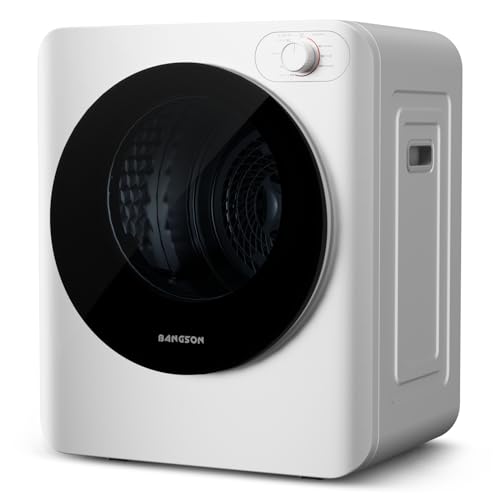 BANGSON BANGSON 1.5 Cu.Ft. Portable Clothes Dryer,120V Vented Electric Dryer |…
View on Amazon ↗
 PANDA Panda 3.5 Cu. Ft. Portable Clothes Dryer, 13.2 lbs Capacity,…
View on Amazon ↗
 COSTWAY COSTWAY 1.5 Cu.Ft. Portable Clothes Dryer with LED Control, 8lbs,…
View on Amazon ↗
Listing names and images come from Amazon and are rechecked against the live listings; last checked Nov 8, 2026. No prices shown; the current price is on the listing.
Scope and limits. This guide is written from general knowledge of how portable clothes dryers work as a category, not from testing individual models. It cannot tell you how a specific listing performs in your home, so check the vent hose length, wattage, and drum capacity on the product page before you buy.