A phone teleprompter works when the glass sits at the right height and angle for your camera, and when the scrolling speed matches your delivery. Choose a rigid beam design for tripod shoots and interviews. Choose a compact folding design for travel and handheld work. The main tradeoff is stability versus portability, and the remote is what makes solo recording practical.
The Beam Height Has to Match Your Phone
The beam is the horizontal arm that holds the glass in front of your phone. Its height is fixed on most models, so the glass either lines up with your lens or it does not. Check where your phone's camera sits when mounted. A phone with a centered lens works with a lower beam. A phone with a corner lens often needs the beam raised or the phone shifted sideways.
If the beam is too low, the glass covers only part of the screen and you see the phone's edge in the reflection. If it is too high, the glass blocks the lens or forces you to look up. Compare the beam's height to your phone's camera position before buying. Some designs let you slide the phone left or right in the mount, which helps a little, but the beam height is the first check.
Glass Angle Sets the Eye Line
The glass sits at a fixed angle, usually around 45 degrees. That angle reflects the phone screen up to your eyes while the camera shoots through the glass. A steeper angle makes the text appear higher, so your eyes look closer to the lens. A shallower angle drops the text lower, and your eyes drift away from the lens.
This matters most in interviews and product videos where the viewer watches your face. A small eye drift reads as you reading, not speaking. Look for a design where the glass angle places the reflected text just below the lens. If the angle is not listed, check photos of the glass from the side and compare where the reflection would sit.
The Remote Decides Who Controls the Scroll
Most phone teleprompters come with a small Bluetooth remote. It starts, pauses, speeds up, and slows down the text. Without it, you either tap the screen between takes or ask someone else to scroll. For solo creators, the remote is not a bonus, it is the control that makes the rig usable.
Remotes vary in range and button layout. A simple three button remote covers start, pause, and speed. A fuller remote adds font size and mirroring controls. The remote pairs with the phone, not the glass, so any teleprompter app can read its signals. Check that the remote uses standard Bluetooth and that the buttons map to the app you plan to use.
Rigid, Clamp On, or Foldable: The Main Designs
Three designs dominate. A rigid beam model has a solid base and a fixed arm, made for tripods and sit down shoots. It stays put through long takes but takes up desk space. A clamp on model attaches to a desk edge or shelf, so it frees the tripod but limits where you can set up. A foldable model hinges flat for a bag, which suits travel and handheld shots, but the moving parts wobble more.
Think about where you record most. A desk setup favors a rigid beam or clamp. A hotel room or outdoor shoot favors a foldable. The table below lines up the main differences.
| Design | Setup effort | Stability | Suits |
|---|---|---|---|
| Rigid beam | Low, set once | High | Tripod and studio shoots |
| Clamp on | Medium, attach to desk | Medium to high | Desk recordings and live streams |
| Foldable | Medium, unfold and mount | Low to medium | Travel and handheld creators |
A foldable model is not automatically flimsy, but its hinges and thinner materials move more than a solid arm. If you shoot handheld, that movement shows. If you shoot on a tripod, a rigid beam keeps the glass still from take to take.
The App Is Half the Product
The glass and beam only reflect what the phone displays. The scrolling text comes from a teleprompter app, and the app's controls decide how comfortable the read feels. Look for an app that lets you adjust font size, line spacing, and scroll speed in fine steps. Mirroring matters if you use a second device to control the text.
Some apps play a moving highlight bar over the line you are reading. That helps keep your place in long scripts. Others let you import scripts from cloud storage or paste text directly. The hardware may include a suggested app, but most apps work with any glass rig. Test the app before a shoot, because a slow or jumpy scroll is more distracting than no prompter at all.
Phone Size and Case Fit
The phone mount on a teleprompter has a width limit. A large phone with a thick case may not fit, or may sit crooked. Check the mount's maximum width and depth. A case with a protruding camera bump can also push the phone away from the glass, changing the reflection.
Most mounts grip the phone by its edges. A smooth case slides less than a textured one. If you plan to keep your case on, measure the phone with the case. If the mount is too tight, you either remove the case every time or buy a different mount. Some teleprompters include adjustable brackets that help, but the listed dimensions are the real limit.
What to Check on a Listing Before Buying
Start with the beam height and the glass angle. If the listing does not show the beam height, ask the seller for the measurement from the base to the center of the glass. Then check the phone mount width and depth against your phone with its case on.
Next, look at the remote. Does it use Bluetooth, and does it list the apps it works with? A remote that only works with one obscure app is less useful. Also check the glass material. Tempered glass resists scratches better than acrylic. Acrylic is lighter but scuffs faster. And confirm the tripod thread size, since most use a standard 1/4 inch thread.
Mistakes That Make the Footage Look Off
The biggest mistake is buying for the wrong phone position. A teleprompter built for a centered lens phone will not line up with a corner lens phone without awkward tilting. Another mistake is skipping the remote. You can tap the screen to scroll, but every tap breaks your eye contact and shakes the phone.
A third mistake is ignoring the app's scroll smoothness. A cheap app that jumps line by line forces you to read in bursts. And a fourth is using a teleprompter for a shot where you need to move around. The glass only works when you stay in one spot. If you walk and talk, a teleprompter is the wrong tool.
When a Teleprompter Is Not Worth It
Skip a phone teleprompter if you shoot mostly action or movement. The glass and beam only help when your face stays in a fixed position. If you record short clips and can memorize a few lines, a teleprompter adds setup time without much benefit.
Also skip it if you already have a larger camera with a built in prompter or a dedicated monitor. A phone teleprompter is a niche tool for phone based video. If your phone is your only camera and you read scripts often, it pays off. If you shoot once a month, a printed script taped near the lens may be enough.
Phone Teleprompter Questions Before You Buy
Is a phone teleprompter worth it for TikTok creators?
It is worth it if you post scripted videos often and struggle to keep eye contact with the lens. The glass lets you read while looking almost at the camera, which makes the delivery feel more direct. For short, off the cuff clips, the setup time may not be worth it.
Which phone teleprompter works for travel photography?
A foldable model works best for travel because it packs flat and weighs less. Look for one with a simple hinge and a rigid enough arm to stay still on a tripod. The remote should be small enough to fit in a camera bag pocket.
How do I choose a phone teleprompter?
Choose by beam height, glass angle, and remote control. The beam height must match your phone's camera position. The glass angle sets where your eyes look. The remote lets you control the scroll without touching the phone. After those three, check the phone mount width and the app's scroll smoothness.
Can I use a phone teleprompter with any app?
Most teleprompters work with any app that displays scrolling text, but the included remote may map better to certain apps. Check the listing for a list of supported apps. If none is listed, the remote likely sends standard Bluetooth media commands, which many teleprompter apps accept.
Does a phone teleprompter make you look at the camera?
It gets you close. The glass reflects the text at an angle that places the words just below the lens, so your eyes look at the lens area instead of off to the side. The exact result depends on the glass angle and how far you stand from the phone.
Which Phone Teleprompter Fits Your Shoot
A creator who records sit down videos at a desk with a tripod should pick a rigid beam model with a Bluetooth remote. The fixed arm and solid base keep the glass still, and the remote lets you run the scroll alone. For someone who shoots travel clips or handheld interviews, a foldable model is the better pick, even though it trades some steadiness for a small packed size.
Real phone teleprompter listings, so you can check the points in this guide against actual products. These are affiliate links: as an Amazon Associate we earn from qualifying purchases, at no extra cost to you.
 NEEWER NEEWER RT113 Remote Control for NEEWER Teleprompter App ONLY, Upgraded…
View on Amazon ↗
 DESVIEW Desview T3 Teleprompter for Camera & Smartphone - Supports iPad/Tablet…
View on Amazon ↗
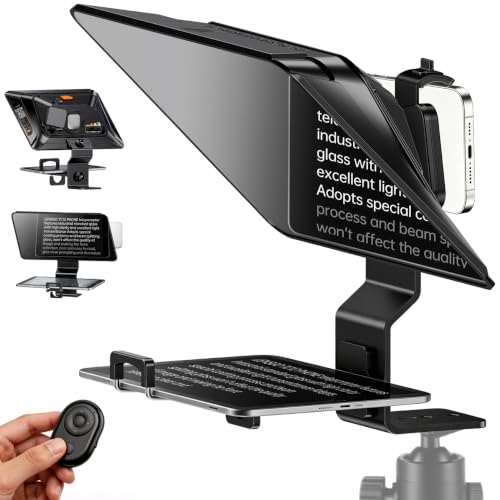 LENSGO Teleprompter for Smartphone, LENSGO TC12P 14.5-Inch HD Wide-Angle Beam Splitter…
View on Amazon ↗
Listing names and images come from Amazon and are rechecked against the live listings; last checked Nov 8, 2026. No prices shown; the current price is on the listing.
Scope and limits. This guide covers phone teleprompters as a category, not individual models, and is written from general product knowledge. No specific product documents or reviews were read, and no units were handled, so verify any listed dimension on the product page before buying.