Two factors decide most of it: key spacing and how the keyboard holds your phone. Narrow key pitches under 16 mm cause typos on long messages. A weak hinge lets the phone flop backward mid sentence. Buyers who type more than a few lines should prioritize key travel and a firm hinge over pocket size. The main tradeoff is typing comfort versus portability.
The key spacing check that predicts typos
On a phone keyboard, the distance between key centers is the first number to check. Most full size laptop keys sit on a 19 mm pitch. Many phone boards shrink that to 15 mm or less to save space. A pitch under 16 mm forces your fingertips to overlap, which causes repeated letters and missed spaces.
Look for the pitch in the listing or ask the seller. If it is not listed, compare the width of the board to the number of keys. A board with 60 keys across 22 cm has a tighter pitch than one with 60 keys across 28 cm. Wider spacing lets you keep your normal typing rhythm instead of stabbing at keys.
Key travel is the second number that matters. Travel under 1.5 mm feels like tapping a tablet screen, not typing. Scissor switch or low profile mechanical boards often keep 1.5 to 2 mm of travel while staying thin. Membrane and roll up boards compress to almost nothing and give the least feedback.
The hinge is the part that fails first
Most phone keyboards hold the phone in a groove or a fold out cradle. The groove design is simple, but it only works if the phone sits at a readable angle. A groove cut too shallow lets the phone fall backward when you type on a soft surface like a bed or couch.
A fold out cradle with a hinge gives you a set angle, often around 110 to 130 degrees. Check how the hinge is built. A metal pin hinge holds tension longer than a plastic friction hinge. Plastic hinges loosen after a few months of daily opening, and then the phone flops flat mid message.
If you plan to use the keyboard on your lap, a rigid one piece board is safer than a foldable one. Foldable boards put the phone on one half and the keys on the other, which works on a desk but wobbles on a lap. The hinge becomes the weak point every time you open and close it.
Pairing behavior separates a tool from a toy
Almost every phone keyboard pairs over Bluetooth, but the pairing mode changes how it fits your day. A board that remembers only one device is fine if you always type on the same phone. A board with three device memory lets you switch between a phone, a tablet, and a laptop with a key combo.
Check whether the keyboard reconnects automatically after sleep. Some boards drop the connection when the phone screen locks, then need a manual re pair. That gets old if you type in bursts between calls or classes. A keyboard that wakes and reconnects in a second or two is worth the extra money.
The operating system shortcut row is another real feature. Keys for home, search, volume, and media control save you from reaching for the phone. Without those keys, you still type fine, but you will touch the screen more often. Some boards also include a slot for a stylus or a small trackpad.
Foldable, roll up, or rigid: pick your carry
Three design types cover most of the market. Foldable boards collapse to the size of a thick wallet and fit in a front pocket. They are the easiest to carry but give the least key travel and the most hinge risk. Roll up boards are made of silicone and pack flat, but the keys feel like a calculator.
Rigid mini boards keep a solid frame and real scissor or mechanical switches. They are bigger than a foldable but still fit in a jacket pocket or a small bag. A rigid board with a 60 percent layout gives you about the same typing feel as a laptop, minus the number pad.
Full size boards with a phone cradle are rare but exist. They are best for a desk setup where the phone replaces a laptop. The extra width lets the keys sit at a natural pitch, and the cradle is often more stable than a fold out hinge. You give up pocket carry completely.
| Design | Carry size | Key feel | Hinge risk | Best for |
|---|---|---|---|---|
| Foldable | Mushy | High | Occasional notes | |
| Roll up | Flat pouch | Very mushy | None | Emergency typing |
| Rigid mini | Jacket pocket | Crisp | Low | Daily messages |
| Full size | Bag | Laptop like | Low | Desk work |
Foldable boards look appealing in photos because they close into a neat square. The tradeoff is that every fold line is a potential failure point. If you type more than a few sentences a day, a rigid board will outlast a foldable and feel better the whole time.
Battery type changes how you live with it
Rechargeable lithium ion batteries are standard on rigid boards. They last weeks of normal use on a charge, and the USB-C port is usually the same cable you use for the phone. Check whether the board charges while in use. Some boards refuse to connect while plugged in, which matters if you forget to charge it.
Coin cell powered boards are thinner and lighter, but you will replace the cells every few months. That cost adds up and is easy to forget. Coin cell boards also tend to have weaker Bluetooth radios because the battery cannot push as much power.
AAA powered boards are a middle ground. They are easy to swap in a hotel or classroom, and the batteries are cheap. The downside is the extra bulk of a battery tube along the back of the board. If you travel with a spare set of AAAs anyway, this can be the most reliable choice.
The listing details most buyers skip
Weight is the detail that changes how often you actually carry the board. A foldable board under 200 grams disappears in a pocket. A rigid board over 400 grams feels like a small book in your bag and gets left behind. Check the weight and compare it to what you already carry daily.
The cradle width decides which phones fit. A cradle that holds a 6.1 inch phone may not fit a 6.7 inch phone with a case. Look for a stated maximum width in millimeters. If the listing only says “fits most phones,” assume it fits a bare phone, not one in a chunky case.
Bluetooth version matters less than pairing behavior. Bluetooth 5.0 and later use less power and reconnect faster, but a well made Bluetooth 4.2 board can still be reliable. Do not pay extra for Bluetooth 5.3 unless the board also has the device memory and shortcut keys you want.
Who should skip this type and type another way
If you type long documents, a phone keyboard will frustrate you no matter how good it is. The screen is too small to see more than a few lines at once, and the keyboard is never as stable as a laptop. A folding Bluetooth keyboard paired with a tablet is a better tool for real writing.
If you only send short texts, a phone keyboard is also the wrong buy. Your thumbs are already faster on the glass for one liners. The keyboard earns its place when you write several paragraphs a day: emails, journal entries, class notes, or code snippets.
If you use your phone one handed while standing, skip this type entirely. Every phone keyboard needs a flat surface and two hands. A voice dictation app or a one handed swipe keyboard on the screen is faster and cheaper.
Care and the hidden long term cost
The main consumable is the battery, whether it is built in or replaceable. A built in lithium ion battery loses capacity after a few years of daily charging. When it dies, the board is usually trash because replacement parts are not sold. A board with replaceable cells can keep going for a decade if the switches hold up.
Dust and crumbs are the other long term threat. Foldable boards have seams where debris gets under the membrane and causes dead keys. A rigid board with scissor switches can be cleaned with compressed air. Roll up boards can be rinsed, but only if the listing says they are water resistant.
The carry case matters more than it looks. A board that ships with a hard shell case survives being tossed in a backpack with keys and chargers. A board with no case or a thin fabric sleeve will develop scratched keys and a bent hinge within a year.
Phone Keyboard Questions That Come Up Before You Buy
Is a phone Bluetooth keyboard worth it?
Yes, if you type several paragraphs a day on your phone and have a flat surface to work on. The keyboard cuts typos and speeds up long emails or notes. It is not worth it for short texts, because your thumbs are faster on the glass for one liners.
Which phone Bluetooth keyboard fits a large phone with a case?
Check the cradle width in millimeters before buying. A cradle that holds a bare 6.1 inch phone may not fit a 6.7 inch phone with a thick case. Look for a stated maximum width, and avoid listings that only say “fits most phones.”
How do I compare two phone keyboards?
Compare four things in this order: key pitch, key travel, hinge type, and pairing memory. A board with a 19 mm pitch and 1.5 mm travel will feel better than one with a 15 mm pitch and a mushy membrane. Then check whether the hinge is metal or plastic.
Can a phone keyboard connect to a laptop too?
Yes, most phone keyboards are standard Bluetooth keyboards and will pair with a laptop, tablet, or any device that accepts a Bluetooth keyboard. A board with multi device memory lets you switch between them with a key combo instead of re pairing each time.
Does a foldable keyboard last as long as a rigid one?
No. The hinge on a foldable board is the first thing to fail, especially if it uses plastic friction instead of a metal pin. A rigid board has no hinge to break and usually has better key switches, so it outlasts a foldable under daily use.
The Phone Keyboard Pick for Most Typing Days
Someone who types long emails or class notes most days should get a rigid mini board with a firm cradle and at least 16 mm key pitch. It fits a jacket pocket, keeps real key travel, and has no hinge to break. If you only type on a plane tray or a tiny cafe table, choose a foldable board instead and accept the mushy keys for the pocket size.
Real phone bluetooth keyboard listings, so you can check the points in this guide against actual products. These are affiliate links: as an Amazon Associate we earn from qualifying purchases, at no extra cost to you.
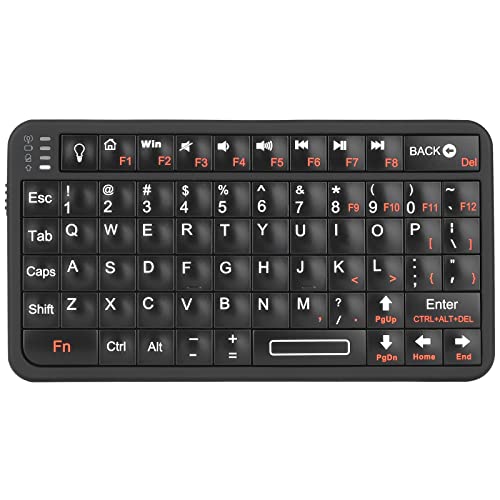 RII Rii Bluetooth Keyboard, Wireless Mini Keyboard with Backlit | Portable…
View on Amazon ↗
 SAMSERS Samsers Foldable Bluetooth Keyboard with Touchpad, Ultra Slim Compact,Black |…
View on Amazon ↗
 DOOHOEEK Doohoeek Universal Bluetooth Mini Keyboard, Wireless Compact Keyboard with Orange…
View on Amazon ↗
Listing names and images come from Amazon and are rechecked against the live listings; last checked Nov 8, 2026. No prices shown; the current price is on the listing.
About this guide. This guide is written from general knowledge of how phone Bluetooth keyboards are designed and how their parts wear. It does not examine any individual model, so verify the key pitch, cradle width, and hinge type on the listing before you buy.