A pancake lens succeeds when the mount matches your camera and the field of view fits your main subject. The widest aperture matters most for indoor portraits and low light, while a slower lens saves money but forces higher ISO. For APS C cameras, a 20 to 27 mm pancake gives a natural everyday view; a 16 mm design favors landscapes and tight rooms, and a 40 mm or longer lens suits headshots. The tradeoff is size versus light gathering: the slimmest designs usually have smaller maximum apertures.
Match the mount before any other spec
A pancake lens only works if the mount physically fits your camera body. Check the listing for the exact mount name, such as a mirrorless mount for your brand, and confirm it does not require an adapter. An adapter adds length and defeats the purpose of a pancake design.
On APS C cameras, the sensor crop changes the effective view. A lens marked 20 mm behaves like a longer lens on that body than it would on a full frame camera. Compare the field of view in the product images, not just the focal length printed on the barrel.
Field of view sets what you can shoot
Pancake lenses cluster into three practical views. A wide option, often 16 to 20 mm on APS C, captures whole rooms and broad landscapes but stretches faces near the edges. A normal option, around 20 to 27 mm on APS C, mimics your eyes and handles street scenes, groups, and everyday snapshots.
A short telephoto pancake, around 40 mm or longer on APS C, flatters faces and isolates subjects from busy backgrounds. This view suits indoor portraits and detail shots, but it feels cramped for landscapes or wildlife. Choose the field of view you use most, not the one that looks most impressive in a spec sheet.
Compact travel camera guides make the same point: a fixed lens camera only works when its field of view matches your usual subject.
Maximum aperture is the real light decision
The widest aperture, written as f/2.8, f/2, or similar, tells you how much light reaches the sensor. A lens with a smaller f number, such as f/2, helps indoor portraits and low light photography because you can keep the shutter speed fast without raising ISO too high.
A slower pancake, such as f/2.8, is often slimmer and cheaper, but it asks for more light. In a dim living room or at dusk, that means noisy images or motion blur. For wildlife shooting, a pancake lens is the wrong tool regardless of aperture: the focal length is too short and the subject too far.
Look for the aperture range in the listing. Some pancakes have a fixed maximum aperture, while others close down as you zoom, though most are fixed focal length designs.
Compare the main pancake designs
Three designs dominate: slow wide, fast wide, and normal or short tele pancakes. Each trades size, light, and framing in a different way.
| Design type | Typical view on APS C | Aperture range | Cleanup effort | Suits |
|---|---|---|---|---|
| Slow wide | Very wide, landscape or room | F/2.8 to f/4 | No moving parts, easy | Outdoor daylight, architecture |
| Fast wide | Wide, environmental portraits | F/1.8 to f/2 | No moving parts, easy | Low light, street, groups |
| Normal | Natural eye view | F/2 to f/2.8 | No moving parts, easy | Everyday carry, documentary |
| Short tele | Flattering headshots | F/2 to f/2.8 | No moving parts, easy | Portraits, details, food |
All pancakes share a simple optical design with few moving parts, so cleaning is limited to the front and rear elements. Check whether the lens has a built in hood or relies on the recessed front element to block stray light.
Which features earn their place
Autofocus speed depends on the motor design, not the lens size. A pancake lens can focus quickly for street scenes or slowly for video. Check the listing for the focus motor type and whether it supports silent autofocus if you record video.
A metal mount outlasts a plastic one if you change lenses often. Aperture control on the lens barrel helps if you shoot manual, while a lens without it relies on camera menus. Ignore claims about 'sharpness' without test images: sharpness varies more by copy and sensor than by marketing language.
For landscape photos, edge sharpness matters more than center sharpness. Compare sample images at the edges, not just the middle of the frame.
Mistakes that lead to a lens sitting unused
Buying a pancake lens for wildlife shooting is the fastest way to waste money. The focal length is too short to fill the frame with a distant animal, and cropping later destroys image quality. A telephoto lens is the right tool for that job.
Another mistake is ignoring the crop factor. A 40 mm pancake on a full frame camera behaves like a 60 mm lens on APS C, which changes portraits from environmental to tight headshots. Read the listing for the converted field of view if you shoot APS C.
Skipping the aperture check before buying for low light leads to noisy indoor photos. A slow pancake forces you to raise ISO or use a tripod, which defeats the handheld freedom a pancake promises.
Long term costs stay low, but check the hood
Pancake lenses have no consumables and rarely need professional cleaning. A bulb blower and a microfiber cloth handle most dust. The main long term cost is a lens cap or a slim filter if you want protection.
Some designs ship without a hood, and the recessed front element does not always block side light. A cheap screw in hood can improve contrast for landscape shots, but check the filter thread size before you buy one.
When a pancake is the wrong lens
Skip a pancake lens if your main subjects are wildlife, sports, or distant landscapes that need compression. The short focal length cannot pull those subjects close, and the small size does not compensate for the missing reach.
Also skip it if you need zoom flexibility. A pancake fixes you to one view, and switching to another lens mid shoot takes time. A compact zoom, though larger, covers more scenes without changing glass.
Pancake Lens Questions That Decide the Purchase
Is a pancake lens worth it for APS C cameras?
Yes, when you want a small everyday kit. An APS C camera pairs well with a pancake because the crop sensor keeps the lens short while the field of view stays practical. Check the mount and crop factor first, since the same focal length behaves differently than on full frame.
Which pancake lens is best for low light photography?
Look for the widest maximum aperture your budget allows, ideally f/2 or brighter. A fast wide or normal pancake lets you shoot handheld in dim rooms without pushing ISO too far. Compare the aperture, not the size, because the thinnest lenses are often the slowest.
What is the difference between a pancake lens and a regular prime lens?
A pancake lens is a prime lens designed to be extremely thin and light. It often has a simpler optical formula and a smaller maximum aperture than a larger prime. The image quality can be similar, but the pancake trades some light gathering for pocketability.
Can a pancake lens shoot landscapes?
A wide pancake, around 16 to 20 mm on APS C, works for landscapes if you stop down to f/5.6 or f/8 for edge sharpness. A normal or short tele pancake is too narrow for sweeping scenes. Compare edge sharpness in sample images before buying.
How do I compare two pancake lenses?
Hold the listings side by side and check mount, field of view, maximum aperture, and minimum focus distance. Then look at the build: metal mount, filter thread, and whether a hood is included. Ignore sharpness claims and compare sample photos at the edges.
Which Pancake Lens Fits Your Camera Bag
A photographer who shoots everyday scenes, indoor portraits, and low light gatherings should look for a normal or fast wide pancake with an f/2 or brighter aperture and a native mount. That combination keeps the kit small without forcing noisy high ISO shots. For landscape shooters who work in daylight and want the slimmest possible body, a slow wide pancake saves money and still delivers edge sharpness stopped down. The fast wide design is the wrong pick only when you need a telephoto reach for distant subjects, where no pancake can help.
Real pancake lens listings, so you can check the points in this guide against actual products. These are affiliate links: as an Amazon Associate we earn from qualifying purchases, at no extra cost to you.
 VILTROX VILTROX 28mm F4.5 XF Pancake Auto Focus Lens for Fujifilm…
View on Amazon ↗
 TTARTISAN TTArtisan AF 27mm F2.8 XF, APS-C Pancake Autofocus Lens for…
View on Amazon ↗
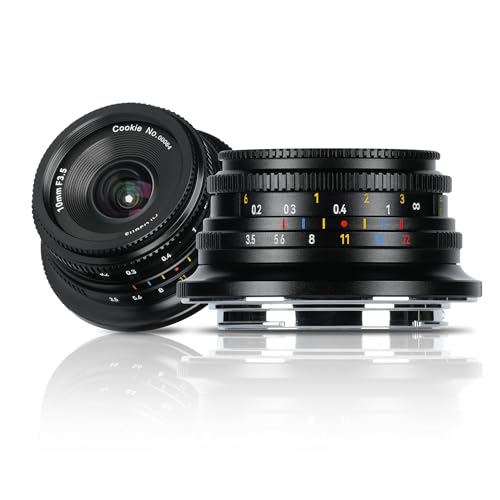 7ARTISANS 7artisans MF10mm F3.5 Wide-Angle Fixed Focus Pancake APS-C Lens Mirrorless…
View on Amazon ↗
Listing names and images come from Amazon and are rechecked against the live listings; last checked Nov 8, 2026. No prices shown; the current price is on the listing.
Scope and limits. Use this guide as a checklist to hold against any pancake lens listing you open. It explains the category in general, not any individual model, so verify mount fit, aperture, and field of view on the product page before you decide.