Match the rack to your cabinet depth first, then to the pans you actually own. Upright dividers suit deep cabinets and heavy pans. Layered racks suit shallow cabinets and lighter cookware. Pull out racks cost more but make daily cooking easier. The tradeoff is always stability versus access: a rack that holds pans tightly is slower to grab from.
Measure the Cabinet Before You Look at Any Rack
Cabinet depth is the number that rules out most pan organizer racks. Measure from the inside back wall to the inside of the closed door, then subtract at least an inch for hinges and the door itself. A rack that is technically 12 inches deep will not fit in a cabinet with 11.5 inches of usable depth.
Height matters less, but only if you store pans on their sides. Upright dividers need clearance for the tallest pan plus the rack's base. Layered racks need height for each layer plus room for your hand to reach in.
Width is the easiest to adjust. Most racks are adjustable or come in a few fixed widths. But do not buy an adjustable rack that only works at its widest setting if your cabinet is narrow. Check the minimum width, not the maximum.
For rental kitchens, assume you cannot change the cabinet. Look for racks that sit inside without screws or brackets. A rack with a flat, weighted base will stay put. One that needs to be mounted to the cabinet floor is a bad idea unless you own the place.
How Your Pans Decide the Rack Style
The pans you cook with most should drive the design. A set of heavy cast iron skillets works poorly in a layered rack. The weight sags the wires and the short sides let pans slide. Heavy pans want upright dividers with a sturdy base.
Light nonstick pans are the opposite. They slide into layered racks easily and do not need much support. But nonstick coatings scratch when pans rub against each other, so any rack that lets pans touch is a bad fit. Look for padded dividers or wide spacing.
Long handles are the hidden problem. A skillet with a 10 inch handle will stick out of a shallow cabinet even if the pan body fits. Before you buy, measure the total length of your longest pan, handle included, and compare it to the rack's depth.
Lids need a plan too. Some racks have a separate lid holder, which keeps them from sliding around. If your rack does not, store lids in a drawer or on a shelf above. Do not balance them on top of the rack; they will fall every time you pull a pan.
Upright, Layered or Pull Out: What Each Style Does
Upright dividers hold pans on their sides, like files in a drawer. They use vertical space well and keep pans from touching. This is the best style for deep cabinets and heavy cookware. The tradeoff is access: you have to lift a pan straight up, which takes two hands for a big skillet.
Layered racks stack pans horizontally, one above the other. They are easier to grab from and work in shallow cabinets. But they use more horizontal space per pan and do not hold heavy pans securely. They suit light pans, small kitchens and anyone who cooks quickly.
Pull out racks mount on slides so the whole rack rolls toward you. They solve the reach problem in deep, low cabinets and make daily cooking easier. They cost more, need a flat cabinet floor, and the slides add moving parts that can wear or jam.
Standalone towers sit on the counter or in a corner and hold pans in open cradles. They work well in kitchens with no spare cabinet space, but they take up counter room and collect dust. They are a fallback, not a first choice, unless your cabinet space is truly gone.
| Style | Cabinet fit | Pan weight | Ease of grab | Stability |
|---|---|---|---|---|
| Upright dividers | Deep cabinets | Heavy pans | Moderate, two hands | High |
| Layered rack | Shallow cabinets | Light pans | Easy, one hand | Moderate |
| Pull out rack | Deep, low cabinets | Mixed weights | Easy after sliding | High |
| Standalone tower | No cabinet needed | Mixed weights | Very easy | Moderate |
The table shows the core tradeoff. Upright dividers and pull out racks hold pans firmly but slow you down. Layered racks and towers let you grab fast but hold pans less securely. Pick based on how often you cook and how much you hate clatter.
What to Check in the Listing Before You Buy
First, check the exact dimensions in the listing, not the title. Many racks are listed by their widest setting. A rack that says 'adjustable 8 to 14 inches' may not work at 8 inches if the base is fixed at 14. Look for the minimum and maximum width in the product details.
Check the material and finish. Bare steel rusts in humid kitchens. Powder coated steel resists rust and is easier to clean. Chrome looks shiny but chips over time. For a rental with poor ventilation, pick powder coated or plastic.
Look at how the rack contacts the cabinet. Rubber feet or a padded base stop it from scratching the shelf. A rack with bare metal edges will gouge a wood cabinet the first time you slide it. If the listing does not mention the base, assume it is bare metal.
Ask the seller only about the one thing the listing does not show: the exact interior depth at the narrowest setting. Everything else should be in the photos or description. If the seller cannot answer that, find a different rack.
Small Kitchens and Rental Flats Have Different Problems
In a small kitchen, counter space is precious. A pan organizer rack that lives inside a cabinet saves that space. A standalone tower does the opposite, so skip it unless every cabinet is already full.
Rental flats usually mean shallow, older cabinets. Many are 11 inches deep or less. Upright dividers often do not fit, so a layered rack is the more realistic choice. Check the depth before you fall in love with a design.
Meal prep cooks use more pans per session but not necessarily heavier ones. A layered rack that lets you pull a sheet pan without moving a skillet saves time. Look for racks with open fronts or low sides.
Family pantries often store pans alongside pots, lids and baking sheets. A rack with a separate section for lids keeps the whole cabinet organized. If the rack is only for pans, plan where lids will go before you buy.
Mistakes That Make a Rack Useless
The biggest mistake is buying for the pans you wish you had instead of the pans you own. A rack with slots for 12 frying pans is useless if you own three skillets and a Dutch oven. Match the rack to your actual cookware, not a fantasy kitchen.
Ignoring handle length is a close second. A pan with a long handle will stick out of a shallow cabinet and block the door. Measure your longest pan, handle included, and compare it to the rack's depth before buying.
Overloading a layered rack is a common failure. The wires sag, the pans tilt and eventually the rack bends. Check the weight rating if the listing gives one. If it does not, assume it holds only light pans.
Buying a rack that needs assembly you cannot do is a waste. Some racks require screwing into the cabinet floor, which is fine if you own the place and have a drill. In a rental, choose a rack that simply sits on the shelf.
Care and Long Term Costs
Most pan organizer racks need almost no care. Wipe them down when you clean the cabinet, and check the joints every few months. Screwed connections can loosen, and a wobbly rack will scratch both the cabinet and the pans.
The only real consumable is the finish. Powder coating can chip if you slide heavy pans across it. Once bare metal shows, the rack may rust. You can touch up small chips with enamel paint, but a heavily chipped rack should be replaced.
Pull out racks have the highest long term cost because the slides wear out. Cheap slides jam after a year of daily use. If you choose a pull out rack, look for ball bearing slides, which last longer than roller slides.
Beyond that, a good pan organizer rack is a one time purchase. It does not need filters, batteries or replacement parts. The main ongoing cost is the time you save by not digging through a pile of pans.
When to Skip a Pan Organizer Rack
Skip a rack if you own fewer than four pans. A drawer or a simple shelf stack works fine and costs nothing. A rack only earns its space when you have enough pans to make stacking a problem.
Skip a rack if your cabinet is unusually shallow, under 9 inches deep. Most racks will not fit, and the ones that do hold pans so loosely they fall over. In that case, store pans on a wall mounted rail or in a deep drawer instead.
Skip a rack if you store your pans in a drawer. Drawer dividers do the same job better because the drawer sides already hold pans upright. A rack inside a drawer is redundant and wastes drawer height.
Skip a rack if you cook only occasionally and do not mind a stack. The main benefit of a rack is daily access. If you pull out a skillet twice a week, a simple pile is not a real problem.
Pan Organizer Questions, Answered Directly
Is a pan organizer rack worth it for a small kitchen?
Yes, if you use your pans often and the cabinet is deep enough. A rack turns a jumbled pile into pans you can grab one handed, which matters when you cook daily. If you cook rarely or the cabinet is under 9 inches deep, a simple stack or a drawer divider works just as well.
Which pan organizer rack works in a narrow cupboard?
A layered rack is usually the best fit for a narrow cupboard because it uses horizontal space efficiently and does not need tall dividers. Check the minimum width setting, not the maximum, and make sure the total depth including handles fits your cabinet. Upright dividers rarely work in cupboards under 11 inches deep.
What is the difference between upright and pull out pan organizers?
Upright organizers hold pans on their sides in fixed dividers. Pull out organizers mount on slides so the whole rack rolls out of the cabinet. Upright racks are cheaper and need no installation, but you must lift pans straight up. Pull out racks cost more and need a flat cabinet floor, but they give full access to deep cabinets.
How do I compare two pan organizer racks?
Compare the minimum and maximum width, the total depth, and the weight rating. Then compare the material: powder coated steel resists rust better than chrome. Finally, check the base. Rubber feet protect the cabinet shelf. If two racks are otherwise equal, pick the one with padded dividers to protect nonstick pans.
Can I use a pan organizer rack in a rental flat?
Yes, but choose a freestanding rack that sits on the shelf without screws or brackets. Most rental cabinets are shallow, so measure the depth first. A layered rack with a weighted base is the safest choice. Avoid any rack that requires drilling into the cabinet.
Which Pan Organizer Rack Should You Get?
If you cook daily in a standard or deep cabinet and own at least one heavy pan, buy a sturdy upright divider rack with padded slots and a powder coated finish. It will hold everything firmly without rusting. But if your cabinet is under 11 inches deep, or you live in a rental with narrow cupboards, pick a layered rack instead. You will trade some stability for a rack that actually fits and lets you grab a skillet one handed.
Real pan organizer rack listings, so you can check the points in this guide against actual products. These are affiliate links: as an Amazon Associate we earn from qualifying purchases, at no extra cost to you.
 HOUSOLUTION Housolution Pot and Pan Lid Organizer Holder Storage Rack, Black…
View on Amazon ↗
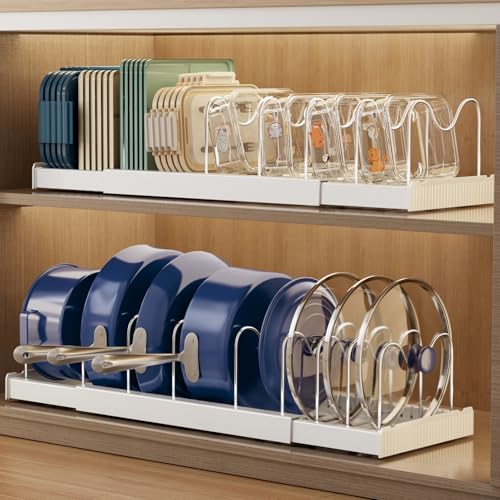 MAGHEO Magheo 2 Pack Expandable Food Storage Container Lid Organizers, 22"…
View on Amazon ↗
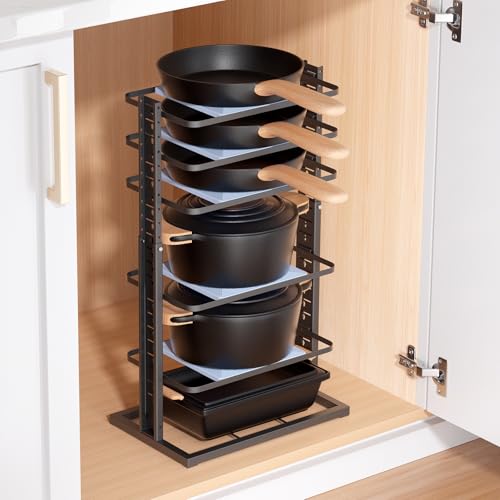 LAMU LAMU Pots and Pans Organizer for under Cabinet, 6-Tier Heavy…
View on Amazon ↗
Listing names and images come from Amazon and are rechecked against the live listings; last checked Nov 8, 2026. No prices shown; the current price is on the listing.
About this guide. This guide covers the pan organizer rack category as a whole, not any individual model. It is written from general knowledge of how these racks are designed and used, without reading product documents, reviews or tests. Always confirm the exact dimensions and weight rating on the listing before you buy.