Start with the tabletop material, because it sets weather resistance and maintenance. Then measure your space for both the tabletop and the space a chair needs to pull out. Finally, check the base, since a central pedestal saves legroom on small patios while four legs feel more stable on uneven ground.
Read the Tabletop Material First
The tabletop is the part that meets sun, rain, spilled drinks, and hot serving dishes. That makes it the first spec to check. A material that works for a shaded porch may fail on a full sun balcony.
Metal tables, usually aluminum or powder coated steel, shrug off rain and wipe clean easily. Aluminum is lighter and never rusts, which helps if you move the table for storage. Steel is heavier and sturdier in wind, but any deep scratch needs touch up paint to stop rust.
Wood looks warm and hides small scratches well. Teak contains natural oils and lasts outdoors for many seasons, but it weathers to silver gray unless you oil it regularly. Softwoods like pine or acacia cost less, but they absorb water and need a fresh sealant coat each year to avoid warping or black stains.
Resin and poly lumber, made from recycled plastics, resist moisture and never need sealing. The tradeoff is weight and look. Some resin tables look close to painted wood, while others have a plastic sheen that stands out on a natural patio.
Glass tabletops look elegant but demand constant wiping, show every water spot, and can shatter if a heavy pot lands on an edge. Tempered glass is safer but still heavy to move. For most outdoor dining, skip glass unless the table sits under a solid roof and you enjoy polishing.
Measure the Space a Chair Needs, Not Just the Table
A patio table that fits the floor space can still feel cramped when people sit down. Measure the tabletop, then add the clearance a chair needs to pull out and a person needs to walk behind it.
Allow 30 to 36 inches from the table edge to the nearest wall, railing, or planter. That gives room for a chair to slide back and for someone to pass. On a narrow balcony, this often means choosing a round table 36 inches across or a rectangular table under 48 inches long.
Think about the seating count you actually use weekly, not the maximum for one holiday meal. A four seater that fits daily life beats a six seater that blocks the grill. For small balconies, a folding or drop leaf table can expand for guests and shrink for everyday use.
Check the table height as well. Standard dining height is 28 to 30 inches, which matches most outdoor dining chairs. Counter height tables at 34 to 36 inches need taller stools and feel less stable on a breezy balcony.
- Measure the tabletop plus 30 to 36 inches on every side for chair pull out
- Test whether a chair can slide fully under the table without hitting the base
- On a balcony, choose a round or drop leaf table if space is tight
The Base Decides Knee Room and Stability
Two tables with the same top can feel completely different because of what holds them up. The base design changes how many chairs fit, how stable the table sits, and whether knees knock against a central post.
Four leg tables are the most stable on uneven pavers or lawn. Each leg finds its own contact point, so the table rarely rocks. They also allow chairs to slide in from any side. The downside is that corner legs can block the person sitting at the corner.
A central pedestal base frees the whole perimeter for knees and chairs. This works well on a small round table where every seat is at the edge. Pedestal tables, however, can tip if someone leans hard on one side, and they wobble more on uneven ground.
Trestle bases, with two end supports and a crossbar, offer a middle ground. They feel stable and allow chairs on the long sides, but the crossbar can limit legroom for the end seats. Check the clearance between the crossbar and the tabletop before choosing this style.
Which Features Matter and Which Are Marketing
Some listed features change daily use; others just sound good on a box. Knowing the difference keeps you from paying extra for a coating you will never notice.
An umbrella hole is genuinely useful if you eat in direct sun. Check the hole diameter, usually 1.5 to 2 inches, and whether the table includes a plug for days without an umbrella. A table without a hole can still use a freestanding offset umbrella, which shades better but takes floor space.
Powder coated finishes on metal resist scratches and rust better than liquid paint. Look for this wording in the listing. A UV resistant clear coat on wood slows fading but does not replace annual oiling.
Marketing phrases like weatherproof, all season, or commercial grade often mean the material resists moisture, not that it ignores it. Any outdoor table still needs cleaning and, for wood, sealing. Check what the warranty actually covers and for how long before paying a premium.
Small Balconies and Rental Gardens Need Different Tables
The same table that anchors a family patio can overwhelm a balcony. Match the table to the space and how permanent it needs to be.
On a small balcony, a round table 32 to 36 inches across seats two comfortably and leaves room for plants or a small grill. A folding table that hangs on a wall hook frees the floor entirely when not in use. Look for a table under 35 pounds so one person can move it.
In a rental garden, you want a table that does not need to stay. A lightweight aluminum set moves easily when the lease ends. Avoid heavy concrete or stone tables that require two people and a truck.
Family patios with room for six or eight people need a table at least 60 inches long or 54 inches wide. A rectangular table fits more people along a wall or fence, while a round table makes conversation easier but uses more floor space for the same seating count.
Care and Long Term Costs Hide in the Material
The purchase price is only the start. The real cost of an outdoor dining table includes the covers, oils, cleaners, and storage you will use every year.
Metal tables need the least care: a wipe with mild soap and water, plus touch up paint for scratches. Aluminum can handle being left uncovered all year in most climates. Steel lasts longer if you cover it in winter or store it in a shed.
Wood tables cost more in time than money. Teak needs cleaning twice a year and oiling once a year if you want to keep the honey color. Softwoods need sanding and resealing every spring. A fitted cover, around the size of the table, keeps rain and bird droppings off when not in use.
Resin and poly lumber tables need almost no maintenance but can fade in strong sun. A cover slows the fading. Glass tops need glass cleaner and a soft cloth after every meal, which adds up over a season.
If you live somewhere with snow or months of rain, budget for a cover or indoor storage. A table that stays wet under a cover can grow mildew, so choose a breathable cover or store the table dry.
Mistakes That End in a Return
Most returns happen because the table looked right in a photo but failed in the real space. Checking a few details in the listing prevents that.
Assuming all outdoor tables are weatherproof is the biggest mistake. Some wood tables are meant for covered porches only. The listing may say 'suitable for covered use' or 'requires sealing'. Read that line before you buy.
Buying by seating count alone ignores chair clearance. A six seater table can be 60 inches long, which may not fit a 10 foot balcony once chairs pull out. Check the full footprint, not just the tabletop.
Forgetting the delivery weight matters on a balcony or upstairs deck. A stone or concrete table can weigh over 150 pounds and may need professional delivery. Check the shipping weight and whether the carrier brings it to the door or just the curb.
Skipping the assembly instructions leads to surprises. Some tables arrive as a flat pack with dozens of bolts and an Allen key. Others need two people to flip the top. If you live alone, look for a table that ships mostly assembled or has a simple base.
| Material | Weather resistance | Care effort | Best placement | Watch for |
|---|---|---|---|---|
| Aluminum | Excellent, no rust | Low, wipe clean | Open patios, balconies | Can feel light in wind |
| Steel | Good with powder coat | Low, touch up scratches | Sheltered patios | Rust at scratches |
| Teak | Excellent, natural oils | Medium, annual oiling | Sunny or shaded patios | Silvers without oil |
| Pine or acacia | Fair, needs sealant | High, yearly resealing | Covered porches | Warping, stains |
| Resin or poly | Excellent, no sealing | Very low, hose off | Full sun, poolside | Fades, looks plastic |
Use this table as a checklist against any listing. If the material row says 'covered porches' but your patio is open, move on.
You can compare two tables of the same material by weight, thickness, and finish. A heavier gauge aluminum or thicker poly board usually means a sturdier table that will not dent or sag.
When a Different Piece of Outdoor Furniture Works Better
An outdoor dining table is not the answer for every patio. Sometimes a smaller or more flexible piece serves the space better.
If you mostly eat alone or with one other person and never host meals outside, a small bistro table or a side table with two chairs may be enough. It leaves more room for a lounge chair or plants.
If your patio is a walkway or a narrow strip, a bar height table along a railing can create a dining spot without blocking the path. The same space that cannot fit a standard table and chairs can hold a narrow ledge with stools.
If you want a place for drinks and snacks but eat meals indoors, consider a coffee table with outdoor seating instead. It costs less and keeps the patio open. Related guides on patio chair tradeoffs and garden bench checks can help with the seating side.
Outdoor Dining Table Questions Before You Buy
What size outdoor dining table do I need for 6 people?
A rectangular table 60 to 72 inches long seats six comfortably, with three chairs on each long side. A round table needs to be at least 54 inches across for six chairs. Measure your patio and add 30 to 36 inches on every side for chair pull out before deciding.
Is a glass top outdoor dining table safe?
Tempered glass is safer than standard glass because it breaks into small cubes instead of sharp shards. Still, glass tops are heavy, show every fingerprint, and can crack if a heavy pot lands on an edge. They work best on a covered porch where you can clean them often.
How do I keep a wood outdoor table from turning gray?
Apply a UV resistant oil or sealant once a year, usually in spring before the sunny season. Clean the table first with a wood cleaner, let it dry fully, then brush on the oil. Teak can go gray without harm, but softwoods need the sealant or they will crack and warp.
Can I leave an aluminum outdoor table outside in winter?
Yes, aluminum does not rust and can stay outside year round in most climates. Wipe it down before winter and remove any standing water from the frame. A cover helps keep off leaves and ice, but it is not required for the metal itself.
Which is better for a small balcony, a round or rectangular table?
A round table usually works better because it has no corners to bump into and allows chairs to tuck underneath evenly. Choose one 32 to 36 inches across for two people. A narrow rectangular table can work along a railing if the balcony is long but not wide.
The Table to Hold Against Your Listing
A buyer with a standard patio, four to six regular diners, and no storage space should start with an aluminum table 48 to 60 inches long. It resists weather, wipes clean, and moves easily. If you eat outside only occasionally on a small balcony, a folding round table under 40 inches across makes more sense, since it can hang on a wall hook and leave the floor open.
Real outdoor dining table listings, so you can check the points in this guide against actual products. These are affiliate links: as an Amazon Associate we earn from qualifying purchases, at no extra cost to you.
 PATIO IN PATIO-IN Cast Aluminum Patio Table,48" Round Patio Dining Table for…
View on Amazon ↗
 OAKLAND LIVING Oakland Living 1923-ROUND-48-MODERN-TABLE-LBK Modern Outdoor Mesh 48-in Aluminum Black Round…
View on Amazon ↗
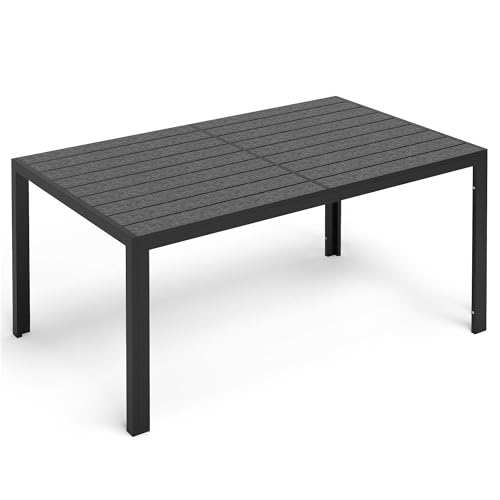 PIZZELLO PIZZELLO Patio Dining Table for 6, 59" Rectangular Outdoor Patio…
View on Amazon ↗
Listing names and images come from Amazon and are rechecked against the live listings; last checked Nov 8, 2026. No prices shown; the current price is on the listing.
Scope and limits. Use this guide as a checklist to hold against any listing you open, not as a verdict on a particular model. It is written from general knowledge of outdoor dining tables, so verify dimensions and material details on the product page before ordering.