Start with the vehicle's clearance and weight, because those two numbers rule out most jacks. Then compare lift range and saddle height, since a jack that cannot reach the frame or lift high enough is useless. Buyers with a low sedan and a flat garage can use a standard low profile jack. Buyers with a truck or SUV need a taller lift, a stronger frame, and often a higher price tier.
Match the jack to the vehicle, not the garage wall
Measure the distance from the ground to the frame rail or pinch weld at the front and rear jacking points. A saddle that cannot slide under that point is a nonstarter. Check the listing's minimum saddle height, not just the collapsed height of the whole jack.
Then check the maximum lift height. You need enough stroke to raise the wheel off the ground by at least an inch or two, plus room for a jack stand. A jack that tops out too low forces you to stack blocks, which is unsafe.
Ground clearance and lift height vary by vehicle. A lowered car may need a saddle under 3 inches. A stock pickup may need a saddle over 5 inches and a lift over 20 inches. Compare the jack's range to your vehicle's numbers before anything else.
Read the listing like a shop manual
Look for the rated capacity in tons or pounds. That rating applies to the entire jack, but vehicles rarely distribute weight evenly. A 3 ton jack is common for cars and small SUVs. A 2 ton jack may be enough for a compact sedan but leaves little margin.
Check the lift range as two numbers: minimum saddle height and maximum lift height. A single number is incomplete. Also look for the chassis length and width, because a short frame is less stable under a long vehicle.
Ask the seller for the saddle diameter and the release valve position if those are not listed. A small saddle can dent a pinch weld. A release valve under the handle is easier to control than one you reach with a separate bar.
- Rated capacity in tons or pounds
- Minimum saddle height and maximum lift height
- Chassis length and width
- Saddle diameter and pad material
- Handle length and release valve position
Heft and frame design separate a tool from a hazard
A heavier jack is not automatically better, but a very light jack with a high capacity claim deserves suspicion. Steel frames bend and twist under load. Compare the listed weight against similar jacks. A 3 ton jack that weighs 25 pounds is likely built from thinner steel than a 50 pound alternative.
Look at the frame layout. A wide, low chassis with a long wheelbase resists tipping when the vehicle shifts. A narrow, tall chassis is fine on a flat slab but gets sketchy on a sloped driveway.
Check the saddle pad material. A rubber pad protects the frame and reduces slipping. A bare steel saddle can scratch coatings and slide on smooth frame rails.
Release control and the slow descent
The release valve is the one control you use every time. A knob or lever that opens in small increments lets you lower the vehicle slowly. A valve that dumps pressure all at once can drop the vehicle onto a stand or your hand.
Look for a handle that doubles as the release control or a clearly marked separate knob. Avoid designs where the release is a bare bolt you turn with a wrench. Also check whether the handle has a padded grip and a two piece design that stores under the jack.
The pump piston and cylinder should be visible in the listing photos. A chrome plated ram resists rust better than a raw steel one. Rust on the ram tears the seals and causes the jack to creep down under load.
Long term care starts before the first lift
Hydraulic jacks need oil. Check whether the listing states the oil type and whether the fill plug is accessible. A jack that ships dry or leaks from the start will fail early. Compare the warranty length and what it covers, since seals and valves are the usual failure points.
Store the jack with the ram retracted and the release valve closed. Keep it off bare dirt, because moisture rusts the frame and the ram. If you live near the coast or use the jack outdoors, look for a powder coated frame and a plated ram.
Replacement parts matter. Some jacks use common O rings and U cups you can buy at a hydraulic supply shop. Others use proprietary seals available only from the importer. Check whether the seller lists a parts diagram or seal kit before you buy.
Where a floor jack is the wrong tool
A floor jack is for lifting, not holding. Never work under a vehicle supported only by a jack. You need jack stands rated for the vehicle weight, and the jack's lift height must clear the stands.
A floor jack is overkill for a roadside flat tire. A compact scissor jack or bottle jack rides in the trunk and weighs a fraction. A floor jack belongs in a garage with a flat, hard floor.
If you work on a gravel driveway or grass, a floor jack's small steel wheels sink and the jack tips. A bottle jack on a plywood base is more stable on soft ground, though it has less lift range.
Some vehicles have no central jacking point. A floor jack with a long saddle can bridge two frame rails, but a unibody car often needs a jack pad adapter that fits the pinch weld. Check your vehicle's jacking points before assuming a floor jack will work.
Home garage picks by vehicle height
| Vehicle | Saddle height | Lift range | Capacity |
|---|---|---|---|
| Low sports car | Under 3 in | 3 to 15 in | 2 ton |
| Sedan or small crossover | 3 to 4 in | 4 to 18 in | 2.5 to 3 ton |
| Pickup or full size SUV | Over 5 in | 5 to 22 in | 3 ton or more |
These ranges are starting points. Check your vehicle's actual jacking points and the jack's published specs before buying. A 3 ton jack with a 20 inch lift covers most home garages, but a low car may still need a lower saddle.
Mistakes that send a jack back or to the scrap pile
Buying by capacity alone is the most common error. A 3 ton jack that cannot reach the frame or lift high enough is worthless. Always check the lift range first.
Ignoring the saddle diameter leads to bent pinch welds and cracked rocker panels. A saddle wider than the jacking point spreads the load onto soft metal. Compare the saddle size to the vehicle's recommended jacking surface.
Assuming a jack is safe on any floor is another mistake. A floor jack needs a smooth, level, hard surface. Sloped garage floors and asphalt driveways let the jack roll or sink, which can drop the vehicle.
Skipping the release valve check turns a simple oil change into a panic. A fast release drops the vehicle too quickly to position a jack stand. Look for a controlled, metered release before you buy.
Hydraulic Floor Jack Questions, Answered
Is a 3 ton floor jack enough for my truck?
A 3 ton jack usually works for a half ton pickup, but check the vehicle's gross weight and the jack's lift range. A full size truck can weigh over 7,000 pounds, so a 3 ton jack leaves little margin. More importantly, the saddle must reach the frame and the jack must lift high enough to clear the tires.
What is the difference between a low profile and a standard floor jack?
A low profile jack has a saddle that sits closer to the ground, often under 3 inches, so it slides under lowered cars. It usually gives up some maximum lift height. A standard jack has a higher saddle, often 4 to 5 inches, and a taller lift. Choose based on your vehicle's ground clearance.
Can I leave a car on a floor jack overnight?
No. A floor jack is a lifting device, not a support. Hydraulic seals can creep and the vehicle can drop. Always lower the vehicle onto jack stands rated for its weight before working underneath or leaving it raised.
Which floor jack is better, aluminum or steel?
Steel jacks are heavier and often more rigid, which helps stability. Aluminum jacks are lighter and easier to move but can flex under load. For a home garage where the jack stays put, steel is a solid choice. For a mobile mechanic, aluminum saves your back.
How do I know if a floor jack will fit under my car?
Measure from the ground to the frame rail or pinch weld at the front and rear jacking points. Compare that to the jack's minimum saddle height. Leave at least half an inch of clearance. If the saddle is too tall, you need a low profile jack or a ramp.
The Floor Jack That Fits a Home Garage
Someone changing oil on a sedan or small crossover in a flat garage should buy a 3 ton steel jack with a saddle height around 3 to 4 inches and a lift range up to 18 inches. That covers most home vehicles with margin. If you drive a lowered car, pick a low profile jack with a saddle under 3 inches, even if it costs more. If you drive a lifted truck, skip the standard jack and get a high lift model with a saddle over 5 inches and a lift over 20 inches.
Real hydraulic floor jack listings, so you can check the points in this guide against actual products. These are affiliate links: as an Amazon Associate we earn from qualifying purchases, at no extra cost to you.
 MAXORITY Maxority 3-Ton (6600lbs) Low Profile Hydraulic Heavy-Duty Steel Floor Jack…
View on Amazon ↗
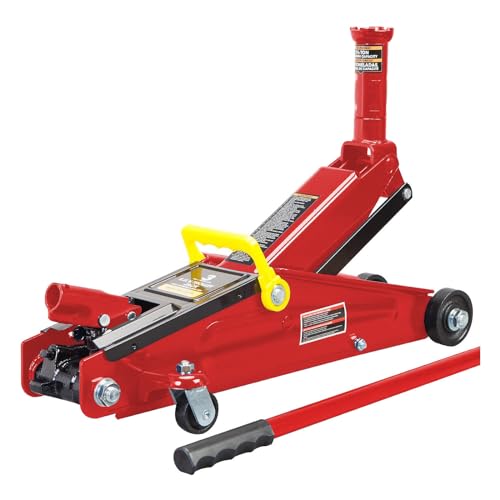 BIG RED BIG RED Hydraulic Trolley Service/Floor Jack with Extra Saddle (Fits:…
View on Amazon ↗
 AV STEEL AV Steel 3 Ton Floor Jack (6000 lbs), Single Piston…
View on Amazon ↗
Listing names and images come from Amazon and are rechecked against the live listings; last checked Nov 8, 2026. No prices shown; the current price is on the listing.
Scope and limits. Use this guide as a checklist to hold against any floor jack listing. It covers the product type, not individual models, and it is written from general category knowledge without testing specific jacks. Verify every dimension on the listing before you buy.