Focus on three factors: the child's developmental stage, the type of thinking the puzzle actually exercises, and whether it invites repeat play. A puzzle that is too easy becomes a one time craft; one that is too hard gets abandoned. The main tradeoff is between open ended exploration and structured skill practice. Buy for the child in front of you, not the grade on the box.
Match the Puzzle to the Child, Not the Label on the Box
Age ranges on educational puzzles are a starting point, not a promise. A four year old who loves sorting may outgrow a 3+ matching puzzle in a week. An eight year old who struggles with spatial tasks may find a 6+ tangram set genuinely hard. Compare the task itself to what the child already does.
Look past the number and check what the child must do. Counting pieces, matching shapes, placing a piece in one correct spot, following a sequence, or solving a logic rule each ask for a different kind of thinking. A puzzle that asks for a skill the child is just starting to practice will hold attention longer than one that repeats mastered skills.
For homeschool families, the best fit is often a puzzle that sits at the edge of current ability. It should feel doable with effort, not instantly solvable or frustratingly abstract. That zone is where the learning happens, and it is the same zone that keeps a child coming back on a rainy day.
Three Kinds of Challenge, Three Kinds of Learning
Educational puzzles fall into a few broad challenge types. Spatial puzzles, like tangrams and pattern blocks, build mental rotation and part to whole reasoning. Logic puzzles, like grid deduction or sequencing sets, build systematic thinking. Memory and matching puzzles build visual discrimination and recall.
A money educational puzzle, for example, usually combines matching faces and values with counting. That is a double challenge: recognizing coins and doing small sums. Check whether the child can do both parts, or whether the coin recognition is the real lesson for now.
Classroom use favors puzzles with clear rules and a fast check. A teacher can glance at a completed grid or a matched set. Open ended pattern puzzles are harder to assess but better for free choice time. Decide which role the puzzle needs to fill before comparing options.
- Spatial puzzles: tangrams, pattern blocks, jigsaw maps, layered scenes.
- Logic puzzles: grid deduction, sequencing cards, coding path games, number lines.
- Memory and matching puzzles: pairs, sorting trays, coin or clock matching, letter sound sets.
What a Listing Tells You Before You Buy
A product listing for an educational puzzle should answer three questions without you having to ask the seller. What is the exact task? What is the material and piece size? How many pieces and how many possible solutions? If the listing is vague on any of these, dig deeper or move on.
Check the material first. Wood puzzles with printed paper layers can peel after a few months of daily use. Cardboard puzzles with thin pieces bend and tear. Plastic puzzles survive water and drops but often have looser fits. For classroom use, look for thick pieces with a smooth finish and no sharp edges.
Piece size matters more than piece count. A 48 piece floor puzzle with large pieces is easier for small hands than a 48 piece table puzzle with small ones. Count the pieces in the photo, not just the number on the box. If the listing does not show a piece next to a hand or a coin, ask the seller for dimensions.
Repeat Value Separates a Lesson From a One Time Craft
Some educational puzzles have exactly one solution and no reason to do them twice. A child completes the map, sees the picture, and never touches it again. That is not a bad thing, but it is a different thing from a puzzle that can be solved several ways or at several levels.
Open ended puzzles like pattern blocks offer many solutions. A child can build the same shape three ways or invent new shapes entirely. That kind of repeat value is what makes a puzzle worth keeping on a homeschool shelf. It also makes a better birthday gift, because the child will still be using it months later.
Structured puzzles can still have repeat value if the difficulty ramps up. A logic puzzle set with 40 cards from easy to hard gives a child a reason to come back. Check whether the set includes a progression of challenges, not just more pieces of the same difficulty.
| Challenge type | Solution style | Repeat value | Best for |
|---|---|---|---|
| Pattern blocks | Many possible solutions | High, with open ended play | Homeschool free time, creative kids |
| Layered puzzles | One correct order | Low, once the order is known | Quick lessons, preschool concepts |
| Logic grid sets | One correct answer per card | High, with leveled card sets | Classroom stations, independent work |
| Matching and sorting trays | Fixed matches | Low to medium, depends on variety | Money and clock lessons, rainy days |
A puzzle's repeat value is not just a feature. It is the difference between a learning tool and a box that lives in a closet. For a birthday gift, choose a puzzle the child can grow into, not one they will finish before the party ends.
The Piece Count Question Nobody Asks
More pieces do not always mean more learning. A 100 piece jigsaw of the solar system teaches patience and image matching. A 12 piece layered puzzle of the human body teaches anatomy and sequence. The second has fewer pieces but a clearer lesson.
Piece count matters most for time and frustration. A child who can sit for ten minutes needs a puzzle that finishes in that window or offers a natural stopping point. A puzzle that takes an hour is a weekend project, not a daily lesson. Match the piece count to the attention span, not the age on the box.
For classroom use, piece count also affects clean up and storage. A 200 piece puzzle that spills is a twenty minute recovery. A set of 20 chunky pieces in a tray is a two minute reset. Think about who will put it away before you buy.
Clever Storage Is Part of the Puzzle
Educational puzzles with many small pieces need a home. A tray puzzle keeps pieces contained but limits the play surface. A boxed puzzle with a lid is fine if the child can open and close it. A puzzle that comes in a flimsy bag will lose pieces within a month.
Check the listing photos for the storage solution. Does the box show a lid? Are the pieces in a tray or loose? A puzzle without decent storage is a puzzle you will replace sooner. That is a long term cost many buyers forget.
For homeschool families, storage also means shelf space. A set of five puzzles in five bulky boxes eats a shelf. A set of five puzzles in one divided box is a better use of a small learning corner. Compare the shelf footprint before you compare the price.
When a Different Toy Does the Job Better
Educational puzzles are not the only way to build thinking skills. A child who hates sitting still may learn more from a coding robot that moves than from a logic grid. A child who needs to calm down may get more from a fidget with the right resistance than from a matching tray.
Building sets like a construction block set for small spaces teach spatial reasoning with more open ended play than most puzzles. If the goal is creative problem solving, blocks may be the better pick. If the goal is focused, rule based practice, a puzzle wins.
Consider what the child already has. A homeschool shelf full of puzzles does not need another one. A classroom with no logic activities may benefit more from a puzzle than from another art supply. Buy the gap, not the category.
Mistakes That Lead to a Shelf Full of Unused Puzzles
The most common mistake is buying for the age on the box instead of the child in the room. A puzzle labeled 4+ may bore a bright four year old or frustrate a four year old who is still working on fine motor control. Watch the child solve a similar puzzle before you commit.
Another mistake is buying a puzzle that teaches a skill the child already has. A child who can count to 100 does not need a counting puzzle. A child who can read simple words does not need a letter matching set. Look for the next step, not a repeat of last year.
Ignoring the material is a quiet budget killer. A cheap cardboard puzzle that bends on day three is not a bargain. A wood puzzle with splinters is worse. Check the finish and the thickness in the photos, and read the listing for the material before you pay.
Educational Puzzle Questions Worth Asking Before You Buy
What age should a child start educational puzzles?
Most children can handle simple knob or chunky piece puzzles around age two, and matching or sequencing puzzles by age three or four. Start with puzzles that have large pieces and one clear task, like putting a shape in its spot. Move to logic and multistep puzzles when the child can follow a two step instruction without help.
How do I know if an educational puzzle is too hard?
Watch for signs of frustration: the child throws pieces, asks for help on every step, or walks away within two minutes. A puzzle that is slightly hard should feel like a stretch, not a wall. If the child cannot explain what the puzzle is asking them to do, it is too abstract for right now.
Are wooden educational puzzles better than cardboard ones?
Not always. Wood puzzles last longer and feel nicer, but they cost more and often have printed paper layers that can peel. Cardboard puzzles are cheaper and come in more themes, but thin pieces bend and tear. For daily use or classroom use, choose thick pieces in either material and avoid anything with a paper thin finish.
Can educational puzzles be used for multiple children at once?
Yes, if the puzzle allows parallel play or a shared goal. Pattern blocks and large floor puzzles let two or three children work side by side. Logic grid puzzles are usually solo tasks. For classroom use, choose puzzles that can be split into stations or that a pair can solve together without fighting over pieces.
What makes a good educational puzzle for a birthday gift?
Pick a puzzle that matches the child's current interest and sits just above their current skill level. Open ended puzzles like pattern blocks have the longest gift life because they can be used many ways. Avoid puzzles with a single fixed solution unless the child is deeply into the theme.
The Puzzle That Earns a Spot on the Shelf
A child who enjoys building and inventing will get the most long term use from a set of pattern blocks with a few design cards. The open ended nature means it teaches spatial reasoning without feeling like a worksheet, and it grows with the child. For a child who needs focused, rule based practice, skip the pattern blocks and choose a leveled logic grid set instead. That structured option works better for classroom stations and for kids who like clear right answers.
Real educational puzzle listings, so you can check the points in this guide against actual products. These are affiliate links: as an Amazon Associate we earn from qualifying purchases, at no extra cost to you.
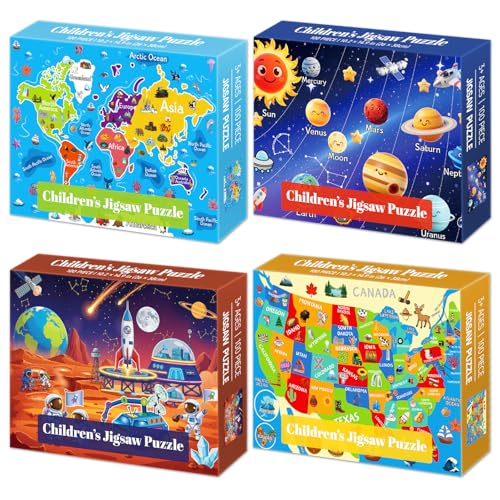 KAZMIDO 4 Packs 100 Piece Puzzles for Kids Ages 4-6 6-8…
View on Amazon ↗
 GENIUS GAMES Human Anatomy Kids Floor Puzzle - Dr Livingston Jr's 100-Piece…
View on Amazon ↗
 QUOKKA 100 Piece Puzzles for Kids Ages 6-8 - 3 Jigsaw…
View on Amazon ↗
Listing names and images come from Amazon and are rechecked against the live listings; last checked Nov 8, 2026. No prices shown; the current price is on the listing.
About this guide. Use this guide as a checklist to hold against any educational puzzle listing. It describes the category in general, not any individual model, so verify the exact piece size, material, and challenge type on the product page before you buy.