Start with water supply: built in tank or faucet hookup. Then check drying method, because many countertop units leave dishes wet unless they have a heated dry or fan. Finally, match capacity to your real dish load. A person washing for one or two can live with a 4 to 6 place setting unit. A family kitchen needs at least 6 to 8 place settings, which pushes the machine toward the larger, heavier end of the category.
Water Supply Decides Where the Machine Can Live
Countertop dishwashers come in two supply styles. A built in water tank model needs no plumbing. You pour water into a reservoir before each cycle. That makes it work in a dorm room, an office break room, or any counter near an outlet. The tradeoff is a refill step every time you run it.
A faucet hookup model connects to a kitchen sink faucet with an adapter. It draws water directly from the tap, so you skip the refill. But it occupies the faucet during the cycle, and the adapter may not fit every faucet shape. Check the listing for the included adapter types and whether your faucet has a removable aerator.
Some machines offer both modes, with a tank for portability and a hose for faucet use. Those add flexibility but also add parts to store and a higher price tier.
Drying Method Separates a Real Clean From a Damp Rack
The least expensive countertop dishwashers rely on residual heat or air dry. Dishes come out warm but wet, especially plastics. You end up towel drying or leaving the door open for an hour. That is fine for a single person with patience, less so in an office where the next user wants dry mugs.
A heated dry element or a built in fan changes that. Heated dry uses a coil to evaporate water, which adds cycle time and energy. A fan assisted dry circulates air, which works more gently on plastics but may still leave some moisture. Compare the listing's dry method before assuming the machine finishes the job.
If you wash a lot of plastic containers, a fan dry or a lower temperature heated dry tends to warp less. Glass and ceramic tolerate heated dry well.
Place Settings and the Real Size of Your Load
Capacity is listed in place settings, a standard measure that assumes one dinner plate, one dessert plate, one soup bowl, one cup, one saucer, and cutlery per setting. A 4 place setting machine holds roughly a day of dishes for one person. A 6 place setting machine suits two people or a small household. An 8 place setting machine approaches a compact built in dishwasher, but it also approaches a much larger footprint.
Check the interior layout, not just the number. Some machines fit plates up to 10 or 11 inches, while others max out at 9 inches. If your dinner plates are large, verify the stated maximum plate diameter. A cutlery basket that clips to the door saves rack space; a fixed basket eats into it.
Countertop units weigh from roughly 30 to 50 pounds. A filled tank adds more. If you plan to move the machine between a cabinet and the counter, consider how often you will lift it.
What to Check on a Listing Before You Buy
Start with the three specs that change daily use: water supply type, dry method, and place settings. Then look at the cycle list. A normal or heavy cycle handles greasy pans; a quick or rinse cycle handles lightly soiled glasses. A delay start is useful if you want the machine to run after you leave the kitchen.
Check the noise level in decibels if the machine will sit in an open office or a studio. A range around 50 to 60 decibels is common; lower is quieter. Also check whether the listing states the required counter depth and whether the machine needs clearance behind it for hoses.
Ask the seller two things if the listing is unclear: whether the faucet adapter fits your faucet type, and whether the maximum plate diameter is measured with the rack in its normal position.
The Table That Matches a Design to a Routine
| Water supply | Drying method | Cleanup effort | Suits |
|---|---|---|---|
| Built in tank | Air dry | Refill each cycle, towel dry after | Dorm, office, no plumbing |
| Built in tank | Heated or fan dry | Refill, but dishes dry on their own | Small kitchen, one or two people |
| Faucet hookup | Air dry | No refill, but wet dishes remain | Kitchen with compatible faucet, patient user |
| Faucet hookup | Heated or fan dry | No refill, dry dishes, least portable | Family kitchen or frequent host |
Use this table as a filter. If your faucet is a pull down sprayer with no removable aerator, a faucet hookup model may not fit. If you have no sink access at all, a tank model is your only option.
The Mistake of Buying by Capacity Alone
A common error is choosing the largest capacity without checking where the machine will sit. An 8 place setting countertop dishwasher can be 22 inches wide or more and over 20 inches deep. On a shallow counter or under a cabinet, it may not fit even though the capacity sounds right.
Another mistake is assuming any faucet adapter works. Pull down faucets, touchless faucets, and some designer shapes do not accept the standard adapter. Check your faucet before ordering, or plan to use a tank model instead.
A third mistake is ignoring the dry cycle and then being surprised by wet dishes. If you hate towel drying, a heated or fan dry is worth the price step up.
Who Should Skip a Countertop Dishwasher
Skip this category if you regularly wash large pots, baking sheets, or serving platters. The racks are too compact for a 12 inch skillet or a full size sheet pan. You will still hand wash those items, which may defeat the purpose.
Skip it if you have a family of four or more that runs a full size dishwasher daily. A countertop unit will need multiple cycles or leave you hand washing the overflow. In that case a compact built in or a standard undercounter dishwasher fits better.
Skip it if your counter space is already tight and you have no shelf or cart to hold the machine. It occupies permanent counter real estate, not just during the cycle. A portable dishwasher on wheels may be a better alternative if you have a floor spot and a faucet hookup.
Care and Consumables That Add Up Over Time
Countertop dishwashers use standard dishwasher detergent, but many work best with powder or liquid rather than pods, because pods may not dissolve fully in the smaller water volume. Check the manual's detergent guidance before buying a bulk pack.
The filter at the bottom needs rinsing after every few cycles, more often if you wash heavily soiled dishes. A clogged filter reduces cleaning performance and can cause odors.
If you have hard water, expect mineral buildup on the spray arms and interior. A monthly run with a dishwasher cleaner or citric acid helps. Some machines have a descaling reminder, but not all do. Long term, a tank model's fill port can develop residue, so wipe it dry after each fill.
The faucet adapter and hose are the wear parts on a hookup model. Inspect the gasket for cracks and tighten connections by hand to avoid leaks. Replacing a cracked adapter is cheaper than repairing water damage under the machine.
Countertop Dishwasher Questions Worth Asking Before You Pay
Can a countertop dishwasher wash pots and pans?
It can wash small pots and pans that fit within the stated plate diameter and rack height, but it cannot handle large skillets, stockpots, or baking sheets. The spray arm needs clearance to rotate, so anything that blocks it will leave food residue. For heavy cookware, expect to hand wash or run a separate small load.
Is a countertop dishwasher worth it for one person?
For one person who cooks most meals at home, a 4 to 6 place setting tank model can replace a daily hand wash and use less water per load than a full sink. The tradeoff is counter space and a refill step. If you eat out often or only use a few dishes a day, hand washing may be simpler.
How does a countertop dishwasher connect to a faucet?
A faucet hookup model includes an adapter that threads onto the faucet spout after you remove the aerator. A hose runs from the adapter to the machine. The faucet must have a removable aerator with standard threading. Pull down, touchless, and some designer faucets do not accept the adapter.
Does a countertop dishwasher dry dishes?
Only models with a heated dry element or a fan assisted dry cycle dry dishes on their own. Air dry models leave dishes damp, especially plastics. Check the listing for the dry method. If it is not stated, assume air dry and plan to towel dry or leave the door open.
Which countertop dishwasher fits large plates?
Check the listing's maximum plate diameter, usually stated in inches. Some machines fit 9 inch plates, others 10 to 11 inches. If your dinner plates are larger than the stated maximum, they will not stand in the rack and may block the spray arm. Measure your plates before buying.
A Countertop Dishwasher Pick for Two Different Kitchens
A person in a dorm, studio, or office break room should start with a built in tank model with a heated or fan dry and at least 4 place settings. It needs no plumbing and finishes with dry dishes. If you live in a family kitchen with a standard faucet and wash for three or more, choose a faucet hookup model with 6 to 8 place settings and a heated dry cycle. That second pick trades portability for capacity and a dry, ready to put away load.
Real countertop dishwasher listings, so you can check the points in this guide against actual products. These are affiliate links: as an Amazon Associate we earn from qualifying purchases, at no extra cost to you.
 EUHOMY EUHOMY Countertop Dishwasher Portable, 6 Programs with 40 dB, No…
View on Amazon ↗
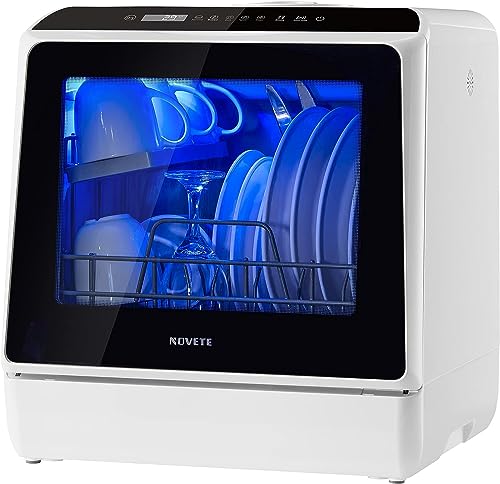 NOVETE NOVETE Portable Countertop Dishwashers for Small Apartments | Compact Dishwashers…
View on Amazon ↗
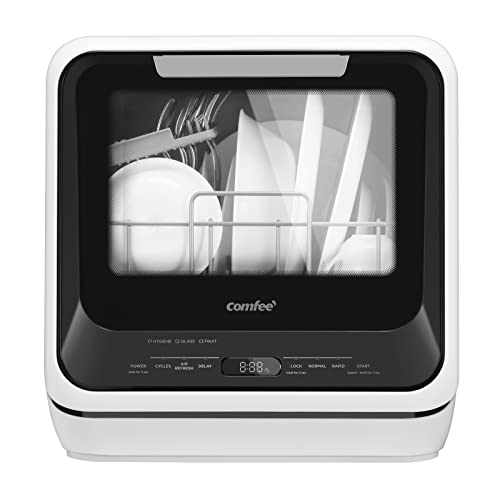 COMFEE' COMFEE' Countertop Dishwasher Portable with 1.32Gal Water Tank, 6 Programs…
View on Amazon ↗
Listing names and images come from Amazon and are rechecked against the live listings; last checked Nov 8, 2026. No prices shown; the current price is on the listing.
About this guide. Use this guide as a checklist to hold against any countertop dishwasher listing, not as a verdict on a specific model. It is written from general knowledge of the category, not from testing or owner reviews, so verify dimensions and adapter fit on the listing before you buy.