Focus on hose reach, filter design, and power source. Pet owners and detailers need strong suction with a crevice tool that reaches under seats. Weekend cleaners can accept less power if the vacuum is easy to grab and empty. The main tradeoff is between corded power and cordless convenience.
Start With Where You Park
Apartment and street parkers rarely have an outlet near the car. A corded household vacuum becomes a hassle unless you carry an extension cord down a hallway or across a sidewalk.
A 12V plug in vacuum runs off the car's socket. That sounds perfect, but check the cord length against your vehicle. Many 12V cords stretch only to the front footwells, leaving the cargo area and third row untouched.
A cordless handheld or stick vacuum removes that constraint. You can walk around the car, open every door, and reach the trunk without unplugging anything. The compromise is runtime and suction, which drop as the battery ages.
The Hose and Crevice Tool Decide the Real Clean
A car interior is mostly seams, tracks, and tight pockets. The vacuum body can sit on the floor and do nothing useful. The hose and nozzle do the work.
Check the hose length and flexibility. A stiff, short hose cannot bend under a front seat or snake between the console and seat rail. A long flexible hose reaches the back of the cargo area and around pedals.
The crevice tool matters as much as the hose. A narrow, angled tip gets into seat tracks and between cushions. A wide floor tool clears open mats quickly but is useless in a door pocket.
Some listings show a brush tool for vents and dashboards. Soft bristles help lift dust from textured plastic without scratching it. Look for tools that attach firmly; a loose tool falls off mid job and sprays debris back onto the seat.
Filters and Bins That Keep Suction Alive
A vacuum's advertised suction is measured with a clean filter and an empty bin. Five minutes into a real car clean, that number means nothing if the filter clogs or the bin is already full.
Washable or reusable filters are the practical choice for car use. You rinse them, let them dry, and the vacuum pulls almost like new. Paper filters work but become a recurring cost and a point of failure when they tear.
Check the bin capacity. A tiny dust cup fills after one pass over a dog haired back seat. Emptying it six times turns a quick clean into a chore. A larger bin helps, but it also adds weight to a handheld unit.
Bagged car vacuums are rare and usually unnecessary. A bag adds ongoing cost and another item to stock. A clear, easy to empty bin shows you when it is full and releases with one latch.
Corded Against Cordless, Beyond the Marketing
Corded vacuums quote higher suction because they pull steady power from a wall or car outlet. That matters for ground in sand, dried mud, and thick pet hair in carpeted footwells.
Cordless vacuums quote peak suction that only holds for the first minute or two on a full battery. As voltage sags, suction falls. For quick crumb pickups and light dust, that drop is acceptable. For a full interior detail, it can be frustrating.
Battery type also matters. Lithium ion batteries hold their voltage longer than older nickel based cells, so suction stays more consistent. Check the listed runtime and remember that the high power mode often cuts that number in half.
A 12V car socket vacuum sits between the two. It never needs recharging, but its motor is limited by the car's circuit. On a hot day with the AC running, voltage can dip and suction weakens further.
| Power source | Suction strength | Reach without outlet | Best for |
|---|---|---|---|
| Household corded | Highest and steady | None | Driveway or garage detailing |
| 12V car socket | Moderate, can dip | Length of cord only | Quick clean at a parking spot |
| Cordless lithium | High at first, then fades | Anywhere | Apartments, street parking, pet touch ups |
| Cordless basic | Low to moderate | Anywhere | Light dust and crumbs only |
Pet Hair and Black Paint Change the Requirements
Pet owners face a different job than a weekend detailer. Dog hair weaves into carpet fibers and seat fabric. A vacuum that works fine on loose crumbs will leave half the hair behind.
For pet hair, look for a motorized brush or a rubberized nozzle. The agitation loosens hair that suction alone cannot pull. A wide bare floor tool skips over embedded fur.
Black paint cars introduce a different concern. The vacuum itself does not touch the paint, but the hose and plug do. Dragging a stiff cord across a dark hood or door leaves fine scratches that show in sunlight.
Use a hose with a soft or rubberized outer layer, or wrap the cord in a microfiber towel before resting it on paint. Better yet, keep the vacuum body on the ground and only bring the nozzle into the car.
New car owners often overestimate how much vacuum they need. A new interior has little embedded dirt. A lightweight cordless unit with a good crevice tool handles the first year of ownership easily.
Weekend detailers need the opposite. They are cleaning accumulated grime, pet hair, and sand. A corded vacuum or a high capacity cordless model with a powered brush saves time and frustration.
Mistakes That Turn a Car Vacuum Into a Closet Item
Buying by watts or pascals alone is the most common error. That number is measured at the motor inlet, not at the nozzle tip after air has traveled through a hose, wand, and filter. Two vacuums with the same motor power can feel very different in the car.
Ignoring the hose and tool set is the close second. A powerful motor attached to a short stiff hose still cannot reach under a seat. The tool set is half the product.
Forgetting about storage is another silent killer. A vacuum that lives in a hall closet or trunk and requires assembly every time gets used less. A compact unit that hangs on a hook or fits in a glovebox gets used weekly.
Assuming a car vacuum replaces a shop vacuum for heavy jobs leads to disappointment. Car vacuums are for maintenance cleaning, not for extracting mud from floor mats after a camping trip. Know the limit.
Skipping the filter check before buying is a long term cost mistake. A vacuum with only disposable filters keeps charging you. A washable filter costs nothing after the first rinse.
What to Ignore on the Listing
HEPA labels on car vacuums are mostly marketing. True HEPA filtration requires a sealed system, which a handheld car vacuum rarely has. A fine mesh or foam filter captures most car dust anyway.
LED lights on the nozzle sound helpful but add little. They illuminate the area you are already looking at. A flexible hose or a longer crevice tool does more for hidden dirt.
Wet and dry capability is useful only if you actually clean spills. If not, the extra seals and tank add weight and cost. Most car owners never use the wet function.
Accessory counts can be padded with cheap brushes you will never attach. Three good tools beat eight flimsy ones. Check that the tools you need are included rather than counting them.
Long Term Costs and Care
The main ongoing cost is filters. Washable filters eliminate it. If you choose a vacuum with disposable filters, check their price and availability before buying the vacuum.
Batteries are the second cost. Lithium ion batteries lose capacity over two to four years of regular use. A vacuum with a replaceable battery outlasts one with a sealed battery.
Cleaning the bin and filter after every few uses keeps suction high. A quick tap over a trash can and a rinse of the filter takes under a minute. Neglect it and the vacuum sounds loud but picks up little.
Store the vacuum out of extreme heat. A car trunk in summer can exceed 140 degrees, which degrades batteries and softens plastic parts. Keep it in the cabin or at home when possible.
Car Vacuum Cleaner Questions Worth Asking Before You Buy
Is a car vacuum worth it compared to a household vacuum?
If you can bring a household vacuum with a hose to the car and have an outlet nearby, it often cleans better. A car vacuum earns its place when you park far from an outlet, need a quick clean between washes, or want a dedicated tool that lives in the car or a small closet. The hose and crevice tools on a car vacuum are also sized for tight cabin spaces.
How much suction do I need for pet hair in a car?
Look for a motorized brush or a rubberized nozzle rather than chasing a suction number. Dog hair weaves into carpet and seat fabric, and agitation does most of the work. A corded vacuum or a lithium ion cordless model with a powered brush will remove more hair than a high suction unit with only a flat floor tool.
Can I use a 12V car vacuum for a full interior detail?
A 12V vacuum works for light touch ups and small messes. For a full detail that includes embedded sand, mud, or thick pet hair, it often struggles. The car socket limits power, and voltage can dip when the engine is off or the AC is running. A corded household vacuum or a high capacity cordless model handles heavy jobs better.
Which filter type is better for a car vacuum?
Washable filters are the better long term choice. You rinse them, let them dry, and reuse them for years. Disposable filters work but add ongoing cost and can tear when you tap them clean. Check that the filter is easy to remove and that replacements are available if the vacuum uses disposable ones.
What makes a car vacuum good for black paint cars?
The risk is not the vacuum body but the hose and cord dragging across the paint. Black paint shows fine scratches in direct sunlight. Choose a vacuum with a soft or rubberized hose, keep the cord off the body, or wrap it in a microfiber towel. A cordless vacuum removes the cord risk entirely.
Which Car Vacuum Cleaner Fits Your Parking and Mess
A driver who parks in an apartment garage or on the street should pick a cordless lithium ion handheld with a flexible hose and a motorized brush for pet hair. That combination reaches under seats without an outlet and handles the most common messes. If you park in a driveway with an outlet nearby, a corded vacuum with a long hose and washable filter cleans deeper for less money over time.
Real car vacuum cleaner listings, so you can check the points in this guide against actual products. These are affiliate links: as an Amazon Associate we earn from qualifying purchases, at no extra cost to you.
 FAOGO FAOGO Car Vacuum Portable Cordless, 50000Pa Strong Suction Brushless Motor,…
View on Amazon ↗
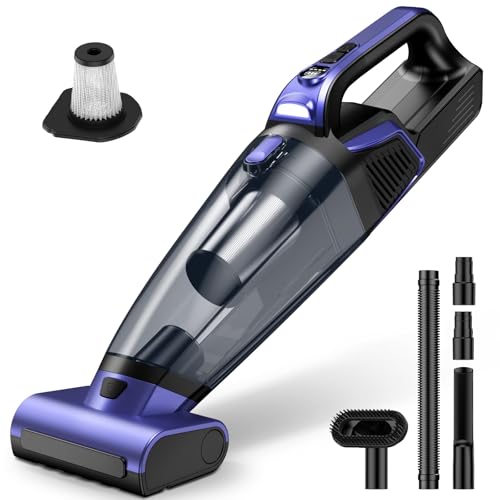 RELIDOL Pet Hair Handheld Vacuum Cordless: 20000PA Rechargeable Car Vacuum Cleaner…
View on Amazon ↗
 ONAVOT Car Vacuum Cordless, 35000PA Strong Suction Handheld Vacuum with 2…
View on Amazon ↗
Listing names and images come from Amazon and are rechecked against the live listings; last checked Nov 8, 2026. No prices shown; the current price is on the listing.
Scope and limits. Use this guide as a checklist to hold against any listing, not as a verdict on a specific model. It is written from general knowledge of how car vacuums work, so verify dimensions, hose length, and filter type on the product page before buying.