Match the flash to the space and the subject. For home studios and product work, a flash with a tilting head and manual power control gives you predictable, repeatable light. For events or moving subjects, TTL metering and fast recycle matter more. The main tradeoff is power versus portability: a big guide number fills a large room but weighs down the camera, while a small unit recycles slowly at full power.
The Guide Number Tells You the Room
Guide number is the honest spec on a flash. It describes how much light the unit puts out at a given ISO and focal length, usually stated in meters at ISO 100. A higher guide number means the flash can light a subject farther away or fill a larger space. This matters more than any marketing phrase about 'professional quality' or 'studio grade'.
For a home studio in a spare bedroom, a guide number around 32 to 43 at 35mm is often enough when you bounce the flash off a ceiling. For a large living room with high ceilings, you may want a guide number above 50. For product photography on a tabletop, a lower guide number works because the flash sits close to the subject, but you will need a way to soften and aim it.
One mistake is buying the highest guide number available and then shooting at arm's length. The flash recycles slower at full power, the batteries drain faster, and the light is too harsh for a portrait. Check the listing for the guide number at a specific zoom setting, not just the maximum across all settings, because the number drops as the zoom head widens.
Head Movement Shapes the Light More Than Power
A flash pointed straight at a face makes a flat, shiny picture. The single feature that separates a useful flash from a harsh one is whether the head tilts and swivels. Tilting up lets you bounce light off a white ceiling. Swiveling sideways lets you bounce off a wall or a reflector. Both turn a small hard light source into a large soft one.
Look for a flash with at least 90 degrees of tilt and 180 degrees of swivel in each direction. Some flashes tilt down a few degrees for close subjects, which helps with product shots on a table. A built in bounce card or a small white panel that slides out of the head gives you a catchlight in the eyes when the head is tilted up.
For video calls and beauty content, a flash is usually the wrong tool. A continuous LED panel gives you a live preview of the light and does not blind the person on the call. Use a flash only when you need to freeze motion or overpower a bright window.
Manual Power Control Versus TTL
Manual power control means you set the output yourself, usually in steps from 1/1 down to 1/128. This gives you the same exposure every time, which matters for product photography where you shoot dozens of items under the same setup. It also forces you to learn how distance and aperture change the light, which is the fastest way to get consistent results.
TTL, or through the lens metering, lets the camera and flash decide the power for each shot. It is faster when the distance changes, such as at an event or when chasing a child around the house. Many flashes offer both, which is useful, but a TTL only flash without a manual mode is limiting for studio work.
A mistake buyers make is assuming TTL is 'automatic' and therefore always better. TTL can shift exposure between shots when the background changes, and it is harder to repeat a setup. For a home studio, a manual mode is non negotiable. For indoor interviews where the subject sits still, manual power gives you stable light across a long recording.
Recycle Time and What It Costs You
Recycle time is the pause between full power shots while the flash recharges its capacitor. A flash that recycles in 2 seconds lets you shoot a burst of three frames in a row. A flash that takes 6 seconds makes you wait, and you will miss a laugh or a gesture.
Recycle time is usually listed at full power with fresh batteries. It gets slower as the batteries drain and as the power level goes up. If you shoot at 1/4 power, most flashes recycle almost instantly. If you shoot at 1/1, even a fast flash takes a breath.
For home studio work with posed subjects, recycle time barely matters. For indoor interviews where you shoot a burst during a reaction, it matters a lot. Check whether the listing states a recycle time at full power or only at a lower power setting, and ask the seller if the number is missing.
Batteries are the main ongoing cost. A flash that uses four AA batteries drains them quickly at high power. Rechargeable nickel metal hydride batteries recycle a flash faster than alkaline batteries and cost less over a year of regular use. Some flashes accept an external battery pack, which shortens recycle time and extends a session, but adds a cord and a pouch to your setup.
The Four Design Types and Where Each One Fails
Most flashes fall into one of four shapes, and each shape has a specific weakness.
A traditional hot shoe flash with a rectangular head is the most common. It mounts on the camera, tilts and swivels, and works for events, portraits, and small product setups. Its weakness is uneven light at wide angles, with falloff at the edges of the frame.
A round head flash produces a circular beam with softer edges and more even coverage. It often works better with softboxes and umbrellas because the round beam fills a modifier evenly. Its weakness is price and size: it costs more than a rectangular head with the same guide number.
A studio strobe is a larger unit that sits on a light stand, plugs into a wall outlet or a battery pack, and often includes a modeling lamp. It gives you high power, fast recycle, and the ability to use large softboxes. Its weakness is setup: you need a stand, a modifier, and space. It is not a flash you carry on the camera.
A macro ring flash mounts around the lens and gives shadowless light for close subjects. It is useful for product details, textures, and small objects. Its weakness is that the light looks flat and unnatural for anything farther than an arm's length, and it is useless for portraits or room shots.
| Design type | Best for | Weakness | Power ceiling | Setup effort |
|---|---|---|---|---|
| Rectangular hot shoe | Events, on camera portraits | Uneven edges at wide zoom | Medium | Low |
| Round head flash | Softboxes, even falloff | Higher cost for same power | Medium high | Low |
| Studio strobe | Large rooms, big modifiers | Needs stand and space | High | High |
| Macro ring flash | Close product details | Flat light, short reach | Low | Low |
The Specs That Matter on a Listing
A listing that emphasizes 'compatible with Canon and Nikon' without naming the mount is hiding something. Flash mounts are not universal. A flash for one camera brand will not fit another without an adapter, and even then the TTL pins may not line up. Check which mount the flash uses and whether it matches your camera body.
Look for the guide number, the recycle time, the head tilt and swivel range, and the manual power steps. These four numbers tell you what the flash can do. If any are missing, ask the seller for them before buying.
Wireless control is a feature that matters only if you plan to use the flash off camera. Some flashes work as a wireless receiver, so a trigger on the camera can fire them from across the room. Some flashes have a built in transmitter, so they can control other flashes. If you only ever use the flash on the hot shoe, wireless is a feature you will not use.
High speed sync, often listed as HSS, lets the flash fire at shutter speeds above the camera's normal sync speed, usually around 1/200 or 1/250 second. This matters when you shoot outdoors in bright light and want a wide aperture. Indoors, it is rarely needed. A flash without HSS is not broken; it is just limited to slower shutter speeds.
Who Should Skip a Flash and Use a Continuous Light
A flash is for freezing motion and adding light without a visible beam. If you shoot video calls, beauty content, or anything where the subject needs to see the light before you press the shutter, a continuous LED panel or a ring light is a better fit. You can adjust the light and see the result live, and the subject is not startled by a burst.
For product photography where the product is static, either tool works. A flash gives you more power and a shorter exposure, which reduces camera shake. A continuous light shows you exactly where the shadows fall, which is easier for beginners. Many product photographers use a flash with a softbox because it allows a smaller aperture for deeper focus.
For indoor interviews, a continuous light is usually kinder to the subject. A flash firing every few seconds is distracting during a conversation. If the interview is recorded as video, a flash is useless because it does not stay on. Choose a flash for still photography, not for video.
The Habit That Prevents the Worst Flash Mistakes
The worst mistake is not buying the wrong flash; it is using a good flash badly. Pointing a flash straight at a subject in a small white room creates a harsh shadow on the wall behind them. The fix is not a more expensive flash. It is tilting the head up to bounce off the ceiling or swiveling it to bounce off a wall.
A second mistake is ignoring the zoom setting on the flash head. A flash zoomed to 105mm throws a narrow beam that is bright in the center and dark at the edges. A flash zoomed to 24mm spreads the light wide but loses reach. Match the zoom to the lens focal length or to the size of the modifier you are using.
A third mistake is buying a flash because it has a high guide number and then using it only at arm's length. The light is too strong, the recycle is slow, and the batteries die quickly. Buy a flash for the room you actually shoot in, not for a hypothetical gymnasium.
Flash Questions Before You Buy
What is a good guide number for a home studio?
For a small room with white walls, a guide number around 32 to 43 at 35mm and ISO 100 is enough when you bounce the flash. For a larger room or higher ceilings, look for a guide number above 50. The number drops as you widen the zoom head, so check the listing for the guide number at a specific focal length rather than the maximum.
Is a camera flash worth it for product photography?
Yes, if you need consistent light across many shots and a small aperture for deep focus. A flash with manual power control lets you set the same exposure every time, which speeds up editing. A continuous LED panel is easier to learn because you see the shadows live, but it has less power and requires a slower shutter speed or a tripod.
Can I use a flash for video calls?
No. A flash fires a brief burst and does not stay on, so it cannot light a video call. Use a continuous LED panel or a ring light instead. The same applies to beauty content and indoor interviews recorded as video. A flash works only for still photography where a short burst is enough to freeze the frame.
Which is better, manual or TTL flash?
Manual power gives you the same output every time, which is better for product shots and posed portraits where the distance does not change. TTL adjusts power automatically for each shot, which is better for moving subjects and changing distances. Many flashes offer both, but a TTL only flash without a manual mode is limiting for studio work.
Does a flash need high speed sync?
Only if you shoot outdoors in bright light and want a shutter speed faster than the camera's sync speed, usually around 1/200 or 1/250 second, with a wide aperture. Indoors, high speed sync is rarely needed. A flash without it is not defective; it simply cannot fire at those faster shutter speeds.
Which Flash Fits a Small Home Studio
A photographer in a spare room shooting portraits and product stills gets the most from a rectangular hot shoe flash with a tilting and swiveling head, manual power control, and a guide number in the mid 30s to low 40s. That combination bounces off a ceiling for soft light and repeats the same exposure shot after shot. If you shoot close product details on a tabletop, a macro ring flash gives shadowless light that a hot shoe flash cannot match.
Real camera flash listings, so you can check the points in this guide against actual products. These are affiliate links: as an Amazon Associate we earn from qualifying purchases, at no extra cost to you.
 ULANZI ULANZI SL03 Camera Mini Flash, Speedlite Video Light GN8 6500K…
View on Amazon ↗
 PHOTOOLEX PHOTOOLEX Camera Flash Speedlite FK300, GN33, Manual S1/S2 Wireless |…
View on Amazon ↗
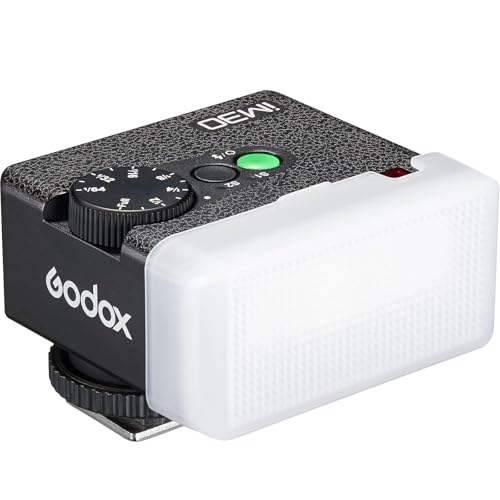 GODOX Godox iM30 Mini Flash with Diffuser for Canon, Nikon, Sony,…
View on Amazon ↗
Listing names and images come from Amazon and are rechecked against the live listings; last checked Nov 8, 2026. No prices shown; the current price is on the listing.
Scope and limits. This guide is written from general knowledge of how camera flashes work and what the different design types do. It does not draw on any individual product documents, owner reports, or tests. Check the guide number, mount, and head movement on the listing before you buy.