Start with where you will mount them and what the light needs to do. A dark walkway calls for a downward, even glow and a light that can mount on a post or rail. A garden party or patio calls for a softer, wider wash of light and a design that looks at home on a fence top. The main tradeoff is between brightness and runtime: a bigger panel and battery can run brighter longer, but the light gets bulkier and harder to place.
Match the Mount to the Fence
Solar fence lights come in three common mounting styles: post caps, wall mounts, and rail or deck lights. Post cap lights sit on top of a post and spread light in all directions. They are the easiest choice for a fence line that already has posts with flat tops, and they look neat without any drilling.
Wall mount lights screw or clamp to the side of a fence, a post, or a wall. They usually aim light downward or forward, which makes them a better fit for a walkway where you want light on the ground rather than in your eyes. Check the listing for the bracket width before you buy, because fence slats vary from about 1.5 to 3.5 inches wide.
Rail or deck lights mount under a handrail or onto a horizontal surface. They often have a low profile and a narrow beam, so they work well for lighting a path along a fence without spilling much light sideways. If your fence has no top rail, a wall mount or post cap is usually simpler.
Beam Shape Decides What You See
A bright light aimed the wrong way still leaves the path dark. Look at the beam angle in the listing. A narrow beam, often around 60 degrees or less, concentrates light in a small pool. That works for stairs, gates, or a short path but can look like a row of spotlights on a long fence.
A wide beam, often around 120 degrees, washes light over a larger area. It is easier on the eyes for a patio or a garden party and needs fewer lights to cover the same fence line. Some lights have a diffuser or a frosted lens, which softens the light and reduces glare. That is a good sign for a seating area.
Check which way the light faces when mounted. A post cap that glows upward may look decorative but do little for the ground. A wall mount with a downward lens puts light where you walk. If the listing does not show the beam direction, ask the seller before you spend.
Battery Size and Panel Size Work Together
Solar fence lights run on a small rechargeable battery, usually lithium ion or nickel metal hydride. The battery is charged by a small panel, often built into the top of the light. A bigger panel charges faster and can support a bigger battery, which means longer runtime after a cloudy day.
A light with a small panel and a small battery may run only a few hours at full brightness. That is fine for a path you use briefly after sunset, but it may go dark before a garden party ends. A larger panel and battery add size and weight, which can look bulky on a narrow fence slat.
Look for a stated runtime, but treat it as a rough guide. Runtime often assumes a full day of direct sun. A fence under trees or on a north facing wall will charge less. If you need light until late at night, choose a light with a larger panel and a battery capacity of at least 1000 milliamp hours, or plan to use a light with a motion sensor.
Weather Resistance Is the Hidden Filter
Outdoor lights face rain, snow, and sun. Look for an IP rating in the listing. IP44 means the light is protected from splashing water from any direction. IP65 means it is protected from low pressure water jets and is dust tight. For most fences, IP44 is enough, but IP65 is a safer choice if the fence faces open weather or a sprinkler.
The battery compartment and the panel are the weak points. A light with a sealed battery compartment and a panel covered with tempered glass will last longer than one with an open battery door and a thin plastic panel. Check the listing for the material. Metal housings resist cracking better than thin plastic, but they can get hot in direct sun.
If you live near the coast, look for a light with stainless steel screws or a corrosion resistant finish. Salt air can rust cheap metal parts within a season. A plastic body with a sealed panel is often a better value in that environment.
How to Read the Listing Without Touching the Light
| Listing claim | What to check | Why it matters |
|---|---|---|
| Brightness in lumens | Check the actual number, not just 'bright' | A walkway needs 10 to 30 lumens per light; a patio wash can use less |
| Runtime in hours | Ask if it assumes full sun or partial shade | A shaded fence may charge half as much as a sunny one |
| IP rating | Look for IP44 or higher | Lower ratings may fail in rain or sprinkler spray |
| Battery capacity | Look for milliamp hours, often 600 to 2000 | Bigger capacity runs longer but adds size |
| Mounting type | Check bracket width and post size | A bracket too narrow will not grip a wide fence slat |
Ask the seller for the beam angle and the battery type if they are not listed. A light with a replaceable battery is easier to keep long term than one with a sealed unit, because all rechargeable batteries lose capacity over time.
Skip the Solar Light If the Fence Sees No Sun
Solar fence lights need direct sun for at least a few hours a day. A fence under a dense tree canopy, on a north facing wall, or behind a tall building may never charge enough. In that situation, a wired low voltage garden light or a battery powered light with a separate solar panel on a sunny spot is a better choice.
Rental homes are a common use case. Solar lights avoid drilling and wiring, which keeps a deposit safe. But if the fence is shaded, the tenant may blame the light. Check the sun path before you buy. A light with a separate panel and a long cable lets you place the panel in the sun while the light stays on the fence.
For a garden party, a string of solar lights or a few lanterns often works better than fence lights. Fence lights are designed to mark a boundary or light a path. They rarely produce enough light to illuminate a table or a seating area. For a party, pair a few fence lights with a brighter overhead or table light.
Mistakes That Leave a Fence Dark
Buying too few lights is the most common mistake. A fence line looks long, and one light every post may be too many, but one light every three posts is often too few. Walk the fence at night with a flashlight and measure the dark gaps before you decide on a number.
Mounting the light too low is another. A light near the ground lights a small patch and gets blocked by grass, leaves, or snow. A light at waist height or higher spreads further and stays cleaner. Post caps naturally sit high, but rail lights can end up too low if the fence is short.
Ignoring the on and off switch is a quiet mistake. Many solar lights ship with the switch off to protect the battery. If you install them without switching them on, they will not charge or light up. Check each light before you mount it.
Care That Keeps the Panel Working
Dust, pollen, and bird droppings block the panel and cut charging. Wipe the panel with a damp cloth every few weeks in dry weather, and more often in spring when pollen is heavy. A panel that is only half covered can lose more than half its output.
Check the screws and brackets after the first few weeks. Wind and temperature changes can loosen a clamp. A light that slips and hangs upside down will not charge and may fall. A drop of thread lock on the screws helps if you live in a windy area.
The battery is the only consumable. Most solar fence lights use a replaceable battery, often an AA or 18650 size. After two or three years, the battery may hold less charge. If the light goes dim earlier than it used to, replace the battery before you replace the whole light.
Solar Fence Light Questions Before You Buy
How many solar fence lights do I need for a walkway?
Plan for one light every 6 to 10 feet along the path. A narrow beam needs closer spacing; a wide beam can stretch further. Walk the path at night with a flashlight and mark where the light pools end. Buy one or two extra to fill gaps or replace a failed unit.
Can solar fence lights charge on a cloudy day?
Yes, but slowly. A panel produces less current in overcast conditions, often half or less of its full sun output. A larger panel and a bigger battery help a light survive a few cloudy days. If your fence is shaded more than a few hours a day, choose a light with a separate panel you can place in the sun.
Is a solar fence light worth it for a rental home?
Often yes. Solar lights need no wiring and no holes, so they are easy to remove and do not risk a security deposit. But check the sun exposure first. A shaded fence will leave a light dim, and the tenant may complain. A light with a clamp mount and a separate panel is the most flexible option for a rental.
What does the IP rating mean on a solar fence light?
The IP code tells you how well the light resists dust and water. The first digit is dust protection, the second is water. IP44 means the light is protected from splashing water. IP65 means it is dust tight and protected from water jets. For a fence exposed to rain and sprinklers, IP44 is a minimum and IP65 is safer.
Which beam angle is best for a garden party?
A wide beam, around 120 degrees or more, works best for a party. It washes light over a seating area without harsh spots. A frosted or diffused lens softens the light further. A narrow beam, around 60 degrees, is better for a path or a gate where you want a focused pool of light.
The Right Solar Fence Light for Your Fence
A homeowner with a dark walkway and a fence that gets afternoon sun should start with a wall mount light with a downward beam and a battery of at least 1000 milliamp hours. It puts light on the path, stays out of the eyes, and runs long enough for most evenings. A garden party host who wants a soft glow should instead choose post cap lights with a wide, frosted beam. They look intentional on a fence top and create a warm wash without harsh pools. Skip the wall mount if the fence has no flat side or if you want the light to disappear into the landscape.
Real solar fence lights listings, so you can check the points in this guide against actual products. These are affiliate links: as an Amazon Associate we earn from qualifying purchases, at no extra cost to you.
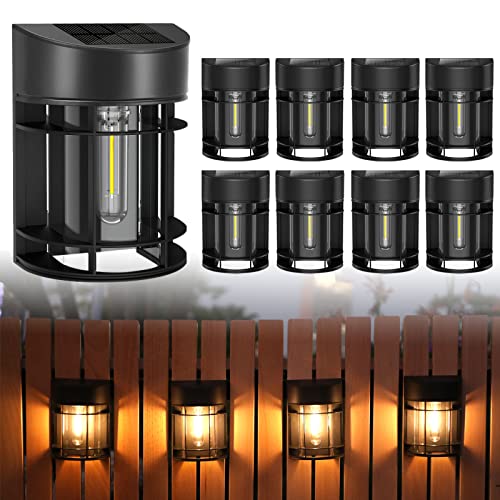 DOESLAG DOESLAG Solar Fence Lights Outdoor, 8 Pack Waterproof Solar Lights…
View on Amazon ↗
 OTHWAY OTHWAY Solar Fence Post Lights Wall Mount Decorative Deck Lighting…
View on Amazon ↗
 KOOPER KOOPER Solar Fence Lights Outdoor Waterproof 10 Pack, Solar Fence…
View on Amazon ↗
Listing names and images come from Amazon and are rechecked against the live listings; last checked Nov 8, 2026. No prices shown; the current price is on the listing.
How to read this guide. This guide covers solar fence lights as a category, not individual models. It is written from general knowledge of how these lights work; no product documents, reviews, or in person tests were used, and you should verify any dimension on the listing before buying.