Two factors decide most of your experience: the clue rules, which set how free or restricted players feel, and the pressure level, which comes from timers, stealing, or head to head play. A rowdy group wants fast turns and loud interruptions. A quieter group wants a game that lets people think for a beat without a buzzer in their face. The main tradeoff is energy against comfort.
Clue Rules Set the Whole Mood
Before you look at anything else, check how a player gives a clue. Some games restrict clues to one word, one sound, one gesture, or one rhyme. Others let a player describe the answer however they like. That single rule changes who enjoys the game.
A one word clue rule rewards people who think fast and know their group's inside jokes. It also punishes anyone who freezes under a countdown. An open ended clue rule is more forgiving, but turns can stretch and the room can lose energy unless the group keeps itself moving.
Look for a rule that matches your players. A family with wide age gaps often does better when clues can be simple descriptions or actions. A group of adults who love wordplay may want a rule that forces clever, indirect hints.
Pressure Comes From a Timer, Not the Cards
The biggest difference between a fun party word game and a stressful one is not the words. It is the clock. A visible timer, a sand timer, or a phone app countdown changes how people speak. Some players get sharper. Others shut down.
Card difficulty matters less than most buyers assume. A hard word with ten seconds on the clock is a groan. The same hard word with no timer becomes a funny story. If your group has anyone who hates being put on the spot, choose a game where the timer is optional or absent.
Stealing adds a second layer of pressure. When another team can steal a missed answer, the room gets louder and more competitive. That is great for a holiday party with rival cousins. It is less great for a couple's game night with two tired adults.
How Many Can Play Without Waiting Around
Party word games advertise a wide player count, often anywhere from two to twenty. The real question is how many people are actively playing at once. In some games, one person gives clues while everyone else shouts. In others, players take turns in pairs while the rest watch.
For a small group of four, a game built for teams of two works well. For eight or more, you want a game where everyone can shout, steal, or guess at the same time. Otherwise half the room checks their phone between turns.
Check the listing for the recommended player count, not just the possible count. A game that technically plays twenty but is best at six will drag at your holiday gathering if you invite the whole table. When in doubt, pick a game where the audience can participate even when it is not their turn.
Scoring That Keeps a Losing Team Laughing
Some party word games keep a tight score. Others barely track points at all. Neither is wrong, but the scoring style changes who wants a rematch.
A tight score with stealing and bonus cards creates a real winner and a real loser. That works for competitive groups who will play three rounds and argue about the last answer. A loose score, where points are almost an afterthought, works for a family game night where the point is the jokes, not the trophy.
Watch for a rule that lets a losing team catch up. A catch up mechanic, like a bonus for a hard category or a steal on a missed clue, keeps the final round interesting. If every turn awards the same points, the last five minutes can feel pointless.
The Words Themselves: Age Range and Inside Jokes
The word list is the hidden engine of the game. Some lists are built for adults, with pop culture references, slang, and risqué words. Others are family friendly, with simple nouns and verbs a child can read.
A word list that matches your group's age range and shared references will feel effortless. A list that misses will produce blank stares. A game about movies fails if nobody has seen the same films. A game about internet slang fails with grandparents.
Look for a game that states its age range clearly and, if possible, describes the word difficulty. If the listing says nothing about the words, that is a warning. You may end up with cards that are too easy for adults or too hard for a ten year old.
Setup and Reset Between Rounds
A party word game should hit the table in under two minutes. If it needs a board, a deck, a timer, a die, and a score pad, the night starts with instructions instead of laughter.
Card only games are the fastest to reset. You shuffle, deal, and start. Games with a board or tokens add a little setup but can still be quick if the pieces are simple. Avoid anything with a long instruction booklet for a party setting. If the host has to read rules for ten minutes, the energy dies.
Also check how a round ends and resets. A game where you reshuffle everything between rounds is fine for one long session but annoying for three short ones. A game where the next round starts with the same cards in a new order is better for a night of back to back play.
Which Real Features Matter and Which Are Marketing
Most party word game listings lead with the same claims: hilarious, quick, easy to learn. Those are not features. They are hopes. Here is what actually changes the game.
A real feature is the clue restriction: one word, one gesture, one sound, a rhyme, a drawing. That changes every turn. A real feature is the timer type: sand, app, or none. A real feature is the card count and whether the deck has expansion packs. A real feature is a scoreboard that stays visible.
A marketing claim is a tagline like 'the game your friends will beg to play.' A marketing claim is a celebrity endorsement. A marketing claim is a vague promise that the game works for everyone from eight to eighty. Ignore those. Compare the rules and the components instead.
The box art and the card design do not change the game, but they do change how it feels on the table. A game with large, readable cards works better in a dim room. A game with tiny text will have everyone squinting and asking what the card says, which kills the pace.
Who Should Skip a Party Word Game Altogether
A party word game is a social game. It runs on talking, guessing, and a little embarrassment. If your group prefers quiet strategy, a party word game will feel like a chore. A cooperative board game or a puzzle game may fit better. See how cooperative board games handle group dynamics for a comparison.
Skip a party word game if your players get anxious about speaking in front of others. Skip it if your group includes someone who is hard of hearing or struggles with fast verbal instructions. Skip it if you want a game for two people only. Most party word games are weakest at exactly two players, where the social energy disappears.
Also skip it if your group hates timers and loud arguments. Some people want a calm, thinky game. A party word game is the opposite. In that case, a family card game with a lighter play style may be a better match. See why play style matters in family card games before you decide.
Design Types Compared
| Design style | Turn pace | Cleanup effort | Suits |
|---|---|---|---|
| Timer based | Very fast, loud | Low, cards only | Rowdy parties, big groups |
| Head to head | Quick, tense | Low to medium | Competitive pairs, small groups |
| Team clue giving | Steady, social | Medium, board or cards | Family nights, mixed ages |
| Open ended | Slow, creative | Low, cards only | Quiet groups, couples |
Timer based games sit at the loud end of the spectrum. Open ended games sit at the calm end. Head to head and team clue giving fill the middle, with different flavors of competition.
Mistakes That Turn a Game Night Sour
The most common mistake is buying for the party you imagine, not the party you actually host. You picture twelve people laughing. You usually have four tired adults on a couch. A game built for a big, loud group will flop with four.
Another mistake is ignoring the word list. A game full of current slang will confuse a family night with grandparents. A game full of simple words will bore a group of adults. Read the age range and the sample cards if the listing shows any.
A third mistake is buying a game with a long rulebook. Party word games should be learned in one minute. If the rulebook has more than a few pages, the game is probably too complicated for the setting. The best party word games can be explained while someone opens a drink.
Finally, do not buy a game that requires a phone app if your group includes people who do not want to download anything. An app timer is convenient, but it adds a barrier. A sand timer or no timer at all works for everyone.
Party Word Game Questions, Answered Before the Box Opens
Is a party word game good for a family game night?
Yes, if you pick a family friendly word list and a game with simple clue rules. Look for a minimum age on the box and avoid games with adult content or heavy pop culture references. A team clue giving game often works best for mixed ages, because kids can guess while adults give clues.
Which party word game works for two players?
Very few party word games are designed for two. Most lose their energy without a group. If you want a two player word game, look for a head to head design or a couples game that is built specifically for two. Check the recommended player count, not just the possible count, before buying.
What is the difference between a timer game and an open ended game?
A timer game gives each clue giver a countdown, usually 30 to 60 seconds, and often lets other teams steal missed answers. An open ended game has no clock, so players can think, joke, and give longer clues. Timer games are louder and faster. Open ended games are calmer and more creative.
Should I buy a party word game with an app?
Only if your whole group is comfortable using a phone during game night. An app can handle timers, scoring, and word lists, which is convenient. But it also adds a setup step and can exclude someone who does not want to download anything. A card only game with a sand timer works without any devices.
Is a party word game worth it for a holiday gathering?
For a holiday gathering with eight or more people, a party word game is often the best choice. It starts fast, lets everyone participate, and creates shared jokes. Pick a game where the audience can shout or steal, so nobody waits long between turns. Avoid games that only work well at four players.
The Party Word Game Pick for Your Next Gathering
A host who wants a game for six to twelve people, where turns are fast and the room gets loud, should look for a timer based game with a simple one word clue rule and a deck of family friendly cards. That setup starts in under two minutes and keeps everyone involved. A couple or a quiet four person group should instead pick an open ended game with no timer and no stealing, so the night stays relaxed and the jokes have room to breathe.
Real party word game listings, so you can check the points in this guide against actual products. These are affiliate links: as an Amazon Associate we earn from qualifying purchases, at no extra cost to you.
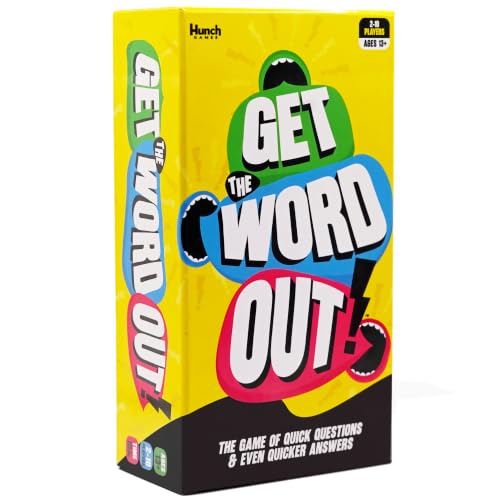 HUNCH GAMES Get The Word Out - Fast Team Party Game for…
View on Amazon ↗
 WORD MINES Word Mines - a Dirty Word-Guessing Card Game, Party Games…
View on Amazon ↗
 HASBRO GAMING Hasbro Gaming Taboo Classic Game, Party Word Guessing Game for…
View on Amazon ↗
Listing names and images come from Amazon and are rechecked against the live listings; last checked Nov 8, 2026. No prices shown; the current price is on the listing.
How to read this guide. This guide covers party word games as a category, not any individual model. It is written from general knowledge of how these games are designed and played, without reading reviews or handling specific units, so check the exact player count, timer type, and card dimensions on the product listing before you buy.