Focus on readability, calibration mass, and draft shielding. Readability is the smallest weight the scale can display, while calibration mass tells you how it is checked. A draft shield matters for milligram work but not for weighing 200 g of powder. Match the scale to your smallest sample and your worst case weighing environment.
Readability Is the First Number That Matters
Readability is the smallest increment the display can show. A 0.01 g scale can show 0.01 g, but that does not mean the last digit is accurate. In a drafty room, that digit may jump around.
Match readability to the smallest amount you must detect. Weighing 5 g of reagent for a school lab needs 0.01 g. Checking a 200 g counterweight to 1 g needs only 0.1 g. Paying for 0.001 g when you weigh 50 g samples is wasted money.
Check the listing for the scale's linearity specification, often given in plus or minus counts. A scale that passes a single point check can still be off by several counts in the middle of its range.
Calibration Mass Shows How the Scale Was Checked
Every scale ships with a factory calibration, but that only proves it worked at the factory. What matters is which mass the manufacturer used. A scale calibrated with a 100 g mass may not be checked at 500 g or 5 g.
Look for the calibration mass in the specifications. A lab scale that claims 0.01 g readability but was calibrated only with a 50 g mass leaves you guessing about 200 g readings. Ask the seller which mass was used if the listing omits it.
An external calibration weight lets you verify the scale on your bench. Without one, you are trusting the factory. Some scales allow user calibration with a known mass; others are factory locked, which means drift cannot be corrected at home.
Draft Shielding Decides Low End Stability
Air movement is the enemy of fine weighing. A person walking past, an HVAC vent, or a closing door can change the reading by several counts on a 0.001 g scale. A draft shield creates a still pocket of air around the pan.
For work at 0.01 g or finer, choose a scale with a physical shield: sliding glass doors, a removable draft ring, or a deep pan well. For 0.1 g work, a simple wind ring or even an open pan is usually fine.
Think about where the scale will sit. A teaching lab with students moving around needs more shielding than a quiet prep room. If you cannot control the air, control the scale.
Linearity and Repeatability Are the Hidden Specs
Repeatability is how consistently the scale returns the same reading for the same object. A scale can have 0.01 g readability but poor repeatability, so the same coin reads 5.02 g, then 5.05 g, then 5.01 g. Check the listing for a repeatability specification, often quoted as a standard deviation.
Linearity describes how far the scale deviates from true across its full range. A scale might be perfect at zero and at full capacity but off by 0.03 g at half capacity. This is the most common hidden flaw in budget lab scales.
If the listing gives neither linearity nor repeatability, assume the numbers are not good enough to publish. For quality control work, written specifications for linearity are not optional.
Weighing Pans and Sample Handling
The pan size and shape affect how you work. A 100 mm round pan fits a beaker but wastes space on a narrow bench. A square pan is easier for weighing paper and small trays. Check the pan diameter in the listing and compare it to your sample containers.
Some scales have a removable pan, which makes cleaning easier when powders spill. A fixed pan means you must wipe around it carefully. In teaching labs, a removable stainless steel pan survives more abuse than a fixed plastic one.
Consider how you will get samples onto the pan. A tall draft shield with a small top opening forces you to pour through a funnel. A side door shield lets you slide a spatula in. Your workflow should not fight the scale's design.
Power, Portability, and Bench Fit
Most lab scales run on an AC adapter, but many also accept batteries. Battery power is useful for field work or when the bench has no outlet nearby. Check whether the scale auto calibrates on power up; some require a warm up period before readings stabilize.
Size matters more than people expect. A scale with a 180 mm pan and a tall draft shield needs a dedicated bench spot. A pocket scale fits in a drawer but cannot hold a 500 mL beaker. Measure your bench and your largest container before you buy.
The display should be readable from your working position. A backlit LCD helps in dim labs, while a large digit height reduces reading errors. If you will use the scale under a fume hood, check that the display is not too dim.
Who Should Skip a Digital Lab Scale
If you only need to check whether a package is roughly 500 g, a kitchen scale is cheaper and just as good. Lab scales pay for their precision with smaller capacities and more careful handling.
For weighing people or large animals, a lab scale is the wrong tool. Lab scales top out at a few kilograms, and their pans are too small for a foot. A platform scale or a veterinary scale is the right category.
If your work demands legal metrology, such as selling goods by weight, a lab scale without a certificate is not sufficient. You need a scale with a recognized approval mark, which is a different product category.
Comparing the Main Scale Types
The table below groups digital lab scales by the design that most affects how they weigh. Each type trades stability for convenience in a different way.
| Scale type | Readability range | Draft sensitivity | Typical bench use |
|---|---|---|---|
| Enclosed analytical | 0.1 mg to 1 mg | Low, doors closed | Quantitative chemistry |
| Compact precision | 1 mg to 10 mg | Medium, draft ring helps | Sample prep, QC checks |
| Open pan bench | 0.01 g to 0.1 g | High, avoid breezes | Classroom weighing |
| Portable pocket | 0.01 g to 0.1 g | Very high, use a shield | Field work, quick checks |
Enclosed analytical scales hold their reading best but cost more and load slowly. Open pan scales are fastest to use but drift with any air movement.
Care and Long Term Costs
A lab scale needs recalibration at least once a year, more often if it is moved or used daily. If the scale has no external calibration weight, you may need to send it to a service lab, which costs more than the weight itself.
Keep the scale clean and dry. Spilled chemicals can corrode the pan and the load cell underneath. A soft brush and a damp cloth are usually enough; never submerge the scale. Some pans are dishwasher safe, but the scale body never is.
Batteries are a recurring cost if you run on battery power. Rechargeable lithium ion packs last longer but die eventually. Check whether the battery is user replaceable or sealed inside, because a sealed battery means the scale is disposable when it dies.
Lab Scale Questions That Come Up Before the Cart
Is a digital lab scale worth it for a school classroom?
Yes, if students weigh small amounts like 5 g of salt or 10 mL of water. A 0.01 g readability scale with a draft ring is enough for most school experiments. Avoid 0.001 g scales, because they are too sensitive for a room full of moving students and cost more than the curriculum needs.
What is the difference between readability and accuracy?
Readability is the smallest digit the display can show. Accuracy is how close the reading is to the true weight. A scale can show 0.01 g but be off by 0.05 g. Accuracy comes from calibration, linearity, and repeatability, not from the number of decimal places.
How do I compare two lab scales with the same readability?
Compare the calibration mass, the linearity specification, and the draft shielding. A scale calibrated at 200 g is more trustworthy at 200 g than one calibrated only at 50 g. A scale with published linearity of plus or minus 0.02 g is better than one with no linearity spec at all.
Which calibration weight should I buy for my scale?
Buy a weight that matches your most common sample mass, not the scale's full capacity. If you weigh 100 g samples, a 100 g calibration weight checks that exact point. A 500 g weight on a 500 g capacity scale does not tell you if 100 g readings are correct.
Can I use a digital lab scale for quality control?
Yes, if the scale has a written linearity specification and you keep a calibration log. QC work often requires traceability, so you need a calibration weight with a certificate. A scale without a linearity spec cannot be trusted for pass/fail decisions.
The Scale That Belongs on Your Bench
A chemistry teacher weighing 5 g samples for a class needs a compact precision scale with 0.01 g readability, a 100 g calibration mass, and a removable draft ring. It reads stable enough for students and costs a budget price. A quality control technician checking 200 g parts to 0.1 g should instead pick an open pan bench scale with a 200 g calibration weight and a larger pan, because speed matters more than milligram stability.
Real digital laboratory scale listings, so you can check the points in this guide against actual products. These are affiliate links: as an Amazon Associate we earn from qualifying purchases, at no extra cost to you.
 SASVY SASVY Digital Lab Scale 1000g x 0.01g oz/g/ct/DWT/tl/gn/ozt Precision Electronic…
View on Amazon ↗
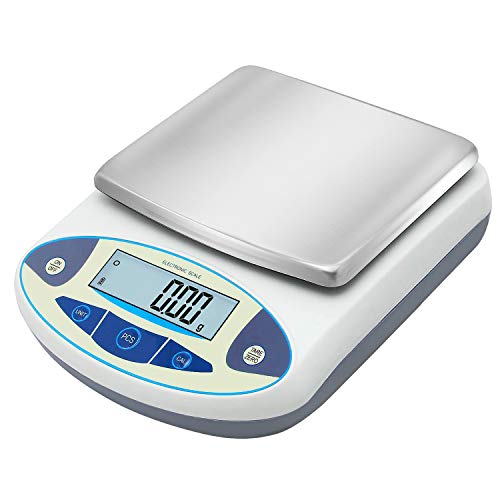 BONVOISIN Bonvoisin Lab Scale 5000gx0.01g High Precision Electronic Analytical Balance 0.01g…
View on Amazon ↗
 RUISHAN RUISHAN Lab Scale 5000gx0.01g High Precision Scientific Electronic Digital Laboratory…
View on Amazon ↗
Listing names and images come from Amazon and are rechecked against the live listings; last checked Nov 8, 2026. No prices shown; the current price is on the listing.
How to read this guide. This guide covers the digital laboratory scale category as a whole, written from general knowledge of how these instruments work. No individual product documents, user reviews, or in person testing were used, so verify any dimension or specification on the listing before you buy.