Focus on three factors: interior size against your coin's diameter, paper weight for stiffness, and the closure style you will actually use. A snug fit prevents sliding and rim damage. Kraft paper resists tearing but costs more. Peel and seal closures are fast, yet they can lose grip if reopened often. For long term storage, choose a slightly oversized envelope with a gummed flap.
A Coin Moves More Than You Think
A coin inside an envelope is not static. Every time you pick up the envelope, flip through a box, or mail it, the coin shifts a fraction of an inch. That movement rubs the coin's rim and face against the paper. Over months, fine abrasions can dull a proof finish or wear down a high point on a circulated coin.
The main job of a coin envelope is to limit that movement. A close interior fit does most of the work. The coin should drop in without forcing, but have no more than a few millimeters of play in any direction. If the envelope is too large, the coin travels and the paper acts like fine grit. If it is too small, you risk bending the coin or splitting the seams when you insert it.
Paper texture matters as much as size. Smooth, calendered paper creates less friction than rough kraft. For uncirculated or proof coins, look for envelopes described as smooth or glassine lined. For circulated coins, standard kraft is usually fine, since a little surface contact will not change a coin that already has wear.
Paper Weight Is the Real Durability Test
Paper weight is measured in pounds or grams per square meter, but what you feel is stiffness. A flimsy envelope folds around the coin instead of protecting it. A stiff envelope holds its shape in a storage box and resists the coin's edge cutting through the corner.
For a single coin, an envelope made from 24 lb or heavier paper is a reasonable starting point. Lighter paper works only if the coin is small, like a dime, or if the envelope will sit undisturbed in a drawer. If you mail coins or stack envelopes tightly, choose the heaviest paper in your budget.
Kraft paper is the most common choice because its long fibers resist tearing. White wove paper looks cleaner and takes writing well, but it is often slightly weaker for the same weight. Glassine envelopes add a translucent, grease resistant layer that protects against fingerprints, at a higher price.
Check the side seams. Envelopes with glued side seams can split if you overstuff them. For a single coin, this is rarely a problem, but if you plan to store several small coins or a coin plus a paper insert, look for envelopes with reinforced or double glued seams.
Closure Style Sets How Often You Can Open It
Coin envelopes come in four main closure types, and each trades convenience against permanence. An open end envelope has no flap at all. It is the fastest to use and the least protective, since dust can enter and the coin can slide out if the envelope tips over.
A peel and seal flap uses a pressure sensitive adhesive covered by a release strip. You peel the strip and press the flap down. It is clean and fast, with no moisture needed. The limitation is that the adhesive is designed for one strong bond. If you open and reseal it several times, the flap may lift, especially if paper dust or skin oil gets on the adhesive.
A gummed flap is the traditional choice. You moisten the adhesive, fold the flap, and press. Once dry, the bond is strong and tamper evident. Opening it usually tears the paper. For long term storage where the envelope stays sealed for years, gummed is often the most reliable.
A string and button closure uses a string wound around a paper or metal button. It is reusable and secure without adhesive. The tradeoff is bulk: the button creates a lump that can press into adjacent envelopes and the string can catch on other items in a box. It is more common for larger document envelopes than for small coin sizes.
Match the Size to the Coin, Not the Guess
Coin envelopes are sold by a numbered system, like #1, #3, or #5, but the numbers are not standardized across all manufacturers. A #3 from one paper company may differ by an eighth of an inch from another. Always check the listed interior dimensions, not just the envelope number.
Measure your coin's diameter with a caliper or a ruler, then add about a quarter inch for clearance. That total is the minimum interior width and height you need. For a US silver dollar at about 1.5 inches, a 2 inch by 2 inch interior is tight but workable. A 2.25 inch square gives easier insertion with only a little extra movement.
If you store coins in flips or capsules first, measure the outer dimensions of that holder, not the coin. A coin inside a 2x2 cardboard flip needs an envelope with at least a 2.25 inch interior to avoid jamming. The envelope should hold the holder snugly so the holder does not rotate inside.
Thickness matters too. A single thin coin fits almost any envelope, but a stack of small cents or a thick ancient coin can strain the side seams. Check the envelope's listed gusset or note whether it is a flat, nonexpanding style. Flat envelopes have no expandable bottom, so the coin stack cannot exceed the paper's fold capacity.
| Closure style | Reuse | Dust protection | Best for |
|---|---|---|---|
| Open end | Unlimited | None | Short term sorting or display |
| Peel and seal | A few times | Good when sealed | Mailing or quick storage |
| Gummed flap | Once | Excellent | Long term sealed storage |
| String and button | Unlimited | Moderate | Frequent access without adhesive |
For most collectors, the decision comes down to how often you retrieve the coin. If you open envelopes monthly to check or photograph coins, a peel and seal or string and button style avoids constant tearing. If envelopes go into a safe deposit box for years, a gummed flap is the better match.
Moisture and Plastic Are the Hidden Enemies
Paper envelopes breathe, which is usually good for coins. Trapped moisture is a bigger risk than dry air. However, in a humid room, paper absorbs water and holds it against the coin. That can cause spotting or toning, especially on copper and silver.
If you live in a humid climate or store coins in a basement, pair a paper envelope with a desiccant pack in the storage box. Do not put the desiccant inside the envelope with the coin; the granules can abrade the surface. A separate compartment in the same box is enough.
Do not store coins in plastic bags inside paper envelopes for long periods. The plastic can trap moisture and the paper can absorb it, creating a microclimate against the coin. If you need a vapor barrier, use a rigid holder or a capsule instead, and skip the paper envelope.
Acid free and archival are real terms, but they are not magic. Acid free paper will not accelerate toning the way acidic newsprint can. Still, it does not stop environmental moisture or physical wear. If you plan to keep coins for decades, acid free is worth paying for. For short term use, standard kraft is acceptable.
Read the Listing for What Is Missing
Many coin envelope listings show only the outer dimensions. That is the size of the envelope before folding, not the usable interior space. A listing that says 3 by 4 inches may have an interior of 2.75 by 3.75 inches after the side seams and bottom fold take up space.
Look for the words interior dimensions or usable size. If they are absent, ask the seller before ordering a large quantity. A quarter inch error matters when you are fitting a coin that is already close to the envelope's limit.
Check the flap placement. Some coin envelopes have the flap on the short side, others on the long side. This does not change protection, but it changes how you label and file them. If you write the coin's details on the front, a long side flap can cover your writing when closed.
Paper color is a practical choice, not just an aesthetic one. White envelopes make pencil and pen marks easy to read. Kraft brown hides dirt and stains. Glassine is translucent, so you can see the coin's outline without opening the flap, but it is more expensive and tears more easily.
Ask about the adhesive on gummed flaps if you are storing for decades. Some gummed adhesives dry out and lose grip over time, especially in hot, dry storage. A flap that pops open after ten years defeats the purpose. If you cannot verify the adhesive, peel and seal or string and button may be safer for very long storage.
The Mistake of the Perfect Fit
A common error is buying the smallest envelope that the coin will barely enter. The logic is that a tighter fit means less movement. In practice, a coin forced into an undersized envelope stresses the side seams and can catch its edge on the paper, causing a nick or a bent corner on the envelope.
Another mistake is using the envelope as a permanent storage solution for high value coins. Paper is fine for circulated coins and for short term organization, but it offers no impact protection. A dropped envelope can still transfer a shock to the coin. For proof coins, uncirculated silver, or anything with significant value, use a rigid holder or capsule inside the envelope, or skip the envelope entirely.
Writing directly on the envelope with a ballpoint pen can leave an impression that transfers to the coin if the envelopes are stacked tightly. Use a soft pencil, a label, or write before inserting the coin. If you must write on a filled envelope, place a piece of cardstock between the coin and the writing surface.
Do not staple coin envelopes shut. The staple can scratch the coin if it protrudes inside, and it makes the envelope awkward to open without tearing. If you need extra security, use a small piece of tape on the flap or place the envelope inside a larger document envelope.
When a Coin Envelope Is the Wrong Tool
Skip coin envelopes if you need to display coins or view them often. Every time you open an envelope, you handle the coin or its holder, which adds wear. For coins you want to see, a coin loupe station with a stand and a rigid holder make more sense.
If you are mailing valuable coins, a paper envelope alone is not enough. The postal system can bend, crush, or tear a lightweight envelope. Use a padded mailer or a rigid cardboard mailer with the coin in a capsule or flip first. The coin envelope can serve as an inner layer for documentation, not as the outer packaging.
For long term storage of an entire collection, coin envelopes inside a box are a workable system, but they lack organization. You must label each envelope clearly and keep an inventory. If you want to flip through coins quickly without opening each one, consider coin capsules sized to the coin's diameter or coin holders with a clear viewing window instead.
If you have coins that tarnish easily, like high grade copper or silver proofs, paper is not an inert environment. Acid free paper helps, but it cannot match the protection of an airtight capsule. Use envelopes for coins that already have some circulation wear or for temporary sorting before final storage.
Coin Envelope Questions Collectors Ask
What size coin envelope do I need for a silver dollar?
A US silver dollar is about 1.5 inches in diameter. Look for an envelope with an interior of at least 1.75 by 1.75 inches, and 2 by 2 inches is more comfortable. If the coin is in a 2x2 cardboard flip, you need an envelope with an interior of at least 2.25 inches to avoid jamming the holder.
Can I store proof coins in paper coin envelopes?
You can, but it is not the best protection. Paper does not stop impact or moisture, and rough fibers can leave hairlines on a proof finish. If you use paper, choose a smooth, acid free envelope and place the coin in a capsule or rigid holder first. For high value proofs, skip the paper envelope and use a capsule alone.
Is a peel and seal or gummed flap better for storage?
Gummed flaps form a stronger, tamper evident seal that stays closed for years, but they are single use. Peel and seal flaps are cleaner and faster, and they can be reopened a few times, but the adhesive weakens with dust and repeated opening. For long term, untouched storage, choose gummed. For frequent access, choose peel and seal.
Do coin envelopes cause toning or tarnish?
Standard paper envelopes made from acidic pulp can release compounds that speed up toning, especially on silver and copper. Acid free or archival envelopes reduce this risk. Moisture is a bigger factor: paper absorbs humidity and holds it against the coin. Store envelopes in a dry place and use a desiccant in the storage box.
How many coins can I put in one coin envelope?
For long term storage, one coin per envelope is best. Stacking coins lets them rub against each other and concentrates weight on the bottom seam. If you must store a small group, wrap each coin in a paper flip or separate them with cardstock, and choose a heavier paper envelope with reinforced seams.
The Coin Envelope Choice for Your Collection
For a collector who stores circulated coins in labeled boxes and wants a balance of cost and durability, a 24 lb kraft envelope with a gummed flap and an interior about a quarter inch larger than the coin is the practical pick. It holds firmly, resists tears, and keeps dust out. If you open envelopes often to photograph or trade coins, switch to a peel and seal flap in the same size and paper weight. The convenience of reopening without tearing outweighs the weaker long term adhesive, and the coins stay protected between uses.
Real coin envelope listings, so you can check the points in this guide against actual products. These are affiliate links: as an Amazon Associate we earn from qualifying purchases, at no extra cost to you.
 GUARDHOUSE Guardhouse 2 x 2 Paper Coin Envelopes Pack of 500…
View on Amazon ↗
 JSFELYE 2 x 2Inches Tiny Coin Envelopes - Self Seal 128-Count…
View on Amazon ↗
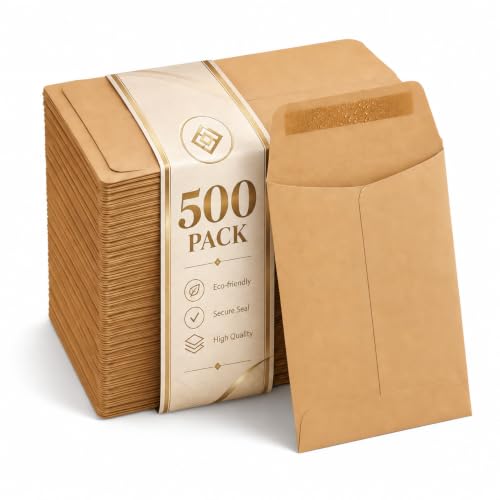 LUCKSEA 500 Pack Mini Coin Envelopes, 2.25 x 3.5 Inch Kraft…
View on Amazon ↗
Listing names and images come from Amazon and are rechecked against the live listings; last checked Nov 8, 2026. No prices shown; the current price is on the listing.
Scope and limits. Use this guide as a checklist when you read any coin envelope listing. It reflects general knowledge about paper, closures, and coin storage, not tests of specific envelope models, so verify the interior dimensions and paper weight on the seller's page before ordering.